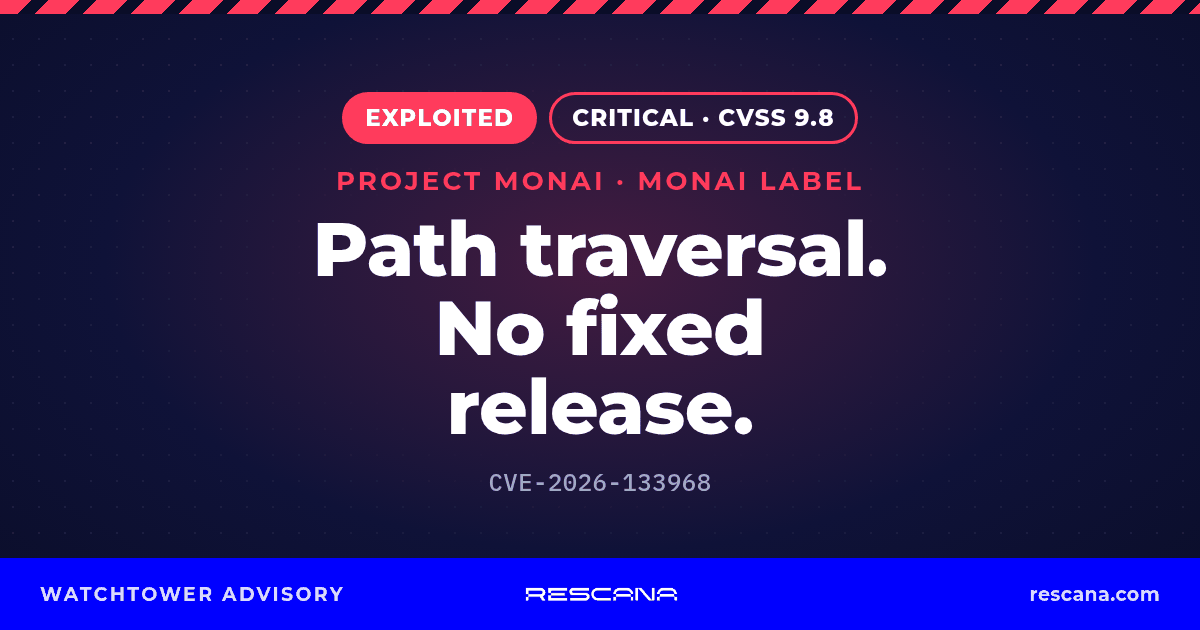
Status: MONAI Label, the open source medical imaging annotation server from Project MONAI, has a path traversal flaw, CVE-2026-133968, that lets a network client write files anywhere the server process can write and, per the project's own advisory, that can lead to remote code execution. Every release through 0.8.5, which is also the latest release, is affected. As of 16:12 EST on November 21, 2026 there is no fixed release: the GitHub Security Advisory lists patched versions as none, and the maintainers' fix is merged into the main branch only. The CVE record says the flaw was exploited in the wild starting in September 2026, and Amazon Threat Intelligence describes AI agents run by a threat actor finding and using a zero-day in an open source medical imaging application, with a link to the MONAI Label advisory. In the default configuration authentication is off, so any client that can reach the server can use it. CVE-2026-133968 is not in CISA's Known Exploited Vulnerabilities (KEV) catalog. The catalog version we checked is 2026.11.20, released at 12:48 EST on November 20, 2026, with 1,790 entries. The CVE record scores the flaw CVSS 3.1 9.8 (the CVE record's CNA is MITRE), and NVD has not yet analyzed it. We checked all sources between 16:11 and 16:18 EST on November 21, 2026.
Executive Summary
MONAI Label is an open source server and client system for annotating medical images with AI assistance, as the project describes it. Research groups and imaging teams run it on machines with GPUs (Rescana's reading of typical use). The project's own README refers to the sensitivity of the medical imaging data it processes. CVE-2026-133968 matters now because there is nothing to install: the fix exists in source form only, and the maintainers themselves now tell users not to run the server on the internet.
What matters for planning:
- There is no fixed release. The GitHub Security Advisory GHSA-qc22-rmgc-vg94, published November 18, 2026, lists affected versions as 0.8.5 and earlier and patched versions as none, and says the fix "will be included in the next MONAI Label release." We found no later release on PyPI or the project's tags; 0.8.5 is still the latest. Amazon's post says the maintainers "released a fix and a GitHub Security Advisory." BleepingComputer's report says the maintainers "released a security update" on November 18; that date matches the advisory's publication, and we found no release on PyPI or the project's tags on that day or since. The code fix is real and merged (PR #1915, October 19, 2026), but it is not packaged in a release we could find.
- Exploitation is reported by the CVE record and by Amazon, not by CISA or the vendor. The CVE record text, written by the CNA, says the flaw was "exploited in the wild starting in September 2026." Amazon Threat Intelligence, in a November 20, 2026 post by CJ Moses, describes the campaign. CISA has not added the CVE to KEV, and CISA's own Coordinator enrichment in the CVE and NVD records lists exploitation as "none" (more below). We do not resolve that difference. In Rescana's reading, the CVE record and Amazon's account are the exploitation evidence here, and CISA's field is CISA's current view.
- Authentication is off by default. The advisory says authentication is disabled by default (
MONAI_LABEL_AUTH_ENABLE=False), so in the default configuration any network client that can reach the server can exploit the flaw. With authentication enabled, the advisory says the ANNOTATOR role is sufficient, so turning authentication on reduces the audience but does not close the flaw. - The published impact is arbitrary file write that can become code execution. The advisory's own examples of how a file write leads to code execution are overwriting application code or adding entries to SSH authorized keys or cron. Amazon's account describes a path through a Python startup file and a training endpoint that ended in a reverse shell running as root.
- Amazon's attribution is Amazon's assessment. Amazon says with moderate confidence that the operator is a Chinese-nexus threat actor, based on Simplified Chinese prompts, China Standard Time script timestamps and the targeting of universities. Amazon names no group. Neither do we.
If you run MONAI Label anywhere, take it off untrusted networks today, enable authentication, restrict who holds the ANNOTATOR role, run it as an unprivileged user, and review the host for the signs listed below (Rescana guidance built on the vendor's published workarounds). This advisory is a new post, not a follow-up: no live Rescana post covers CVE-2026-133968, MONAI Label or the Cairn framework.
Technical Information
The following is the vendor's and the CVE record's published description, not a reproduction of any exploit.
The CVE record, published by MITRE, says that monailabel (aka MONAI Label) through 0.8.5 allows directory traversal, with resultant remote code execution, via the image parameter to the PUT /datastore/image endpoint, as exploited in the wild starting in September 2026. The CVSS 3.1 vector in the record is CVSS:3.1/AV:N/AC:L/PR:N/UI:N/S:U/C:H/I:H/A:H, base score 9.8, severity Critical: network-reachable, low complexity, no privileges, no user interaction, and high impact on confidentiality, integrity and availability. NVD carries that same MITRE score as its only CVSS metric and shows vulnerability status Received (not yet analyzed) when we checked. NVD has not produced a score of its own.
The maintainers' advisory GHSA-qc22-rmgc-vg94, titled "Path traversal in datastore upload endpoints allows arbitrary file write," explains the mechanism. The PUT /datastore/image endpoint accepts a caller-controlled image query parameter and uses it as the image ID without validation. The datastore code appends the file extension to that ID, joins it onto the datastore image directory and writes the uploaded file to the resulting path. Because the resolved path is never checked to be inside the datastore, a value that climbs out of the directory writes the uploaded content to any location the MONAI Label process can write to. The advisory says the label save path, PUT /datastore/label, builds its destination from the image ID and label tag in the same way. The CVE record names only the image endpoint; the advisory covers both, and so does the maintainers' fix.
Weakness classification differs by source, and both are path traversal. The CVE record lists CWE-24 (Path Traversal: '../filedir'). The GitHub advisory data lists CWE-22 (Improper Limitation of a Pathname to a Restricted Directory). We report both as the sources give them.
The advisory says the flaw was originally reported by a GitHub account named aws-sec-vdp, in a private advisory on the main MONAI repository (GHSA-cxx7-378q-5622), and says it was "re-reported to generate CVE in the correct repository" because the affected code is in MONAI Label. That private report is not public, and we did not read it. The repository advisory page did not yet show a CVE identifier when we checked; the CVE record and a separate unreviewed GitHub Advisory Database entry (GHSA-2f43-rwqm-6h67, published November 20, 2026) carry CVE-2026-133968.
The fix. The advisory says the fix is in PR #1915, which GitHub shows merged into the main branch on October 19, 2026. As the PR and the advisory describe it, the datastore code now resolves each destination, including the label tag directory, and rejects any path outside the datastore image and labels directories, and the image endpoint reduces the image ID to its base name and rejects empty or dot-prefixed IDs with HTTP 400. We read the current main branch source and see a containment check in the datastore code and image ID normalization in the endpoint, which matches that description. Rescana has not tested the fix. It is source code on a branch, not a vendor release.
The maintainers' own warning. On November 19, 2026, the maintainers added a security notice to the top of the project README. It says: "MONAI Label is not intended to be run as an internet-facing application," that there are "a number of known, unpatched security issues" that make it "fragile when it is exposed to untrusted networks," and that it should only be deployed on a closed, trusted local area network. The notice is the maintainers' position. It does not list the issues, and we do not know which they are.
CISA's enrichment. CISA's Coordinator record in the CVE record and in NVD, timestamped 16:34 EST on November 20, 2026, sets SSVC options to exploitation: none, automatable: yes and technical impact: total. SSVC is CISA's decision framework, and these values are CISA's assessment at that time. They sit next to a CVE description that says the flaw was exploited in the wild. We do not know why they differ and do not speculate; we note that the enrichment was recorded within hours of the CVE record's publication. FIRST EPSS for CVE-2026-133968 was 0.03131 (percentile 0.88189) on the 2026-11-21 daily score. An EPSS score is not evidence for or against exploitation.
What Amazon reports. In its November 20, 2026 post, Amazon Threat Intelligence says that on September 10, 2026 it found a publicly hosted instance of Cairn, an open source autonomous AI penetration testing framework, running without authentication, which exposed the operator's project configuration, prompts and AI output. Amazon says the campaign targeted IP addresses associated with universities in East Asia outside mainland China over roughly 48 hours beginning September 8, 2026, that the operator's prompts were written in Simplified Chinese, and that script timestamps used China Standard Time. The operator gave the agents a goal of obtaining shell access.
Amazon's post describes two long operations that failed (about 16 hours and 148 actions against an unauthenticated Redis instance, and more than 6 hours of credential guessing against a university GPU server), and then an operation against "an open-source medical imaging AI application" that worked. In Amazon's words, the agents identified the application's framework, mapped its API endpoints and found an upload endpoint with a filename parameter, tested the parameter for path traversal, and "in about 11 minutes" went from exploring the API to arbitrary file writes. In a later session, Amazon says, the agents used the same flaw to write a Python payload to sitecustomize.py, a file Python imports automatically at interpreter startup, then called a training API endpoint that starts a new Python process, which loaded the payload and opened a reverse shell running as root. Amazon says that in another session the operator supplied a proxy tunnelling into a second university network, to a server running the same vulnerable software, and that Amazon infers the actor had used the flaw to compromise it.
Amazon's post does not name MONAI Label or a CVE in its text. It links the MONAI Label GitHub Security Advisory GHSA-qc22-rmgc-vg94 as the advisory the maintainers released, and The Register's report on the post names MONAI Label directly. The technical details Amazon gives (an upload endpoint with a filename parameter, a training endpoint) match the advisory. Amazon says it assesses with high confidence that the flaw was a zero-day when the agents used it, because it saw no corresponding fix, issue, advisory or prior mention in vulnerability databases. Amazon says the affected organizations were not AWS customers, and that AWS worked with a government partner to notify them. Amazon also points to a separate Gambit Security report on a different, financially motivated actor using Cairn against online retailers; that report does not concern this CVE.
We found no public proof-of-concept stated by the maintainers, Amazon, MITRE, NVD or CISA in the pages and records we opened. The technique is described publicly at the level above. This post does not link to or describe proof-of-concept repositories, request values or steps.
Affected Product Versions
The sources agree on the package and the version ceiling. No source lists a fixed version.
| Product or component | Version listed | Source |
|---|---|---|
MONAI Label (PyPI package monailabel, vendor field "Project-MONIA" in the CVE record) |
Versions 0 through 0.8.5 affected | CVE record; NVD |
MONAI Label (PyPI package monailabel) |
0.8.5 and earlier affected; patched versions none | GitHub Security Advisory GHSA-qc22-rmgc-vg94 |
| Latest MONAI Label release | 0.8.5 (affected) | PyPI; GitHub tags |
| MONAI Label main branch at or after the PR #1915 merge commit (113527bf6) | Contains the maintainers' fix; unreleased source | PR #1915; main branch source |
The advisory describes the flaw in the local datastore code of the server. We could not tell from the sources whether servers configured with other datastores are affected, and we do not claim they are not. Treat every MONAI Label server on 0.8.5 or earlier as affected until you can show otherwise (Rescana guidance).
Timeline (EST)
- September 8, 2026. Amazon says the Cairn campaign began, running about 48 hours, a period consistent with the CVE record's "exploited in the wild starting in September 2026." The CVE record does not cite Amazon's post.
- September 10, 2026. Amazon says it identified the publicly hosted Cairn instance.
- October 12, 2026. PR #1915, "fix: confine datastore write paths," is opened in the MONAI Label repository.
- October 19, 2026. PR #1915 is merged into the main branch.
- November 18, 2026, 10:45 EST. The maintainers publicly release GitHub Security Advisory GHSA-qc22-rmgc-vg94 (affected 0.8.5 and earlier, with no patched release).
- November 19, 2026, 03:51 EST. The maintainers commit the README security notice on main against internet-facing deployment.
- November 20, 2026, 12:30 EST. The Register publishes its report on Amazon's post (the post itself carries the date November 20, 2026).
- November 20, 2026, 13:31 EST. MITRE reserves and publishes CVE-2026-133968.
- November 20, 2026, 14:18 EST. NVD publishes the record. CISA's Coordinator SSVC enrichment is timestamped 16:34 EST, and NVD's last modification we saw is 17:17 EST.
- November 21, 2026, 16:11 to 16:18 EST. We re-checked NVD, the CVE record, both GitHub advisories, PyPI, the project tags and main branch, CISA's KEV catalog and EPSS. Status unchanged: no fixed release, NVD status Received, not in KEV.
The CVE record's "exploited in the wild starting in September 2026" is the CNA's wording. Amazon's post gives the dates above for the campaign it observed and does not say whether use of the flaw continued after September 10, 2026.
How to Find Your Exposure
The checks below are Rescana guidance. The maintainers, MITRE, CISA and Amazon publish no detection signatures for this CVE.
- Inventory every MONAI Label server. Check each host, container and notebook environment for the
monailabelpackage (pip show monailabelreports the version). Include research labs, shared GPU servers, cloud test instances and anything a department stood up without central IT. Every version through 0.8.5 is affected. - Check authentication. Look for
MONAI_LABEL_AUTH_ENABLE. If it is not set to True, the server is open to any client that can reach it. If it is True, list who holds the ANNOTATOR role, because that role is enough to use the flaw. - List which servers are reachable from outside. Check firewalls, security groups, reverse proxies and campus or partner networks. The maintainers say not to expose the server, or any proxy in front of it, to the public internet.
- Check the account the service runs as. Amazon's account ended in a reverse shell running as root on the server it compromised. A service that runs as root widens the impact of any file write (Rescana's reading).
- Review the host for file writes you did not make. Look for new or modified files outside the datastore directory around any period the server was reachable: unexpected
sitecustomize.pyfiles in the Python environment or working directories, changed application or model code, new SSH authorized keys, new cron entries or changed configuration files. These are the places the advisory and Amazon name; they are not a complete list. - Review web and application logs for
PUTrequests to/datastore/imageor/datastore/labelfrom addresses you do not recognize, especially with unusualimagevalues or label tags, and for training endpoint calls you did not start. Preserve the logs before you rebuild anything. - Check outbound connections from the host to unfamiliar addresses, which is what a reverse shell looks like from the network side, and compare against the two addresses in the Indicators section. An empty match against those two addresses is not closure.
- Plan a compromise assessment for any server that was reachable from untrusted networks since September 2026. Amazon observed the activity against East Asian universities; Rescana has no data on how many MONAI Label servers are exposed or who else has used the flaw. Bring in your privacy and compliance teams if the server holds patient data (Rescana guidance).
We will add vendor, CISA or Amazon detection guidance here if it is published.
Workaround and Mitigation
There is no fixed release, so the vendor's published workarounds are the starting point. The advisory lists three, each of which reduces exposure without removing the flaw:
- Enable authentication (
MONAI_LABEL_AUTH_ENABLE=True) and do not grant the ANNOTATOR role to untrusted users. - Do not expose the MONAI Label server to untrusted networks. The README security notice adds that the server, and any proxy in front of it, should not face the public internet and should sit only on a closed, trusted local network.
- Run the server as an unprivileged user with write access limited to the datastore directory.
Because the advisory says the ANNOTATOR role is enough to use the flaw even with authentication on, the second and third workarounds carry most of the weight (Rescana's reading of the advisory). Network isolation is the control that stops an outside client, and a low-privilege account with narrow write access limits what a successful write can reach.
Rescana guidance beyond the vendor's list:
- Move reachable servers behind network controls now: remove public exposure, and limit access to the specific hosts and users that need the annotation service. A web application firewall or reverse proxy is not a substitute for removing exposure.
- If you must run a build with the code fix (Rescana guidance), it exists only as source on the main branch at or after PR #1915. Treat it as an unreleased build: pin an exact commit, test it in a non-production environment, and do not assume the project has reviewed it as a release. The maintainers have not said when the next release will ship.
- If you cannot isolate a server, stop it until you can, particularly if it is on an internet-facing address or holds patient data.
- After changes, repeat the review above and keep a record of the version or commit and the controls in place.
We will update this advisory when the maintainers publish a release that contains the fix, when NVD finishes its analysis, or if CISA changes its assessment.
Indicators of Compromise
The only published indicators are two IPv4 addresses in Amazon's post. Amazon says they appear in records dated September 8 to 10, 2026, and Amazon does not describe what role either address played. We repeat them in the defanged form Amazon used, and we do not add anything to them:
142[.]4.98.145142[.]4.107.34
The maintainers, MITRE, NVD and CISA publish no indicators, file hashes, domains, malware names or log signatures for CVE-2026-133968. Amazon publishes no file hashes or domains. Do not read the two addresses as a complete list: they come from one operator's records over three days, and the same flaw can be used by anyone. Blocking them is cheap, and matching them in your logs is worth doing (Rescana guidance), but a match against two addresses is neither a confirmation nor an all clear.
Generic signs worth checking (Rescana guidance, not published indicators): file writes outside the datastore directory by the MONAI Label process, unexpected Python startup files, new SSH keys or cron entries on the host, unexpected child processes of the MONAI Label service, and outbound connections from the server to unfamiliar addresses. We will update this advisory if the maintainers, Amazon or CISA publish more.
Third-Party Risk (TPRM) Angle
MONAI Label is the sort of tool a university lab, a hospital research group, a contract research organization or an imaging AI vendor runs on a shared GPU machine, sometimes outside central IT's view (Rescana's reading). The project says the server handles sensitive medical imaging data. Because the flaw needs no login in the default configuration, a supplier's user policy does not, on its own, close it (Rescana's reading). Amazon reports that universities were the targets in the campaign it saw. Rescana covered a different medical imaging server, with different CVEs, in an earlier post on Orthanc DICOM; it is not a follow-up.
The suppliers to ask first (Rescana guidance):
- Research partners, universities and hospital research groups that annotate or label data for you, or that hold your data on a shared imaging server.
- Imaging AI and annotation vendors, and contract research organizations, that run MONAI Label, or build on it, for your projects.
- Cloud and managed GPU hosting providers that run these servers for customers.
Send these five questions (Rescana guidance):
- Do you run MONAI Label (the
monailabelpackage), or a product built on it, in any environment that touches our data? - Which version or commit is it, and is it on 0.8.5 or earlier without the code fix?
- Is authentication enabled, who holds the ANNOTATOR role, and is the server reachable from the internet or from shared networks?
- What account does the service run as, and what can it write to?
- Have you reviewed the host and logs for file writes, startup files, keys or cron entries you did not make, back to September 2026, and what did you find?
Ask for evidence, not reassurance: the version or commit, the authentication and network configuration, the date of the review and the result. Because there is no fixed release, "we are waiting for the patch" is not an answer to question 3.
What to do internally (Rescana guidance): inventory every MONAI Label server today, take reachable ones off untrusted networks, enable authentication, run the service unprivileged, review hosts for the signs above, and chase the suppliers above. We will update this advisory if the maintainers publish a fixed release, if NVD completes its analysis, if CISA changes its assessment or adds the CVE to KEV, or if Amazon or the maintainers publish more indicators.
Need help working out which suppliers run MONAI Label or other imaging and annotation tools with access to your data? Our team can help you prioritize them and track their answers. Talk to an expert
Sources
- AWS Security Blog: Chinese-nexus actor's Cairn AI agents found a zero-day on their own: Amazon Threat Intelligence, CJ Moses, November 20, 2026; campaign dates, zero-day account, attribution, two IPv4 addresses; the post links the MONAI Label advisory and does not name MONAI Label or a CVE in its text; checked 16:12 EST, November 21, 2026.
- BleepingComputer: Hackers use autonomous AI tool Cairn to find zero-day, take over server: published November 20, 2026; names MONAI Label; says the maintainers released a security update on November 18, which we could not match to any release; opened through a rendering fetch after a direct fetch returned 403; checked 16:18 EST, November 21, 2026.
- The Register: China attackers deployed AI agents that autonomously found and exploited a 0-day to take over a university server: published 12:30 EST, November 20, 2026; names MONAI Label as the application; checked 16:12 EST, November 21, 2026.
- GitHub Security Advisory GHSA-qc22-rmgc-vg94: Path traversal in datastore upload endpoints allows arbitrary file write: maintainers' advisory, published November 18, 2026 (10:45 EST), severity Critical, affected 0.8.5 and earlier, patched versions none, workarounds; checked 16:11 EST, November 21, 2026.
- GitHub Advisory Database: GHSA-2f43-rwqm-6h67: unreviewed entry for CVE-2026-133968, published November 20, 2026, severity critical; checked 16:11 EST, November 21, 2026.
- MONAI Label PR #1915: fix: confine datastore write paths: merged October 19, 2026, merge commit 113527bf6; checked 16:11 EST, November 21, 2026.
- MONAI Label commit af39c0c: docs: add security warning against internet-facing deployments: README security notice committed on main, November 19, 2026 (03:51 EST); checked 16:11 EST, November 21, 2026.
- PyPI: monailabel: latest release 0.8.5; checked 16:12 EST, November 21, 2026.
- NVD API 2.0: CVE-2026-133968 and the NVD detail page (HTML shell only; facts taken from the API): status Received; published 14:18 EST, November 20, 2026; last modified 17:17 EST, November 20, 2026; checked 16:11 EST, November 21, 2026.
- CVE API: CVE-2026-133968: published 13:31 EST, November 20, 2026; updated 16:46 EST, November 20, 2026; CVSS 3.1 9.8; CWE-24; CISA ADP SSVC; checked 16:11 EST, November 21, 2026.
- CISA: KEV catalog JSON feed: catalogVersion 2026.11.20, released 12:48 EST, November 20, 2026, 1,790 entries; CVE-2026-133968 not present; checked 16:12 EST, November 21, 2026.
- FIRST: EPSS API, CVE-2026-133968: 0.03131, percentile 0.88189, date 2026-11-21; checked 16:12 EST, November 21, 2026.
- MITRE CWE-24: Path Traversal: '../filedir' and CWE-22: weakness names; checked 16:12 EST, November 21, 2026.
- Gambit Security: Autonomous AI Agents are breaking into hundreds of Online Retailers for $25 a target: the separate Cairn report Amazon links; not about this CVE; checked 16:12 EST, November 21, 2026.
- Rescana: Critical Orthanc DICOM Server Vulnerabilities: earlier Rescana post (April 1, 2026) on a different medical imaging server and different CVEs; related reading only; checked 16:12 EST, November 21, 2026.