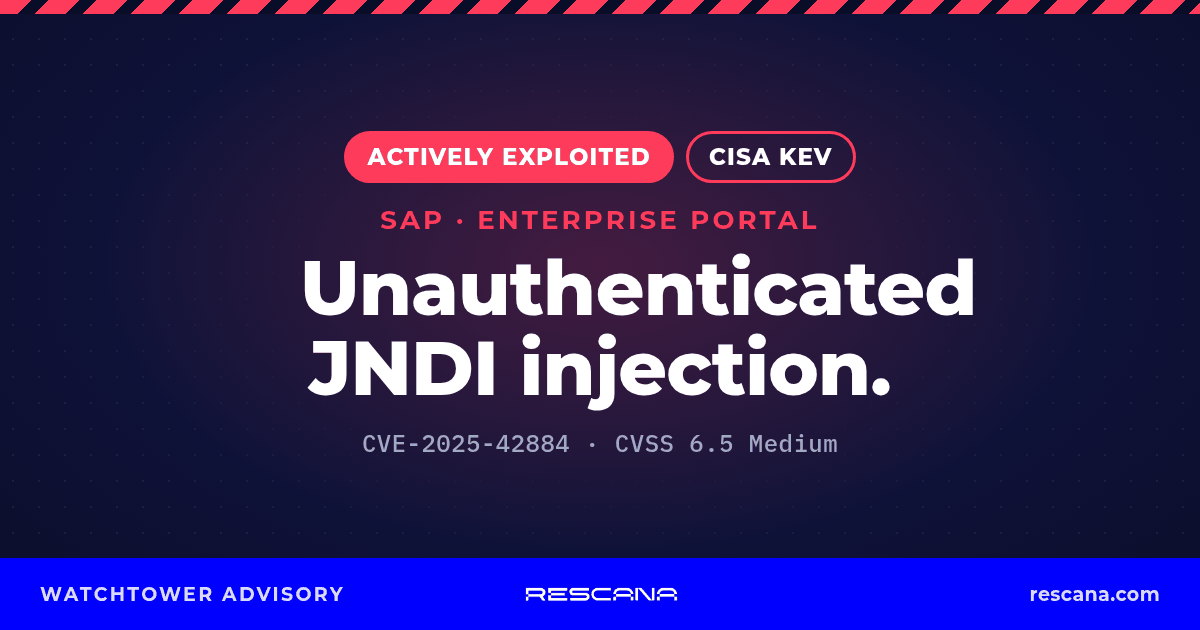
Status: On November 20, 2026, CISA added CVE-2025-42884 to its Known Exploited Vulnerabilities catalog, based on evidence of active exploitation. CVE-2025-42884 is in CISA's Known Exploited Vulnerabilities (KEV) catalog, added November 20, 2026. The catalog version we checked is 2026.11.20, released at 12:48 EST on November 20, 2026, with 1,790 entries. CISA's due date for federal civilian agencies is November 23, 2026. CISA lists ransomware campaign use as Unknown and says forensic triage is not required under BOD 26-04. The flaw itself is not new. SAP fixed it on its November 11, 2025 Security Patch Day in SAP Security Note 3660969, and rates it Medium, CVSS 3.1 6.5 (CVSS:3.1/AV:N/AC:L/PR:N/UI:N/S:U/C:L/I:L/A:N). SAP, NVD and the CVE record say an unauthenticated attacker can inject JNDI environment properties or a URL used during JNDI lookup, and that this can lead to disclosure or modification of information about the server, with no impact on availability. Onapsis Research Labs, which reported the issue to SAP, published advisory ONAPSIS-2026-0100 on November 20, 2026. In Onapsis's view, remote code execution is possible if a gadget chain is available and is not blocked by a deserialization filter; Onapsis says it originally scored the issue CVSS 10 when it reported it on August 18, 2025. CISA, SAP and Onapsis publish no indicators of compromise and name no threat actor. We last checked all sources between 15:51 and 15:53 EST on November 21, 2026.
Executive Summary
SAP NetWeaver Enterprise Portal is the Java-stack portal that many SAP customers put in front of employee and partner access to SAP systems, and it is often reachable from the internet (Rescana's reading of the product's usual role; SAP's public bulletin does not discuss exposure). CVE-2025-42884 is an unauthenticated JNDI injection in that portal. CISA's addition to the KEV catalog is the reason unpatched portals are urgent now, a year after the patch was issued, even though SAP's own score is Medium.
What matters for planning:
- CISA has evidence of active exploitation. CISA's November 20, 2026 alert says the four CVEs added that day, including this one, were added "based on evidence of active exploitation." CISA has not described the attacks, named an actor, or published indicators.
- SAP's published impact is information disclosure or modification, not code execution. The CVE record, the NVD entry (status Analyzed when we checked), and CISA's KEV short description all follow SAP's wording: disclosure or modification of server information, no impact on availability. CISA's Coordinator enrichment rates exploitation as active, automatable as yes, and technical impact as partial.
- Onapsis's view is stricter on impact. Onapsis says unprotected SOAP operations on a NetWeaver AS Java endpoint let an unauthenticated attacker control JNDI lookup properties, and that this can be used to reach an attacker-operated RMI registry and, if a gadget chain is available and is not blocked by a deserialization filter, to run code. Onapsis also says that in other cases the impact stays a low-risk effect on confidentiality and integrity. That RCE path is Onapsis's analysis, not SAP's or CISA's published description. This post labels it as such and does not present it as confirmed in the attacks CISA cited.
- The fix has been public since November 11, 2025. SAP Security Note 3660969 is the patch. The public bulletin lists the affected components as EP-BASIS 7.50 and EP-RUNTIME 7.50. Exact support package levels are in the note, which requires a SAP Support Portal login; we could not read the note itself. The public bulletin does not describe an alternative to applying the note.
- A different November 2025 note is not this CVE. Onapsis also tells customers to follow the measures in SAP Security Note 3660659. The public bulletin lists 3660659 as a November 2025 update to an October 2025 note for CVE-2025-42944 (insecure deserialization hardening in SAP NetWeaver AS Java, SERVERCORE 7.50, SAP priority Critical, CVSS 10.0). That is a different CVE, already covered in a live Rescana post. This post does not present 3660659 as a fix for CVE-2025-42884.
If you run SAP NetWeaver Enterprise Portal on the 7.50 components above, apply note 3660969 through the SAP Support Portal and confirm the portal is no longer reachable from untrusted networks without a business need (Rescana guidance). This advisory is not a follow-up to Rescana's November 2026 SAP Security Patch Day post, which covers a later patch day and a different set of CVEs.
Technical Information
The following is SAP's and CISA's published description, not a reproduction of any exploit.
SAP's CVE record, carried by NVD and the CVE record, is titled "JNDI Injection vulnerability in SAP NetWeaver Enterprise Portal." It says SAP NetWeaver Enterprise Portal allows an unauthenticated attacker to inject JNDI environment properties or pass a URL used during JNDI lookup operations, enabling access to an unintended JNDI provider, and that this could lead to disclosure or modification of information about the server, with no impact on availability. The weakness is CWE-943 (Improper Neutralization of Special Elements in Data Query Logic), assigned by SAP. The CVSS 3.1 vector is network-reachable, low complexity, no privileges, and no user interaction, with low confidentiality and integrity impact and no availability impact.
CISA's KEV entry uses the vulnerability name "SAP NetWeaver Improper Neutralization of Special Elements in Data Query Logic Vulnerability" and describes the same unauthenticated JNDI property or lookup-URL behavior and the same disclose-or-modify outcome. CISA's required action is to apply mitigations in accordance with vendor instructions, follow BOD 26-04, and follow CISA's forensics triage guidance; the KEV record marks forensic triage as No. BOD 26-04 itself applies to Federal Civilian Executive Branch agencies. CISA encourages other organizations to prioritize KEV catalog vulnerabilities as well.
CISA's Coordinator enrichment, present in the NVD metrics block and in the CVE ADP container and dated November 20, 2026, sets SSVC options to exploitation: active, automatable: yes, and technical impact: partial. "Partial" is CISA's term in that enrichment. It is consistent with SAP's official impact (no availability impact, low confidentiality and integrity). It is not a finding about whether any particular attack achieved code execution.
Onapsis advisory ONAPSIS-2026-0100, published November 20, 2026 by researchers Fabian Hagg and Ignacio Favro, goes further on mechanism and impact. Onapsis says unprotected SOAP operations in a certain endpoint of SAP NetWeaver AS Java allow a remote unauthenticated attacker to control the environment properties of a JNDI lookup, bypassing the platform's JNDI restrictions. In Onapsis's view, that can cause the server to contact an attacker-operated RMI registry, which can return a malicious serialized Java object over the Java Remote Method Protocol, and deserialization of that object can lead to remote code execution if an exploitable gadget chain is available and is not blocked by any deserialization filter. Onapsis also says that in other cases attackers might still have a low-risk impact on confidentiality and integrity. The advisory's current CVSS listing is 6.5, matching SAP's score, written by Onapsis as a CVSS 3.0 vector with the same metrics SAP published as CVSS 3.1. In the report timeline, Onapsis says it reported the vulnerability to SAP on August 18, 2025, "rating the vulnerability at CVSS 10 (Critical, CVSS:3.0/AV:N/AC:L/PR:N/UI:N/S:C/C:H/I:H/A:H)," and that SAP issued the patch on November 11, 2025 with the 6.5 Medium score. Those original and current scores, and the RCE condition, are Onapsis's view. This post keeps SAP's Medium score as the vendor score, and it does not present Onapsis's worst-case RCE path as a fact CISA or SAP have confirmed in the exploitation CISA cited.
Onapsis also notes that the unauthenticated JNDI injection in this advisory is one of several JNDI issues, both unauthenticated and authenticated, that Onapsis Research Labs reported and that SAP resolved in Security Note 3660969. The public CVE, the bulletin line, and this post are about CVE-2025-42884, the unauthenticated issue. We do not have public CVE identifiers for any sibling JNDI issues in that note, and we do not invent any.
NVD's HTML detail page is a JavaScript application. We used the NVD API 2.0 and the CVE API as the machine-readable records (a fetch of the HTML shell is not a finding). When we checked at 15:51 EST on November 21, 2026, NVD status was Analyzed, published November 11, 2025, 20:15 EST on November 10, 2025 (01:15 UTC on November 11), and last modified 00:18 EST on November 21, 2026. NVD lists SAP's CVSS 3.1 6.5 metric, the CISA KEV dates, and the SSVC block above. It does not list a separate NVD-generated base score. FIRST EPSS for CVE-2025-42884 was 0.00714 (percentile 0.54582) on the 2026-11-21 daily score. An EPSS score is not evidence for or against the KEV listing.
We found no public proof-of-concept stated by SAP, CISA, NVD or Onapsis in the pages and records we opened. Onapsis describes the class of issue and the conditions it believes are needed for code execution; it does not publish exploit code in the advisory we cached. This post does not link to or describe proof-of-concept repositories or steps.
Affected Product Versions
The public sources agree on the product and the two component versions, and they defer finer release detail to the login-walled note.
| Product or component | Version listed as affected | Source |
|---|---|---|
| SAP NetWeaver Enterprise Portal (EP-BASIS) | 7.50 | SAP November 2025 Security Patch Day bulletin; CVE record; NVD |
| SAP NetWeaver Enterprise Portal (EP-RUNTIME) | 7.50 | SAP November 2025 Security Patch Day bulletin; CVE record; NVD |
| SAP NetWeaver Enterprise Portal | 7.50 (CPE cpe:2.3:a:sap:netweaver_enterprise_portal:7.50) |
NVD configuration |
| SAP NetWeaver Application Server for Java (EP-RUNTIME, EP-BASIS) | Check note 3660969 for detailed releases | Onapsis ONAPSIS-2026-0100 |
SAP's November 11, 2025 bulletin line for note 3660969 is: "JNDI Injection vulnerability in SAP NetWeaver Enterprise Portal"; product SAP NetWeaver Enterprise Portal; versions EP-BASIS 7.50, EP-RUNTIME 7.50; priority Medium; CVSS 6.5. Onapsis says the vulnerability affects the EP-RUNTIME and EP-BASIS software components of SAP NetWeaver Application Server for Java, and tells readers to refer to note 3660969 for specific affected releases and support package levels. We did not read those support package levels, because the SAP Support Portal page for note 3660969 returned a login redirect. This post does not invent support package numbers.
The bulletin does not list ABAP-only systems, S/4HANA systems without Enterprise Portal, or other NetWeaver Java components as affected for this CVE. Absence from the public bulletin line is not a complete inventory; confirm the components actually installed in each landscape against the note (Rescana guidance).
This CVE is not one of the November 2026 SAP Security Patch Day CVEs covered in our later patch-day advisory.
Timeline (EST)
- August 18, 2025. Onapsis says it reported the vulnerability to SAP and, in Onapsis's view, rated it CVSS 10.
- November 10, 2025, 19:14 EST (00:14 UTC, November 11). CVE datePublished for CVE-2025-42884, SAP as CNA.
- November 11, 2025. SAP's November 2025 Security Patch Day. The public bulletin says SAP released 18 new security notes and 2 updates that day, including note 3660969 for CVE-2025-42884 (Medium, 6.5). The same patch day also updated note 3660659 for CVE-2025-42944 (SAP priority Critical, CVSS 10.0). Onapsis says SAP issued the patch on this date.
- November 20, 2026. Onapsis publishes ONAPSIS-2026-0100. The same calendar day, CISA adds CVE-2025-42884 to the KEV catalog (catalogVersion 2026.11.20, dateReleased 12:48 EST) and publishes an alert listing this CVE among four additions, "based on evidence of active exploitation." CISA's due date is November 23, 2026. CISA Coordinator SSVC options in the NVD and CVE records are dated November 20, 2026.
- November 21, 2026, 00:18 EST. NVD lastModified on the CVE-2025-42884 record (status Analyzed when we checked). We re-checked CISA, NVD, the CVE record, Onapsis and the SAP bulletin between 15:51 and 15:53 EST.
CISA's November 20 alert also added three other CVEs (Cisco Expressway Series CVE-2026-76466, VMware vCenter CVE-2026-123890, and Apache Roller CVE-2026-129448). Those are different products and are not in the body of this advisory.
How to Find Your Exposure
CISA, SAP and Onapsis publish no detection signatures for this CVE. The checks below are Rescana guidance, not a vendor playbook.
- Inventory every SAP NetWeaver Enterprise Portal and the Java components under it. Look specifically for EP-BASIS 7.50 and EP-RUNTIME 7.50. Include portals used by employees, partners and suppliers, including those reached through a reverse proxy or web dispatcher.
- Check in the SAP Support Portal whether note 3660969 is implemented on each of those systems, including the support package or patch level the note requires. If the note is not implemented, treat the system as affected until you can show otherwise.
- List which of those portals are reachable from the internet or from networks you do not control. Unauthenticated exploitation, as SAP and CISA describe it, needs network access to the portal, not a logged-in user.
- If the portal has been reachable from untrusted networks at any time since the patch was issued, and the note was not in place, plan a compromise assessment (Rescana guidance). CISA has evidence of exploitation and has not published a start date, indicators, or a description of the attacks. CISA's KEV record marks forensic triage as not required under BOD 26-04; that is CISA's federal-directive flag, not a finding that your system was quiet. Preserve logs before you rebuild anything you later wish you had kept.
- Do not treat an empty result in a public scanner as closure. Confirm the note against your own component list.
We will add vendor or CISA detection guidance here if it is published.
Workaround and Mitigation
SAP's public November 2025 bulletin lists note 3660969 as the fix and does not describe an alternative to applying the note. The note itself is behind a SAP Support Portal login, so this post cannot say whether the note adds an alternative configuration, a switch, or only patched component versions. Onapsis says SAP has released note 3660969, which provides patched versions of the affected components, and strongly recommends that SAP customers download and apply those fixes. That is the vendor path, as described in the public bulletin and by Onapsis.
In addition, Onapsis advises customers to follow the security measures in SAP Security Note 3660659. As set out above, the public bulletin lists 3660659 as the November 2025 update of the CVE-2025-42944 deserialization-hardening note, not as a fix for CVE-2025-42884. If you already track CVE-2025-42944, confirm that note as well; do not substitute it for 3660969 (Rescana's reading of the two bulletin lines).
Until note 3660969 is implemented, Rescana guidance (not a vendor-published alternative to the note) is:
- Apply SAP Security Note 3660969 from the SAP Support Portal on every system with EP-BASIS 7.50 or EP-RUNTIME 7.50, in a change window you can defend, and record the resulting component levels.
- Restrict network access to Enterprise Portal so that unauthenticated internet or partner-network access is limited to the audiences that actually need the portal. A WAF or reverse proxy is not a substitute for the note (Rescana guidance).
- If you cannot patch immediately, treat internet-facing, unpatched portals as a priority exception and keep a date for when the note will land. CISA's federal due date of November 23, 2026 is three days after the KEV addition; it is a useful clock even for organizations that BOD 26-04 does not bind (Rescana guidance).
- After the note is applied, confirm the portal still serves only the expected audiences and that the component versions match the note.
Indicators of Compromise
CISA, SAP, NVD and Onapsis publish no indicators of compromise, file hashes, source addresses, domains, malware names or log signatures for CVE-2025-42884, and none of them names a threat actor. CISA lists ransomware campaign use as Unknown. We list none, and we do not invent any.
Signals worth checking in the meantime (Rescana guidance, and generic rather than specific to this CVE): unusual unauthenticated requests to Enterprise Portal or the underlying NetWeaver AS Java HTTP and SOAP ports from addresses outside your expected user and integration networks; unexpected outbound connections from portal or Java-stack hosts to unfamiliar RMI or directory services; new or changed JNDI provider configuration; and, if you are also assessing Onapsis's described code-execution condition, unexpected child processes or serialized-object errors in the Java stack around the time of those requests. These are generic signs of misuse. They are not a published IoC list. We will update this advisory if SAP, CISA or Onapsis publish indicators.
Third-Party Risk (TPRM) Angle
Enterprise Portal is often the front door a supplier, shared-services partner or outsourced SAP basis team runs for several customers, or the portal your own employees use to reach a supplier's SAP landscape (Rescana's reading). Because the flaw is unauthenticated, a supplier's own user-access policy does not, by itself, close it (Rescana's reading). CISA's KEV listing means you should not wait for a quiet week before you ask.
The suppliers to ask first (Rescana guidance):
- SAP hosting, RISE, and basis-managed service providers that run NetWeaver Enterprise Portal or NetWeaver AS Java with EP-BASIS or EP-RUNTIME 7.50 on your behalf.
- Suppliers and partners whose employees reach your systems through your Enterprise Portal, or who run a portal that your staff use to reach theirs.
- Integrators and shared-services teams that expose a portal to the internet or to a multi-customer network.
Send these five questions (Rescana guidance):
- Do you run SAP NetWeaver Enterprise Portal, or NetWeaver AS Java with EP-BASIS 7.50 or EP-RUNTIME 7.50, that our users, data or integrations depend on?
- Is SAP Security Note 3660969 implemented on each of those systems, and on what date, at what component or support package level?
- Has that portal been reachable from the internet or from networks shared with other customers, and for what period?
- Have you reviewed portal and Java-stack logs for unexplained unauthenticated access, back to what date, and what did you find?
- If you also operate the NetWeaver AS Java stack covered by note 3660659 (CVE-2025-42944), is that note implemented as well?
Ask for evidence, not reassurance: the note implementation record or component level, the date, the log period reviewed and the result. CISA has evidence of exploitation and has published no indicators, so a "we saw nothing obvious" answer is not closure.
What to do internally (Rescana guidance): inventory every Enterprise Portal and the two 7.50 components today, apply note 3660969, restrict untrusted access, review logs, and chase the suppliers above. We will update this advisory if SAP revises the public bulletin or the note, if CISA updates the KEV entry or publishes indicators, if Onapsis revises ONAPSIS-2026-0100, or if a public workaround is described.
Need help working out which suppliers run SAP NetWeaver Enterprise Portal with access to your users or data? Our team can help you prioritize them and track their answers. Talk to an expert
Sources
- CISA: Known Exploited Vulnerabilities catalog, CVE-2025-42884: added November 20, 2026; due November 23, 2026; ransomware Unknown; forensic triage No; CWE-943; checked 15:51 EST, November 21, 2026.
- CISA: KEV catalog JSON feed: catalogVersion 2026.11.20, dateReleased 2026-11-20T17:48:39Z (12:48 EST), 1,790 entries; CVE-2025-42884 record as above; checked 15:51 EST, November 21, 2026.
- CISA: CISA Adds Four Known Exploited Vulnerabilities to Catalog: release date November 20, 2026; checked 15:51 EST, November 21, 2026.
- CISA: BOD 26-04, Prioritizing Security Updates Based on Risk and BOD 26-04 implementation guidance: linked from the KEV notes; checked 15:53 EST, November 21, 2026.
- SAP: Security notes news, 2025 bulletin: November 2025 Security Patch Day section, note 3660969 / CVE-2025-42884 (Medium, 6.5, EP-BASIS 7.50, EP-RUNTIME 7.50); checked 15:51 EST, November 21, 2026. The same bulletin section lists the note 3660659 / CVE-2025-42944 update (SAP priority Critical, CVSS 10.0).
- SAP: Security notes news (url.sap/sapsecuritypatchday): redirects to the security notes news page; checked 15:53 EST, November 21, 2026.
- SAP Support Portal: Security Note 3660969: login redirect when checked at 15:51 EST, November 21, 2026; the note is behind a Support Portal login. This pack uses the public bulletin for vendor facts, not the login page.
- Onapsis: ONAPSIS-2026-0100, Unauthenticated JNDI Injection in SAP NetWeaver Enterprise Portal: public release date November 20, 2026; checked 15:51 EST, November 21, 2026.
- NVD API 2.0: CVE-2025-42884 and the NVD detail page (HTML shell only; facts taken from the API): status Analyzed; published 2025-11-11T01:15:36.893; lastModified 2026-11-21T05:18:10.650; checked 15:51 EST, November 21, 2026.
- CVE API: CVE-2025-42884: datePublished 2025-11-11T00:14:02.774Z; dateUpdated 2026-11-21T04:55:22.428Z; checked 15:51 EST, November 21, 2026.
- FIRST: EPSS API, CVE-2025-42884: 0.00714, percentile 0.54582, date 2026-11-21; checked 15:53 EST, November 21, 2026.
- Rescana: SAP Security Patch Day November 2026: related later patch day, different CVEs; checked 15:51 EST, November 21, 2026.
- Rescana: SAP NetWeaver AS Java CVE-2025-42944: related note 3660659 / CVE-2025-42944; listed because Onapsis also points to that note.