Executive Summary
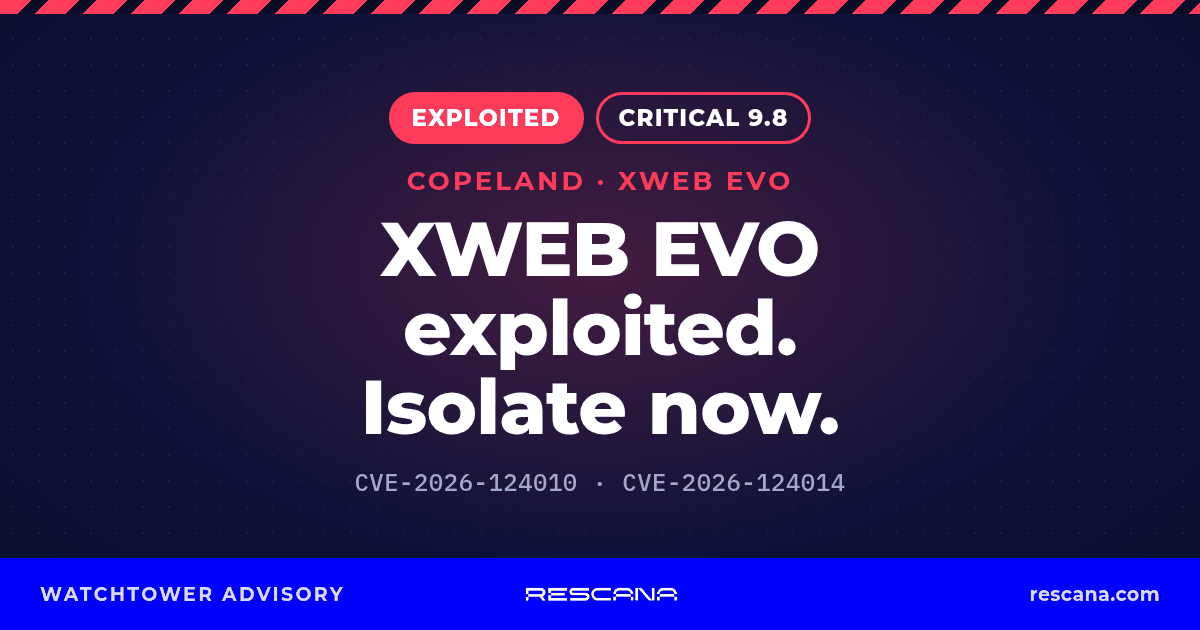
On November 12, 2026, VulnCheck, acting as the CVE Numbering Authority, published 14 CVE records for Copeland (Dixell) XWEB EVO refrigeration supervisory controllers. Two of those issues were then observed in exploitation or probing by VulnCheck canary sensors. According to VulnCheck, in-the-wild activity against CVE-2026-124014, an unauthenticated configuration write, began at 5:00 p.m. EST on November 12, about an hour and 40 minutes after the NVD records went live, and probing of CVE-2026-124010, unauthenticated command execution as root, began at 10:41 p.m. EST the same day. VulnCheck added both identifiers to VulnCheck KEV. VulnCheck's November 13 disclosure also says it has built exploit code for one of the other issues, without saying whether that code is public; we are not linking to or describing it. CVE-2026-124010 is not in CISA's Known Exploited Vulnerabilities (KEV) catalog. CVE-2026-124014 is not in CISA's Known Exploited Vulnerabilities (KEV) catalog. We checked catalogVersion 2026.11.20 (1,790 entries, released at 12:48 p.m. EST on November 20, 2026) at 3:43 p.m. EST on November 21, 2026.
The product line is already past its end of software support. Copeland's March 2026 bulletin sets March 16, 2026 as the date after which it will no longer release security patches, firmware updates or bug fixes for any XWEB EVO model, and it directs customers to transition to XWEB PRO models while applying compensating controls. CVE-2026-124010 is listed as fixed in version 5.6.2, but CVE-2026-124014 is listed as affecting versions 4.3.0 through 5.8.8 with no fixed release. On the public Copeland system software update pages we re-fetched on November 21, 2026, the newest XWEB EVO packages still offered are version 5.2.3, dated July 9, 2018. That publicly posted build is in the affected range for both exploited CVEs.
Operators who still run XWEB EVO, especially any unit reachable from the internet, should isolate the controller, inventory model and firmware, review access and logs, and plan a move to a supported platform. These November disclosures are a new vulnerability event. They are not, on the evidence VulnCheck published, a continuation of the October 2026 French supermarket refrigeration attacks, although CERT-FR had already named Copeland and Dixell XWEB among the product families in that earlier incident, which we covered in Europe Supermarket Refrigeration Cyberattacks: What Retailers and Cold-Chain Vendors Should Do Now.
Technical Information
XWEB EVO is a Dixell refrigeration site supervisor now sold under Copeland, part of Emerson. It sits on the operational network of a store or cold-chain site and supervises the refrigeration estate. The CVE records and VulnCheck advisories name the product as Copeland XWEB EVO. Copeland's update portal lists EVO software pages for the XWEB300D, XWEB500D and XWEB500 family and for the XWEB3000 and XWEB5000 family.
CVE-2026-124010 is an unauthenticated command execution issue in a setuid-root CGI component, xwconsole.cgi. VulnCheck, as CNA, rates it Critical at CVSS 3.1 9.8 (CVSS:3.1/AV:N/AC:L/PR:N/UI:N/S:U/C:H/I:H/A:H) and Critical at CVSS 4.0 9.3 (CVSS:4.0/AV:N/AC:L/AT:N/PR:N/UI:N/VC:H/VI:H/VA:H/SC:N/SI:N/SA:N). The record lists CWE-78 and CWE-250. Affected versions are those before 5.6.2; version 5.6.2 is listed as unaffected.
CVE-2026-124014 is an unauthenticated write to the system configuration through the config.lua component. VulnCheck, as CNA, rates it Critical at CVSS 3.1 9.1 (CVSS:3.1/AV:N/AC:L/PR:N/UI:N/S:U/C:N/I:H/A:H) and 8.8 at CVSS 4.0 (CVSS:4.0/AV:N/AC:L/AT:N/PR:N/UI:N/VC:N/VI:H/VA:H/SC:N/SI:N/SA:N). The record lists CWE-306. Affected versions are 4.3.0 through 5.8.8. No later fixed version is stated.
VulnCheck says the only public artifact for CVE-2026-124014 when the probing began was the NVD description, and that no public proof-of-concept was available at that time. VulnCheck's November 13 disclosure also says its Initial Access Intelligence team built exploit code for another of the 14 issues, CVE-2026-124002, which it does not describe as having canary hits, and notes that VulnCheck publishes exploits in a public repository, without saying whether this one has been released there. We are not linking to or describing that code. Its canaries recorded 87 hits against CVE-2026-124014 in the first hour and 125 hits through 1:16 a.m. EST on November 13, all from a single source, and later four probes against CVE-2026-124010 from a second source. VulnCheck added CVE-2026-124014 to VulnCheck KEV on November 12 and CVE-2026-124010 on November 13. It also states that neither scanning source is evidence of the October refrigeration campaign, describing both as opportunistic activity against a freshly published advisory. Source addresses are in Indicators of Compromise below.
The remaining 12 CVE records, also assigned by VulnCheck as CNA and published on November 12, are not described by VulnCheck as having in-the-wild canary hits. Several are rated Critical or High by the CNA and several, including credential and configuration issues, are listed as reaching version 5.8.8, which VulnCheck calls the current end-of-support firmware. The table in Affected Product Versions summarises each identifier, the CNA CVSS 3.1 score, the version range in the CVE record, and whether a fixed version is stated.
NVD lists all 14 records with vulnStatus Deferred. The NVD entries carry the VulnCheck CNA CVSS 3.1 and 4.0 metrics and have no separate NIST base score. Last-modified timestamps on the NVD records are in mid-November 2026 and were unchanged, apart from the NVD API response timestamp, when we re-fetched them at 3:44 p.m. EST on November 21, 2026. CVE.org records were byte-identical to the November 20 cache. CISA's ADP enrichment on those records marks SSVC Exploitation as "poc" for CVE-2026-124010 and CVE-2026-124014, among others. That ADP label is not a CISA KEV listing.
According to VulnCheck's November 13 disclosure, the 14 findings were submitted to Copeland PSIRT on October 17, 2026, and on November 10, 2026 Copeland PSIRT, citing end of support, deferred a request about whether the issues also affected Pro, after which VulnCheck allocated the CVE identifiers as CNA. We do not have a separate Copeland PSIRT advisory to cite for that exchange. The Copeland pages we opened (the system software update index, the two EVO download pages, the March 2026 end-of-service bulletin, and the March 2024 security best-practices bulletin) do not mention these 14 CVE identifiers. VulnCheck, citing Onyphe, reported about 1,960 internet-exposed XWEB EVO hosts compared with 108 for XWEB Pro.
CISA has not added these 14 CVEs to KEV and has not published an ICS advisory that lists them. We re-fetched CISA's ICS advisories feed (30 items, byte-identical to the November 20 cache) and the ICSA-26-057-10 advisory page. ICSA-26-057-10, released February 26, 2026, covers Copeland XWEB and XWEB Pro issues in a different CVE series and names Pro models at or below version 1.12.1. It does not list CVE-2026-124002 through CVE-2026-124015.
Affected Product Versions
All 14 CVE records name the vendor as Copeland and the product as XWEB EVO. Version ranges below are taken from the CVE.org records (re-fetched 3:44 p.m. EST, November 21, 2026). "Fixed version stated" means the record lists an unaffected version. Where the range runs through 5.8.8 with no unaffected version, the CNA record does not name a fix.
| CVE | Issue (CNA title, shortened) | CVSS 3.1 (VulnCheck) | Affected versions (CVE.org) | Fixed version stated |
|---|---|---|---|---|
| CVE-2026-124010 | Unauthenticated command injection via xwconsole.cgi | 9.8 Critical | before 5.6.2 | 5.6.2 |
| CVE-2026-124014 | Unauthenticated configuration write via config.lua | 9.1 Critical | 4.3.0 through 5.8.8 | none stated |
| CVE-2026-124002 | Pre-auth OS command injection via username | 9.8 Critical | 5.2.3 before 5.7.0 | 5.7.0 |
| CVE-2026-124003 | Setuid Lua CGI root command injection | 7.8 High | before 5.6.2 | 5.6.2 |
| CVE-2026-124004 | Hardcoded administrator backdoor password | 9.8 Critical | before 5.6.2 | 5.6.2 |
| CVE-2026-124005 | Predictable administrator password generation | 8.1 High | 4.3.0 through 5.8.8 | none stated |
| CVE-2026-124006 | Predictable root password generation | 8.1 High | through 5.8.8 | none stated |
| CVE-2026-124007 | Pre-auth OS command injection via password field | 8.1 High | before 5.6.2 | not listed as a separate unaffected version; range is before 5.6.2 |
| CVE-2026-124008 | OS command injection via devices.lua | 7.2 High | 5.2.3 through 5.8.8 | none stated |
| CVE-2026-124009 | OS command injection via backup.lua | 7.2 High | 5.2.3 through 5.8.8 | none stated |
| CVE-2026-124011 | Information disclosure via sysinfo.lua | 5.3 Medium | 5.6.2 through 5.8.8 | none stated |
| CVE-2026-124012 | Hardcoded administrator daily password bypass | 8.1 High | 5.6.2 through 5.8.8 | none stated |
| CVE-2026-124013 | OS command injection via api.lua | 8.8 High | 5.6.2 through 5.8.8 | none stated |
| CVE-2026-124015 | Authentication bypass via users.lua | 5.9 Medium | 5.6.2 through 5.8.8 | none stated |
On Copeland's public XWEB300D/500D/500 EVO software page, the listed packages are v3.0.8 (June 23, 2016), v4.3.0 (July 24, 2017) and v5.2.3 (July 9, 2018). The XWEB3000/5000 EVO page lists only v5.2.3 (July 9, 2018). Those pages were byte-identical on November 21 to the November 20 fetch. VulnCheck says it reproduced findings against vendor firmware labelled 5.2.3.STANDARD and 5.8.8.STANDARD. The 5.8.8 package is not listed on the public update pages we opened.
Timeline (EST)
- October 2023: Copeland's end-of-service bulletin gives this as the end of sales date for the XWEB EVO family.
- March 16, 2026: End of software support. Copeland says security patches, firmware updates, bug fixes and updated technical documentation will no longer be provided.
- October 11-12, 2026: CERT-FR alert CERTFR-2026-ALE-012 describes attacks on refrigeration controllers at French supermarket sites and names Copeland and Dixell XWEB among the compromised product families, alongside Danfoss series. This is prior incident context, not a source that assigns the November CVE identifiers to that campaign.
- October 16-17, 2026: VulnCheck says it rebuilt 5.2.3.STANDARD and 5.8.8.STANDARD from vendor firmware and submitted 14 findings to Copeland PSIRT on October 17.
- November 10, 2026: VulnCheck says Copeland PSIRT, citing end of support, deferred a Pro-duplication question, after which the 14 identifiers were allocated through the VulnCheck CNA.
- November 12, 2026, 2:34 p.m. to 3:07 p.m. EST: CVE.org publishes the 14 records (CVE-2026-124002 through CVE-2026-124015).
- November 12, 2026, 3:18 p.m. EST: NVD records go live, according to VulnCheck (NVD published timestamps for these IDs are 3:18 p.m. EST).
- November 12, 2026, 5:00 p.m. EST: VulnCheck canaries record the first in-the-wild activity against CVE-2026-124014. VulnCheck adds that CVE to VulnCheck KEV the same day.
- November 12, 2026, 10:41 p.m. EST: VulnCheck canaries record the first probes of CVE-2026-124010 (four requests through 11:09 p.m. EST). VulnCheck adds that CVE to VulnCheck KEV on November 13.
- November 13, 2026: VulnCheck publishes its disclosure blog.
- November 16, 2026: SecurityWeek reports the VulnCheck disclosure and the canary activity.
- November 20, 2026, 12:48 p.m. EST: CISA KEV catalogVersion 2026.11.20 is released with 1,790 entries. The four additions since catalogVersion 2026.11.18 do not include these Copeland identifiers.
- November 21, 2026, 3:43 p.m. to 3:45 p.m. EST: This pack's re-fetch of VulnCheck, CVE.org, NVD, CISA KEV, CISA ICS materials, and Copeland's update pages and end-of-service bulletin.
How to Find Your Exposure
- Inventory every Copeland or Dixell XWEB EVO controller in stores, warehouses, distribution sites and any managed cold-chain environment, including XWEB300D, XWEB500D, XWEB500, XWEB3000 and XWEB5000 EVO units, and record model, serial, firmware version, network placement and whether a web or management interface is reachable from outside the control network. (Rescana guidance)
- Compare the firmware version with the table above. Treat 5.2.3, which is the newest package on Copeland's public EVO update pages, as in range for both exploited CVEs. Treat any build before 5.6.2 as in range for CVE-2026-124010, and any build from 4.3.0 through 5.8.8 as in range for CVE-2026-124014.
- Confirm, as Copeland's March 2024 best-practices bulletin requires, that the controller is not exposed to the broader internet, that administrative protocols are restricted, and that inbound and outbound communications to the control system are limited. Internet-facing web interfaces are the exposure VulnCheck and CERT-FR both highlight for this product class.
- Review authentication, web and firewall logs around 5:00 p.m. EST on November 12, 2026 and after, and hunt for the source addresses in Indicators of Compromise. Successful authentication or configuration changes after those times deserve incident-response handling, not only a patch discussion.
- Ask refrigeration contractors, facilities managers and any MSP that remotely supports these sites the supplier questions in the Third-Party Risk section. Do not rely on a software-update page visit alone: the public EVO downloads we fetched do not go past 5.2.3 and do not mention these CVEs.
Workaround and Mitigation
There is no complete vendor patch set for this disclosure. Copeland's March 16, 2026 end-of-service bulletin states that security patches for identified vulnerabilities will no longer be provided for the XWEB EVO series. CVE-2026-124014 has no fixed version through 5.8.8 in the CNA record. Even where a CVE record lists 5.6.2 or 5.7.0 as unaffected, those builds are not offered on the public EVO update pages we opened, and Copeland is no longer committing to further EVO security updates.
Until a device is replaced, the controls Copeland already published are the ones to apply, and they should be treated as mandatory rather than optional (Rescana guidance):
- Take internet-reachable XWEB EVO interfaces off the public internet immediately (Rescana guidance). Copeland's March 2024 bulletin says never to expose the control system, including its web interface, to the broader internet, even if HTTPS is enabled.
- Place remaining units on a segmented control network with tightly restricted inbound and outbound communications and restricted administrative access, including SSH, in line with that bulletin and with the compensating measures in the March 2026 end-of-service notice (network segmentation, restricted access and enhanced monitoring).
- Change default account passwords. This is necessary hygiene, but it is not sufficient for the predictable or hardcoded credential issues VulnCheck describes in several of the 14 CVE records, and it does not close CVE-2026-124010 or CVE-2026-124014.
- Increase monitoring of configuration changes, authentication events and unusual management-plane traffic, and retain logs long enough to investigate the November 12 activity window.
- Plan the vendor-recommended transition to currently available XWEB PRO models with Copeland or your distributor. That migration is the only path Copeland now offers for software support. It is not automatically a clean bill of health: CISA's February 26, 2026 advisory ICSA-26-057-10 addressed a separate set of vulnerabilities in Copeland XWEB and XWEB Pro, including Pro models at or below 1.12.1. Confirm the current supported and patched Pro version with Copeland before you treat a replacement as complete.
- If a unit was internet-reachable after the records were published, or if logs show the probe sources below, handle it as a possible compromise. CERT-FR, writing about internet-exposed end-of-life refrigeration supervisors in the October incident, warned that a factory reset is not a durable recovery if the device remains exposed and unpatched. That advice is about persistent risk on unsupported equipment, not a claim that the November canary traffic used the October campaign's methods.
Do not use the 5.2.3 packages on Copeland's public update pages as a remediation for this advisory. Those packages predate the fixed versions named for CVE-2026-124010 and sit inside the CVE-2026-124014 range.
Indicators of Compromise
VulnCheck published two source addresses from its canary observations. We have not independently observed this traffic, and we are not adding indicators that the sources do not publish. VulnCheck says the other 12 of the 14 CVEs had no in-the-wild canary hits in that dataset.
- 202.61.138[.]117, AS152194, CTG Server Limited, geolocated by VulnCheck to Tokyo, Japan. First hit 5:00:05 p.m. EST on November 12, 2026. Volume: 125 hits through 1:16 a.m. EST on November 13, including 87 in the first hour. Associated by VulnCheck with CVE-2026-124014.
- 177.4.12[.]11, AS140227, Hong Kong Communications International Co., Limited, geolocated by VulnCheck to Hong Kong. First hit 10:41:20 p.m. EST on November 12, 2026. Volume: 4 hits through 11:09:55 p.m. EST. Associated by VulnCheck with CVE-2026-124010.
VulnCheck describes both sources as opportunistic scanners acting on a fresh advisory and says neither is evidence of the October refrigeration campaign, and that no botnet, named threat actor or ransomware group is tied to these addresses or to CVE-2026-124014 in its IOC feeds. No file hashes, malware families or additional domains were published as indicators in the sources we opened.
Third-Party Risk (TPRM) Angle
The urgent vendor work is with anyone who still operates or remotely supports Copeland or Dixell XWEB EVO on your sites, and with the refrigeration and facilities contractors who may have placed those controllers on a reachable network. This is not a routine "ask if they patched" exercise. The product line is out of software support, one of the two exploited issues has no stated fixed version, and the public update portal we fetched still offers 5.2.3.
Ask each relevant supplier, in writing, and track the answers:
- Do you operate, support or remotely administer any Copeland or Dixell XWEB EVO controller on our sites or on sites that handle our goods, including 300D, 500D, 500, 3000 and 5000 EVO models?
- What firmware version is running on each unit, and was any unit reachable from the internet or from a partner network on or after November 12, 2026?
- What compensating controls (segmentation, access restriction, monitoring) have been in place since the March 16, 2026 end of software support, and what changed after this disclosure?
- Have you reviewed logs for the source addresses VulnCheck published, and for unauthenticated configuration or console activity in that window? If you found a match, what was done?
- What is the dated plan to migrate each remaining EVO unit to a currently supported platform, and which XWEB PRO (or other) version will you install, including confirmation that it is a build Copeland still supports after CISA advisory ICSA-26-057-10?
Need help working through refrigeration or other OT suppliers who may still be running end-of-service Copeland (Dixell) XWEB EVO controllers exposed to CVE-2026-124010 and CVE-2026-124014? Our team can help you prioritize them and track their answers. Talk to an expert
Sources
- VulnCheck: Code of the Day, Unauthenticated Root in Copeland XWEB EVO: published November 13, 2026; checked 3:43 p.m. EST, November 21, 2026 (visible text unchanged from the November 20 cache). Primary source for the 14-CVE disclosure, canary timeline, VulnCheck KEV additions, Copeland PSIRT chronology as reported by VulnCheck, Onyphe exposure figures, and the statement that the November probe sources are not evidence of the October campaign.
- VulnCheck advisory: Dixell/Copeland XWEB EVO Unauthenticated Command Injection via xwconsole.cgi (CVE-2026-124010): dated November 12, 2026; states the advisory is in the VulnCheck KEV database; checked 3:43 p.m. EST, November 21, 2026 (visible text unchanged).
- VulnCheck advisory: Dixell/Copeland XWEB EVO Unauthenticated Configuration Write via config.lua (CVE-2026-124014): dated November 12, 2026; states the advisory is in the VulnCheck KEV database; checked 3:43 p.m. EST, November 21, 2026 (visible text unchanged).
- CVE.org API records for CVE-2026-124002 through CVE-2026-124015: published November 12, 2026, 2:34 p.m. to 3:07 p.m. EST, VulnCheck as CNA; re-fetched 3:44 p.m. EST, November 21, 2026, byte-identical to the November 20 cache. Used for titles, version ranges, CVSS 3.1 and 4.0 vectors, CWEs and references. Companion URLs follow the same API path for each identifier.
- NVD API records for CVE-2026-124002 through CVE-2026-124015: vulnStatus Deferred; CNA metrics only; published timestamps 3:18 p.m. EST on November 12, 2026; re-fetched 3:44 p.m. EST, November 21, 2026. Record bodies unchanged from November 20 except the NVD API timestamp.
- CISA: KEV catalog JSON feed: catalogVersion 2026.11.20, released November 20, 2026, 12:48 p.m. EST, 1,790 entries; none of CVE-2026-124002 through CVE-2026-124015 are present; checked 3:43 p.m. EST, November 21, 2026. Four identifiers were added after catalogVersion 2026.11.18 (1,786 entries); none are these Copeland CVEs.
- CISA: ICS advisories feed: 30 items, byte-identical to the November 20 cache; no item names these 14 CVEs, XWEB EVO, Copeland or Dixell; checked 3:45 p.m. EST, November 21, 2026.
- CISA: ICS advisory ICSA-26-057-10, Copeland XWEB and XWEB Pro: released February 26, 2026; a different CVE series, focused on XWEB Pro models at or below 1.12.1; does not list CVE-2026-124002 through CVE-2026-124015; visible text unchanged on re-fetch at 3:43 p.m. EST, November 21, 2026.
- Copeland: System Software Updates: index of product update pages, including XWEB EVO and XWEB PRO families; byte-identical to the November 20 cache; checked 3:43 p.m. EST, November 21, 2026.
- Copeland: XWEB300D/500D/500 EVO software updates: lists v3.0.8 (June 23, 2016), v4.3.0 (July 24, 2017) and v5.2.3 (July 9, 2018); byte-identical on re-fetch; checked 3:43 p.m. EST, November 21, 2026.
- Copeland: XWEB3000/5000 EVO software updates: lists v5.2.3 (July 9, 2018) only; byte-identical on re-fetch; checked 3:43 p.m. EST, November 21, 2026.
- Copeland: End of software support for the XWEB EVO family, March 2026 product bulletin: effective March 16, 2026; end of sales October 2023; no further security patches or firmware updates; transition to XWEB PRO and compensating controls; byte-identical on re-fetch, including the alternate path under the SystemSoftwareUpdate tree; checked 3:43 p.m. EST, November 21, 2026.
- Copeland: Product best practices, March 2024 bulletin: do not expose the control system or its web interface to the broader internet; restrict SSH and other administrative protocols; restrict inbound and outbound communications; change default passwords; enable HTTPS without internet exposure; notes the move toward XWEB PRO; byte-identical on re-fetch; checked 3:43 p.m. EST, November 21, 2026.
- CERT-FR: CERTFR-2026-ALE-012: October 2026 alert on refrigeration-controller attacks; names Copeland and Dixell XWEB among affected families; byte-identical to the November 20 cache; checked 3:43 p.m. EST, November 21, 2026. Cited as prior incident context only.
- SecurityWeek: Hackers Probe Newly Disclosed Flaws in Copeland Refrigeration Controllers: Eduard Kovacs, November 16, 2026; secondary account of the VulnCheck disclosure and canary activity; article body unchanged on re-fetch at 3:43 p.m. EST, November 21, 2026 (sidebar chrome differed). Used as corroboration, not as the source of version ranges or of which firmware the exploited CVEs reach.
- Rescana: Europe Supermarket Refrigeration Cyberattacks, What Retailers and Cold-Chain Vendors Should Do Now: prior Path B post, November 3, 2026; internal context link; live page byte-identical to the November 20 cache; checked 3:43 p.m. EST, November 21, 2026.
- FIRST: EPSS scores for CVE-2026-124010 and CVE-2026-124014: checked 3:43 p.m. EST, November 21, 2026 (CVE-2026-124010 EPSS 0.02609, percentile 0.85776; CVE-2026-124014 EPSS 0.00863, percentile 0.59476, dated November 21). Not used for a body claim.