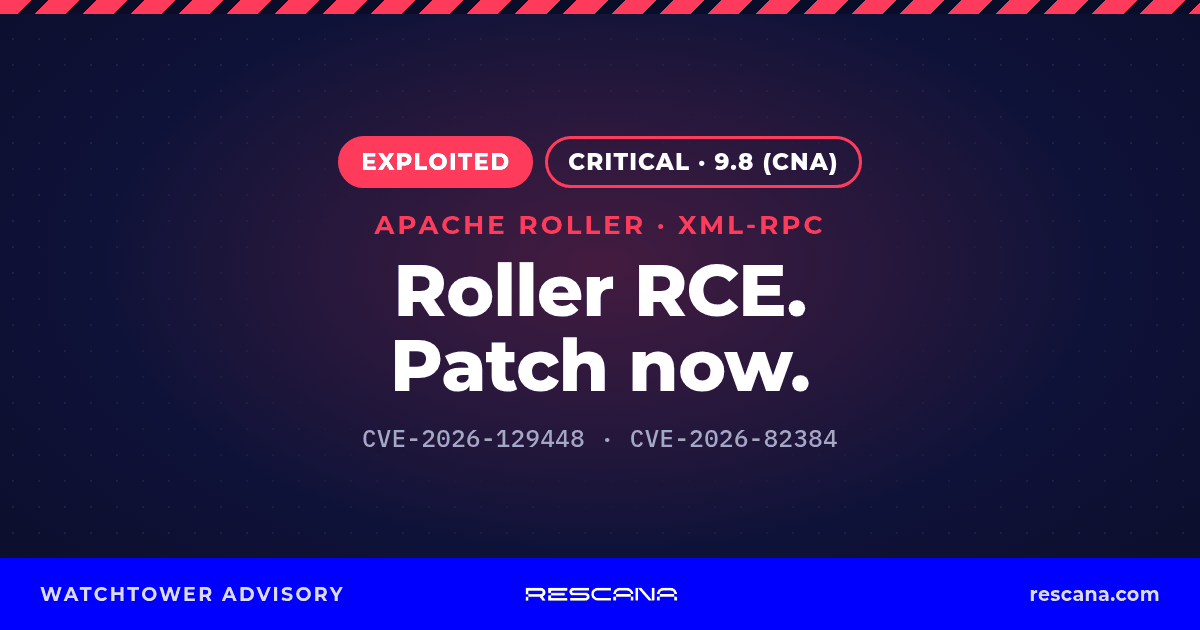
Status: On November 17, 2026 at 06:02 EST, the Apache Software Foundation (ASF) announced CVE-2026-129448, an unauthenticated deserialization flaw in the XML-RPC endpoint of Apache Roller, the ASF's Java blog server. The CVE record says it lets "an unauthenticated remote attacker" execute arbitrary code, and Apache states: "This issue is being actively exploited." Apache, as the CVE Numbering Authority (CNA), scores it CVSS 3.1 9.8 (Critical), and classifies it as CWE-502, deserialization of untrusted data. The record covers Apache Roller 4.0.0 through 6.1.4, and says it is the same vulnerability as CVE-2026-82384, which Apache announced in September for Roller 6.1.5. Apache says to upgrade to Roller 6.1.6 or later; the project's download page lists 6.1.7 as the best available release. CVE-2026-129448 is not in CISA's Known Exploited Vulnerabilities (KEV) catalog (catalogVersion 2026.11.18, checked 15:19 EST on November 19, 2026). Apache gives no details of the exploitation it reports and names no threat actor or indicators of compromise. Security vendor Corgea reports that proof-of-concept code for the same bug has been public since September 28, 2026. We last checked all sources between 15:19 and 15:28 EST on November 19, 2026.
Executive Summary
Apache Roller is a multi-user blog server, and its XML-RPC endpoint parses requests before it checks who sent them. Apache's records say the endpoint accepts "vendor extension types" and deserializes them first. That is the whole flaw: an attacker who can reach the endpoint does not need an account, and the result Apache names is remote code execution.
What makes this advisory different from a routine release note:
- Apache says it is being exploited. That statement is the only report of exploitation we found, and it comes from the vendor and CNA. Separately, Corgea reports that proof-of-concept code has been public since September 28, 2026. CISA's KEV catalog does not list the CVE, and CISA's enrichment record for it, dated November 18, shows the SSVC exploitation field as "none." We do not know why these differ, and we do not claim to. For planning, treat the vendor's statement as the safer assumption (Rescana guidance).
- The fix is not new. Roller 6.1.6 was released on September 24, 2026 and fixes the same bug under CVE-2026-82384. The fix itself was public earlier: the Apache pull request both CVE records cite, titled "Disable vendor extension types on the XML-RPC servlet," was opened publicly on August 29, 2026 and merged on September 5, 2026. What changed on November 17 is that Apache widened the affected range to every release from 4.0.0, and said exploitation is under way.
- Disabling XML-RPC in the Roller administration UI does not protect you. Apache says older versions deserialize the request before they check that setting.
Who should act first (Rescana guidance). Anyone running a Roller release older than 6.1.6 with the XML-RPC path reachable from the internet, including forgotten internal or archive blogs, and any supplier that hosts Roller for you.
Technical Information
What the records say. Apache's description of CVE-2026-129448 reads: "The XML-RPC endpoint accepts vendor extension types and deserializes them before authenticating the requester." The weakness is CWE-502. The September record for CVE-2026-82384 adds that the servlet "is mapped unconditionally, so parsing occurs even when the global XML-RPC feature is set to disabled; no non-default configuration is required for this path." Apache describes the outcome as remote code execution. Neither record names a class, gadget or request format, and we do not speculate about them.
Same bug, two CVE records. CVE-2026-129448 says it "is the same vulnerability as CVE-2026-82384, which listed only Apache Roller 6.1.5 as affected." In other words, the September record named one release and the November record names the rest. Both are scored identically by Apache: CVSS 3.1 9.8, CVSS:3.1/AV:N/AC:L/PR:N/UI:N/S:U/C:H/I:H/A:H. The vector reads as network-reachable, low complexity, no privileges, no user interaction.
Credit. The CVE record credits n0mi1k as finder and Matt Raible as reporter. The September record credits n0mi1k as finder.
Scores and where they come from. The 9.8 score is Apache's, as CNA. NVD lists CVE-2026-129448 with status "Received" and shows the same 9.8 vector as supplied by Apache; NVD has not published its own assessment. Rescana's severity field for this post is Critical, which adopts the CNA score and nothing else.
Exploitation and prioritization signals, as published.
| Signal | Value | Source and time |
|---|---|---|
| Vendor statement | "This issue is being actively exploited." | Apache announcement, November 17, 2026, 06:02 EST |
| Catalog status | CVE-2026-129448 is not in CISA's Known Exploited Vulnerabilities (KEV) catalog. | catalogVersion 2026.11.18, 1,786 entries, checked 15:19 EST on November 19, 2026 |
| CISA enrichment (SSVC) | Exploitation: none; Automatable: yes; Technical Impact: total | CISA ADP record dated November 18, 2026 |
| EPSS | 0.01191 (68.6th percentile) | FIRST, November 19, 2026 |
| Public proof of concept | Reported public since September 28, 2026 (written for CVE-2026-82384, the same bug); per Corgea it needs a separately built gadget chain | Corgea research write-up, November 17, 2026; checked 15:28 EST on November 19, 2026 |
CVE-2026-82384 is also absent from the KEV catalog. Its EPSS value on November 19 was 0.00994 (63.4th percentile).
What we could not establish. Apache does not say when exploitation began, how many sites are affected, who is exploiting it, or what the attackers do afterwards. Apache, the CVE record, NVD and CISA's record do not mention a proof of concept. Corgea's research write-up, dated November 17, says a Python proof of concept has been public since September 28, 2026, and that whether the flaw becomes code execution depends on the gadget classes in the Roller web application and the servlet container's classpath. We have not opened or tested that code, and we do not link it or the page that links it. News coverage on November 18 (BleepingComputer, The Hacker News) repeats Apache's statement and adds no independent evidence of exploitation.
Affected Product Versions
| Release | Status | Source |
|---|---|---|
| Apache Roller 4.0.0 through 6.1.4 | Affected by CVE-2026-129448 | Apache announcement and CVE record |
| Apache Roller 6.1.5 | Affected by CVE-2026-82384, the same bug | CVE record for CVE-2026-82384 |
| Apache Roller 6.1.6 | Fixed, released September 24, 2026 | Roller security page |
| Apache Roller 6.1.7 | Covered by Apache's "6.1.6 or later"; released November 11, 2026; listed as "best available" | Apache announcement, Roller security and download pages |
How to read this (Rescana's reading). Together the two records cover every release from 4.0.0 through 6.1.5, and the fix is 6.1.6 or later. The CVE record's machine-readable range says "4.0.0 before 6.1.5" because 6.1.5 sits under the September CVE; it does not mean 6.1.5 is safe.
Releases before 4.0.0. Neither record says whether they are affected. Roller's security page says that "older releases are not patched in place" and that the fix for an older version is to upgrade to the current release. We read that as: treat any pre-4.0.0 install as unsupported and possibly exposed, and upgrade it (Rescana guidance).
Why 6.1.7 and not only 6.1.6 (Rescana guidance). The project's security page lists 15 further vulnerabilities fixed in 6.1.7, each affecting 6.1.6, including CVE-2026-123374, which Apache titles "Deserialization of untrusted data in weblog update ping responses" and rates Important. The download page tells operators to read the 6.1.7 release notes, "including the behaviour changes, before upgrading a live site." Plan the upgrade to 6.1.7, and treat 6.1.6 as the minimum for this bug.
Timeline (EST)
- August 29, 2026: Apache's fix appears as a public pull request.
- September 5: the pull request is merged.
- September 24: Roller 6.1.6 is released.
- September 25, 15:12: CVE-2026-82384 is announced (Roller 6.1.5 only).
- September 28, 02:47: the CVE-2026-82384 record is published.
- September 28: a proof of concept becomes public, per Corgea.
- November 11: Roller 6.1.7 is released.
- November 17, 06:02: CVE-2026-129448 is announced, with Apache's statement that it is being actively exploited.
- November 18: CISA's enrichment record shows Exploitation "none"; KEV catalog 2026.11.18 (released 14:17) does not list the CVE.
How to Find Your Exposure
These steps are Rescana guidance, not Apache's.
- Inventory every Roller deployment, including internal, departmental and archive blogs, and record the release each one runs. Anything below 6.1.6 is in scope, 6.1.5 included. Dependency scanners will not find it for you: Roller ships as a downloadable web application, and GitHub's advisory entries for both CVEs (GHSA-pxp4-phq9-fx2q and GHSA-9rhg-vvf7-p29p) are unreviewed with no package listed, so check what is actually deployed (Rescana's reading).
- Check whether the
/roller-services/xmlrpcpath is reachable from the internet by reading your reverse proxy, load balancer and servlet configuration. Configuration answers most of this. Then confirm from outside your network, with a plain request that carries no body, whether the path reaches Roller or is refused at the edge. - Check whether the administration UI toggle is your only control. Apache says that toggle does not stop the flaw on older versions.
- Search your web or proxy access logs for requests to
/roller-services/xmlrpc, and look at POST requests from addresses you do not recognise. Apache does not say when exploitation began, so look back as far as your logs go. August 29, 2026, when Apache's fix first appeared as a public pull request, is a sensible minimum. The September 25 announcement and the September 28 proof of concept (per Corgea) both came later. - Keep the logs you find before you restart or redeploy anything.
Workaround and Mitigation
Apache's fix: upgrade. Apache recommends "Apache Roller 6.1.6 or later, which disables the extension types and rejects XML-RPC requests when the XML-RPC feature is disabled."
Apache's workaround if you cannot upgrade right away. Apache says to do one of two things and then restart Roller:
- Set
enabledForExtensionstofalseinWEB-INF/web.xml; or - Remove the
/roller-services/xmlrpcservlet mapping.
Apache adds that disabling XML-RPC in the administration UI "is not enough, because older versions deserialize the request before checking that setting." Apache's notice does not show the surrounding web.xml syntax.
Where the setting sits (Rescana's reading). In the web.xml that Roller itself ships (we checked the 4.0, 5.2.0 and 6.1.5 source releases), enabledForExtensions is an <init-param> on the XmlRpcServlet servlet element, with <param-name>enabledForExtensions</param-name> and <param-value>true</param-value>. Apache's 6.1.6 release changes that value to false, and the Apache XML-RPC library documents the same parameter. Change only that value, keep a copy of the original file, and restart.
Additional steps (Rescana guidance, not Apache's).
- Plan for 6.1.7. Read its release notes first, as the project asks, then upgrade a test copy before production.
- Block the path at the edge as well. Until you have upgraded, deny requests to
/roller-services/xmlrpcat your reverse proxy or web application firewall, including under any context path Roller runs at (for example/roller/roller-services/xmlrpc). Java servlet containers strip path parameters such as;jsessionid=before they map a request, so match the normalised path rather than a literal string. Many reverse proxies do not strip;path parameters when they normalise a path, so check that your rule also refuses spellings such as/roller-services/xmlrpc;x=1and/roller-services;x=1/xmlrpc. Then confirm from outside your network, with bodyless requests, that the path and those spellings are refused at the edge. This is a stopgap and does not replace Apache's two options. - Expect XML-RPC publishing clients to stop working once the mapping is removed or blocked. Roller's own advisory list shows XML-RPC Blogger and MetaWeblog handlers exist, so check with authors who post from desktop tools.
- Make the change survive redeploys. A
web.xmledit inside a deployed web application can be overwritten when the application is redeployed. Record it in your build or configuration management, and re-check after every redeploy. If Roller runs from a container image, rebuild the image with 6.1.6 or later, or with the editedweb.xml; an edit inside a running container is lost when it is recreated. - Confirm after the restart, by reading the deployed configuration, that the setting or the removal is in place.
- If you find unexpected requests to the endpoint in your logs, treat the host as potentially compromised. Preserve evidence, rotate credentials the Roller host can read, such as database and mail credentials, and rebuild from a known-good image instead of cleaning in place.
Indicators of Compromise
Apache, CISA and NVD publish no indicators of compromise, network signatures, source addresses or malware names for this flaw, and none of them attributes the exploitation to a threat actor. We list none, and we do not invent any.
Signals worth checking in the meantime (Rescana guidance): requests to /roller-services/xmlrpc in access logs from addresses outside your authors and tools; the Java process that runs Roller starting unexpected child processes such as shells or download tools; unexpected outbound connections from the Roller host; new or modified files under the web application directory; and new administrator accounts. These are generic signs of server-side code execution and are not specific to this flaw. Standard access logs record the path, method, status and size but not the request body. If your web application firewall or proxy can inspect bodies, Corgea's write-up describes malicious requests as carrying an Apache XML-RPC extension element (ex:serializable) that holds a base64 Java serialized object, which begins rO0AB; treat any request to the endpoint carrying those markers as hostile (Rescana's reading of Corgea). We will update this advisory if Apache or CISA publish indicators.
Third-Party Risk (TPRM) Angle
Roller is a self-hosted blog server, and it can sit behind a supplier in ways you cannot see: a vendor's company or documentation blog, a community site, or an instance run for you by a hosting or managed web provider. Because the endpoint is exposed before authentication, the supplier's own login controls do not help. A supplier running an old Roller release can have a compromised web host even when the blog holds nothing sensitive, and what matters for you is what else that host can reach.
The suppliers to ask first (Rescana guidance):
- Suppliers that host content or portals for you on Roller, or on software built on it.
- Managed web, hosting and agency providers that run blogs on your behalf.
- Any supplier with a blog or knowledge base on the same network as systems that hold your data.
Send these four questions (Rescana guidance):
- Do you run Apache Roller anywhere that serves content for us, or on a network that holds our data, and which release is each instance on?
- For any instance older than 6.1.6, on what date did you upgrade to 6.1.6 or later, preferably 6.1.7, or disable the XML-RPC extension types or remove the
/roller-services/xmlrpcmapping and restart? - Have you reviewed access logs for requests to
/roller-services/xmlrpc, back to what date, and what did you find? - Who patches Roller instances that a hosting provider runs for you, and how will we hear if they were affected?
Ask for evidence, not reassurance: the release shown by the running instance after the upgrade, the date of the change, the log period reviewed and the result. Since Apache says exploitation is under way, set a short follow-up date and record each answer.
What to do internally: inventory every Roller instance and its release today, upgrade or apply Apache's workaround on any internet-facing one, block the XML-RPC path at the edge in the meantime, review logs for requests to it, and chase the suppliers above. We will update this advisory if Apache changes the affected range, publishes details of the exploitation, or if CISA adds the CVE to the KEV catalog.
Need help working out which suppliers run Apache Roller or other self-hosted web software that touches your data? Our team can help you prioritize them and track their answers. Talk to an expert
Sources
- Apache announce list: CVE-2026-129448, Apache Roller: Unauthenticated deserialization in the XML-RPC endpoint (releases before 6.1.5): November 17, 2026, 06:02 EST (also posted to oss-security).
- CVE.org API: CVE-2026-129448: published November 17, 2026, 06:03 EST; record updated November 18, 2026, 23:55 EST; checked 15:19 EST, November 19, 2026.
- NVD API: CVE-2026-129448: status Received, last modified November 19, 2026, 00:18 EST; checked 15:19 EST, November 19, 2026.
- Apache Roller: Security: lists the 6.1.6 and 6.1.7 releases and their advisories, and does not yet list CVE-2026-129448; checked 15:24 EST, November 19, 2026.
- Apache Roller: Downloads: lists 6.1.7 as best available; checked 15:19 EST, November 19, 2026.
- CVE.org API: CVE-2026-82384: published September 28, 2026, 02:47 EST; checked 15:19 EST, November 19, 2026.
- Apache announce list: CVE-2026-82384, Apache Roller: Unauthenticated deserialization in the XML-RPC endpoint and the same notice on oss-security: September 25, 2026, 15:12 EST.
- CISA: KEV catalog JSON feed: catalogVersion 2026.11.18, released November 18, 2026, 14:17 EST, where neither CVE-2026-129448 nor CVE-2026-82384 is listed; checked 15:19 EST, November 19, 2026.
- FIRST: EPSS score for CVE-2026-129448 and for CVE-2026-82384: November 19, 2026.
- Corgea: research write-up on CVE-2026-129448 and CVE-2026-82384 (corgea.com, cited without a link because it links exploit code), November 17, 2026; checked 15:28 EST, November 19, 2026.
- Apache Roller pull request #171, "Disable vendor extension types on the XML-RPC servlet" (cited by both CVE records): opened August 29, 2026, merged September 5, 2026; checked 15:26 EST, November 19, 2026.
- Apache XML-RPC: Server-side XML-RPC: documents the enabledForExtensions servlet parameter; checked 15:26 EST, November 19, 2026.
- BleepingComputer: Apache warns of Roller RCE vulnerability exploited in attacks: November 18, 2026, 05:35 EST.
- The Hacker News: Critical Apache Roller RCE Flaw Under Active Exploitation, No Authentication Required: November 18, 2026.