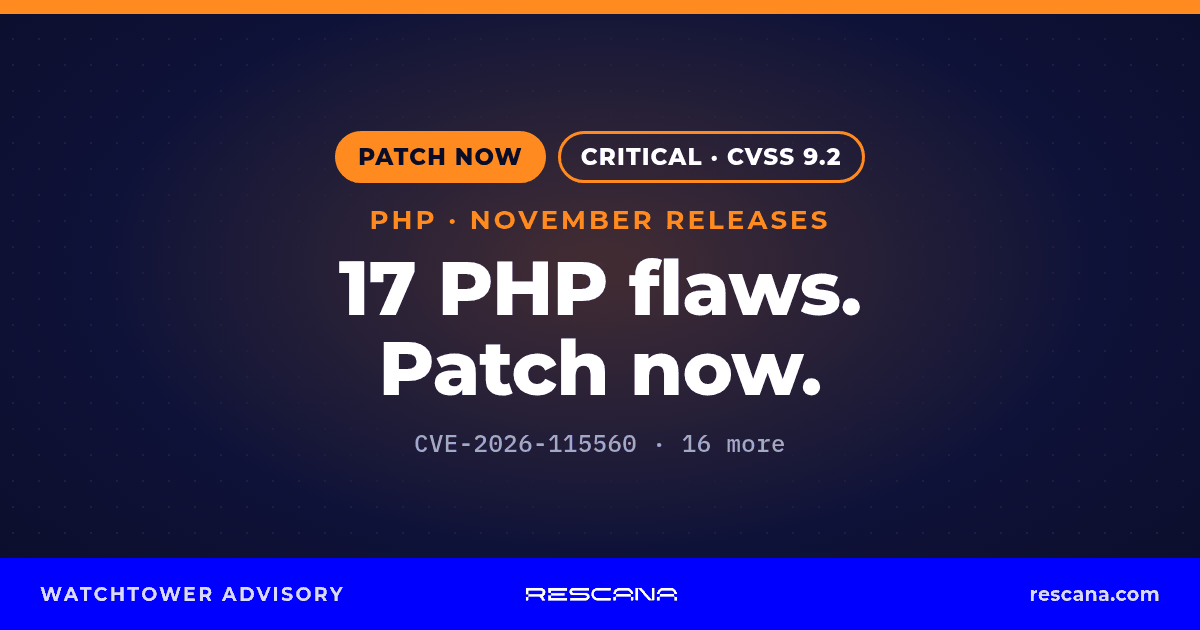
Status: PHP published security releases for all four supported branches at 09:00 EST on November 19, 2026: 8.5.13, 8.4.28, 8.3.37 and 8.2.36. PHP 8.6.0, the new major-line release, followed at 09:01 EST and carries the same fixes. PHP published 17 security advisories for these releases, and PHP's own CVSS 4.0 scores rate seven of them at 9.2 (Critical). NVD had not scored any of the 17 at 13:34 EST.
CVE-2026-115560 is not in CISA's Known Exploited Vulnerabilities (KEV) catalog. The other 16 CVEs in these releases are not listed either (catalog 2026.11.18, checked 13:39 EST on November 19). NVD's CISA-ADP SSVC entries read "exploitation: none" for all 17, and we found no report of exploitation in the wild. Exploit material does exist for some of them: PHP's own advisories describe reporter-demonstrated code execution for CVE-2026-115560, CVE-2026-129289, CVE-2026-129291 and CVE-2026-129496, depthfirst published a demonstration for CVE-2026-126714 on November 19, and public GitHub repositories describe themselves as proof-of-concept code for CVE-2026-115560. We have not run or validated any of it. The 8.5 and 8.6 ChangeLogs also list a bundled uriparser fix, CVE-2026-48841, for 18 CVE identifiers in all.
Executive Summary
PHP's November 18 notice said that "The issues rated CRITICAL require either non-default configuration or uncommon setups." The advisories and NVD records show what that means: several top-rated flaws need specific settings, such as session upload progress, a front end that reuses FastCGI connections, or a non-thread-safe build with a file-based error log. Others, such as CVE-2026-129496, can be reached by an unauthenticated remote client.
What to do (Rescana guidance). Upgrade every PHP 8.2 to 8.5 runtime to its November release, restart the workers, and check the result with php -v from the web server's own runtime. Rank by exposure: internet-facing PHP first, then anything that fetches URLs for users, accepts SOAP or Phar files, or shares sessions. Move any host still on the October releases straight to the November ones.
PHP 8.2 is close to the end. php.net's supported-versions table gives 8.2 security support until December 31, 2026. Plan its replacement.
Technical Information
Severity, as PHP scored it. These are PHP's CVSS 4.0 base scores as recorded in NVD, which listed all 17 records as "Received", with no NVD score yet. Treat them as the vendor's rating (Rescana's reading).
| Score band | CVEs |
|---|---|
| 9.2 (PHP's top score) | CVE-2026-115560, CVE-2026-126714, CVE-2026-129182, CVE-2026-129289, CVE-2026-129474, CVE-2026-129481, CVE-2026-129496 |
| 7.7 to 8.8 | CVE-2026-127960 (8.7), CVE-2026-128064 (8.2), CVE-2026-128090 (7.7), CVE-2026-129291 (8.8) |
| 5.3 to 6.9 | CVE-2026-129292 (5.3), CVE-2026-129438 (6.3), CVE-2026-129501 (6.3), CVE-2026-129506 (6.3), CVE-2026-129538 (6.9), CVE-2026-15353 (6.3) |
The seven rated 9.2, and what each needs, in NVD's words.
- CVE-2026-115560, session serializer mismatch (RCE). Session upload progress can store attacker-controlled data in a session key using the
php_binaryorphp_serializeserializer. If the same session is read with thephpserializer, becausesession.serialize_handleris changed at runtime or differs between applications sharing a session store, the bytes can reach the unserializer. A remote attacker able to submit a multipart upload can inject objects, which may lead to code execution when the application has a suitable gadget chain. PHP's October 23 advisory had already named this CVE. PHP's advisory (GHSA-658j-r8rw-q6mx) says the report included command execution using a Guzzle gadget on PHP 8.2.35, 8.3.36, 8.4.27 and 8.5.12, and with a Monolog gadget. - CVE-2026-126714, partially overwritten session files (RCE). The default
filessession handler writes into the existing file without clearing it, so an interrupted write can leave the start of the new session followed by the end of the old one, and ordinary string bytes can later be unserialized as objects. PHP's advisory says code execution needs a suitable gadget chain in the application. The researchers at depthfirst, who reported it, say in their November 19 write-up that they reached code execution by chaining it with a memory corruption bug in a PHP-native class instead, and published a full-chain demonstration (depthfirst's claim; PHP's advisory does not describe it). - CVE-2026-129289, PHP-FPM request smuggling. When the application has opened
php://inputwithout reading it to the end and the front end reuses backend connections, PHP-FPM can parse leftover bytes as a new FastCGI request. NVD says reuse is not the default in nginx or Apache and namesfastcgi_keep_conn onandmod_proxy_fcgiwithenablereuse=on. An unauthenticated remote attacker can then forge parameters such asSCRIPT_FILENAME,REMOTE_ADDRandPHP_ADMIN_VALUE, which can lead to execution of attacker-controlled PHP code. PHP's advisory (GHSA-qc49-hpvq-g2w6) describes a demonstrated PHP-FPM attack that needs no memory corruption, known addresses or race condition, and also names HAProxy FastCGI backends and LSAPI. - CVE-2026-129496, timezone cache use-after-free (RCE). It affects non-thread-safe builds with a file-based
error_log, when a diagnostic is written during module startup (NVD's examples are an invaliddate.timezoneor a session configuration warning). A later warning in a worker's first request, such asmax_input_vars, then touches freed memory. An unauthenticated remote attacker can crash PHP-FPM,mod_phpor CGI workers, and NVD says code execution may be possible and "has been demonstrated with known memory addresses". PHP's advisory (GHSA-gr4f-wgx5-jpfv) says native command execution was demonstrated locally in PHP-FPM and Apachemod_phpwith ASLR on, given known addresses and extra configuration, and calls a remote ASLR bypass plausible but not demonstrated. - CVE-2026-129474 (PHP 8.5 only), use-after-free in magic method backtraces. A fatal error such as exceeding
memory_limitwhile entering a__call()call can read stale values. It needsfatal_error_backtracesenabled (the default) andzend.exception_ignore_argsdisabled. NVD notes thatphp.ini-productionenableszend.exception_ignore_args, which prevents the issue. - CVE-2026-129182 (PHP 8.5 only), stale fatal-error backtrace. It needs per-path configuration of
max_memory_limit, or ofzlib.output_compressionwithoutput_handler, plus Apache per-directory configuration or aPHP_VALUEorPHP_ADMIN_VALUEparameter from the front end. NVD says it may allow remote code execution. - CVE-2026-129481, session shutdown use-after-free (8.3 to 8.5). NVD says an attacker who triggers a failing cleanup may crash the worker or corrupt memory, and that code execution has not been demonstrated.
The high-rated four. CVE-2026-129291 lets a local attacker who can run PHP code in an FPM worker crash the FPM master or run code with its privileges, "commonly root"; it needs catch_workers_output, which is off by default but, per NVD, on in the official PHP-FPM Docker images. PHP's advisory (GHSA-jm4m-qfqx-967m) says root command execution was reproduced from a www-data worker against unmodified PHP 8.5.12 Docker images (in a container, the master's privileges, not by itself an escape). CVE-2026-128090 lets someone who can modify an OpenSSL-signed Phar archive (but not its public key file) downgrade the signature type and pass verification. CVE-2026-128064 makes stream wrappers send HTTPS:// or FTPS:// URLs (mixed case) over plaintext. CVE-2026-127960 is a CPU denial of service through folded HTTP response headers.
The medium-rated six are a PHP-FPM status page XSS (CVE-2026-129292), a php-cgi out-of-bounds read and write with the default cgi.fix_pathinfo (CVE-2026-129538), two SOAP flaws (CVE-2026-15353, a heap disclosure, and CVE-2026-129506, a DTD use-after-free), a DOM serialization double free in PHP 8.4 and 8.5 (CVE-2026-129501) and an oversized-URI error in PHP 8.5's Uri\Rfc3986\Uri (CVE-2026-129438). NVD has no record for the uriparser entry, CVE-2026-48841.
Affected Product Versions
NVD's affected-version text, the same for every record unless noted: PHP 8.2 before 8.2.36, 8.3 before 8.3.37, 8.4 before 8.4.28 and 8.5 before 8.5.13.
| Branch | Fixed in | Count of CVEs in its ChangeLog | php.net support (security support until) |
|---|---|---|---|
| PHP 8.6 | 8.6.0 (new major-line release) | 17, plus uriparser (CVE-2026-48841) | December 31, 2030 |
| PHP 8.5 | 8.5.13 | 17, plus uriparser (CVE-2026-48841) | December 31, 2029 |
| PHP 8.4 | 8.4.28 | 14 | December 31, 2028 |
| PHP 8.3 | 8.3.37 | 13 | December 31, 2027 |
| PHP 8.2 | 8.2.36 | 12 | December 31, 2026 |
CVE-2026-129474, CVE-2026-129182 and CVE-2026-129438 affect only PHP 8.5, CVE-2026-129501 affects 8.4 and 8.5, and CVE-2026-129481 affects 8.3 to 8.5. Narrower start versions also apply: CVE-2026-127960 from 8.1.32, 8.2.28, 8.3.18 and 8.4.5 (PHP's advisory text says 8.3.19, its version range 8.3.18), and CVE-2026-129291 from 8.2.7. NVD lists no affected version for PHP 8.6, whose first stable release contains the fixes.
PHP 8.6.0 is not a patch release. php.net presents it as a major update with a migration guide. Treat it as a planned upgrade (Rescana guidance); for security the 8.2 to 8.5 patch releases are enough.
End of life. PHP's advisories, last updated between 13:42 and 13:51 EST, add affected-version notes based on code inspection: the flaws reach back to PHP 5.4.0 for CVE-2026-115560, 5.6.0 for CVE-2026-129289, 5.3.18 for CVE-2026-129496, 4.1.0 for CVE-2026-126714 and 8.1.20 for CVE-2026-129291. PHP's advisory for CVE-2026-127960, updated at 13:51 EST, also lists PHP 8.1.32 to 8.1.34 as affected with no fix. The November releases cover 8.2 to 8.6 only, and php.net's October 21 advisory says PHP 8.1 and older no longer receive updates from the PHP project. Treat PHP 8.1 and older as affected and unfixed by PHP unless your distribution or LTS vendor backports.
Distribution packages. A distribution patches its own version, so check the package changelog, not php -v (Rescana guidance): apt changelog php8.4-fpm on Debian or Ubuntu (use your package name), rpm -q --changelog php-fpm | grep -E 'CVE-2026-(115560|129289|129496)' on RHEL-family systems. At 13:39 EST, Debian's security tracker listed fixes for trixie (php8.4 8.4.28-1~deb13u1, DSA-6641-1) and bookworm (php8.2 8.2.36-1~deb12u1, DLA-4916-1), with unstable still vulnerable. Ubuntu's tracker listed php8.1 (22.04), php8.3 (24.04) and php8.5 as needing triage, with no fix, and Alpine's security database (v3.22, v3.23, edge) had no entry. Red Hat's security data API had no record for any of the 17 at 13:46 EST. In October, Red Hat shipped the fixes for CVE-2026-109618 and CVE-2026-109619 to its PHP 8.4, 8.3, 8.2 and 7.4 packages, so RHEL users should watch for Red Hat advisories and check rpm -q --changelog rather than the version number.
How to Find Your Exposure
(Rescana guidance, built from the NVD conditions above. Commands are read-only.)
- List every PHP runtime (FPM pools,
mod_php, CGI, containers, CI runners, bundled PHP), usingphp -vorphp-fpm -vfrom the runtime the web server uses, and the package version for distribution packages. - Mark the branch. 8.5 carries all 17; below 8.5.13, 8.4.28, 8.3.37 and 8.2.36 you are exposed to the ones in the table above.
- Read the settings behind the 9.2 flaws. For each pool check
session.upload_progress.enabled(an explicit=1overrides the new default),session.serialize_handler,zend.exception_ignore_args,cgi.fix_pathinfo,catch_workers_outputand the FPM status page. On the front end runnginx -T 2>/dev/null | grep -n fastcgi_keep_connandgrep -Rni enablereuse /etc/apache2 /etc/httpd, and check HAProxy FastCGI backends and LSAPI for persistent connections. - Check the build. For CVE-2026-129496, run
php -i | grep -E 'Thread Safety|error_log'with the runtime's own ini: non-thread-safe builds logging to a file are the affected case, and PHP says FPM's own error log does not count. Then read the error log for startup warnings such as an invaliddate.timezone. - Find code that fetches URLs through stream functions (CVE-2026-128064, CVE-2026-127960), then rank by reachability: internet-facing first, then partner-facing, then internal.
Exploitation Status
CISA's KEV catalog (version 2026.11.18, 1,786 entries, checked 13:39 EST on November 19) does not list CVE-2026-129496, and the same is true of every other CVE in the November releases. NVD carries a CISA-ADP SSVC entry for each of the 17 records, timestamped between 11:04 and 11:24 EST, with "exploitation: none" for all of them; the same entry reads "exploitation: active" for the October KEV flaws. We found no report of use in the wild.
Public exploit material does exist. For CVE-2026-115560, PHP's advisory says the report included command execution using Guzzle and Monolog gadgets. A GitHub search at 13:39 EST returned 28 repositories whose descriptions mention it. The earliest, created from October 20 EST, began as tools for the October flaws and now list it too; repositories describing themselves as proof-of-concept code for CVE-2026-115560 date from October 23, the day PHP named it. Others describe an exploit framework or a lab, and many are defensive scanners. We opened none. ZEST Security, the reporter, says it is not publishing exploit code. For CVE-2026-126714, depthfirst published a write-up on November 19 with a downloadable end-to-end demonstration, which it says achieves code execution (depthfirst's claim). PHP's advisories also describe demonstrated exploits for CVE-2026-129496, CVE-2026-129291 (root command execution against unmodified PHP 8.5.12 Docker images) and CVE-2026-129289 (one forged request, no memory corruption or race condition needed). One repository created on November 19 describes CVE-2026-129496. Searches for the other 15 CVE identifiers returned none. Rescana's reading: do not treat "none" as permanent, because SSVC entries are point-in-time.
Workaround and Mitigation
Vendor position. php.net says all users of the four supported branches are encouraged to upgrade. The release pages give no workaround, but PHP's GitHub advisories list temporary mitigations for most of these CVEs, and say none replaces the upgrade.
Interim measures, only until you can patch.
- Sessions (CVE-2026-115560, CVE-2026-126714), PHP's advisories. Keep
session.upload_progress.enabled=0in every configuration that can write to the session store, set administratively (php.ini, FPM pool or server configuration). PHP says "Callingini_set()from the application is too late." For CVE-2026-126714, also limit untrusted data stored in sessions. - FastCGI smuggling (CVE-2026-129289), PHP's advisory. Disable backend connection reuse (nginx
fastcgi_keep_conn, Apacheenablereuse, HAProxy FastCGI backends, LSAPI persistent connections) and do not expose PHP-FPM or LSAPI listeners to untrusted networks. - Backtrace flaws (CVE-2026-129474 and CVE-2026-129182, PHP 8.5), PHP's advisories. Set
zend.exception_ignore_args=1(CVE-2026-129474) orfatal_error_backtraces=0(both) in the configuration the workers use, then restart them. Changing only the CLI configuration is not enough. - Startup diagnostics (CVE-2026-129496), PHP's advisory. Fix configuration errors and deprecated settings that produce startup warnings and restart the master and all workers, or send PHP errors to syslog instead of a file.
- FPM (CVE-2026-129291, CVE-2026-129292, CVE-2026-129481), PHP's advisories. Disable
catch_workers_output(on in the official Docker images) and run the master without root; disable the status endpoint or its full HTML output;pm.max_requests=1blocks the demonstrated CVE-2026-129481 sequence, at a performance cost. - Phar signatures (CVE-2026-128090), PHP's advisory. Install the publisher's public key as
<archive>.pubkeythrough an authenticated channel, with permissions that stop the archive path from replacing it. - URL schemes (CVE-2026-128064), PHP's advisory. Write HTTPS and FTPS schemes in lowercase before stream functions, and if redirects are allowed, disable automatic redirects and validate each target.
Patch plan (Rescana guidance). Upgrade internet-facing hosts first. Test in staging, then restart, not reload, every FPM master, Apache with mod_php and CGI process manager, then confirm worker start times are after the upgrade, for example ps -o pid,lstart,cmd -C php-fpm8.4. Do not rely on a WAF rule: PHP's advisories describe configuration and memory triggers, not a request signature.
Expect one behavior change (PHP's advisory for CVE-2026-115560). The fix turns session upload progress off by default and rejects runtime changes to session settings, including session.serialize_handler, while it is enabled. Upload progress bars stop working unless you enable the feature explicitly, and PHP says that if you do, every reader and writer of a shared session store must use the same session.serialize_handler, even after the update. Test applications that call ini_set() on session settings first.
Containers (Rescana guidance). Restarting a container does not patch it: rebuild and redeploy. The official Docker fpm images for 8.5.13, 8.4.28, 8.3.37 and 8.2.36 appeared between 10:23 and 11:03 EST on November 19. Pin the branch tag, for example php:8.5-fpm: the bare and major tags, including php:latest, php:8 and php:fpm, now point to 8.6.0, so a rebuild on them is a major upgrade.
Indicators of Compromise
Neither PHP's advisories nor NVD publish indicators of compromise for these CVEs, and we list none.
What to hunt for (Rescana guidance). Most NVD descriptions name worker crashes. Review each host back to at least October 20, when the October releases appeared (proof-of-concept code for CVE-2026-115560 has been public since October 23), for:
- unexplained PHP-FPM,
mod_phpor CGI worker crashes and restarts, core files, and FPM master restarts on hosts usingcatch_workers_output; - FastCGI errors or unexpected parameters in front-end logs on hosts with connection reuse enabled;
- new or changed files under writable directories that Phar or session handling reads, and sessions with unexpected serialized objects: on hosts that had upload progress enabled, for example
grep -l 'upload_progress.*O:[0-9]' /var/lib/php/sessions/*(use yoursession.save_path); a hit is a lead and a miss proves nothing; - on FastCGI-reuse hosts, PHP-FPM access log entries for scripts with no matching front-end request, and requests whose PHP settings show
auto_prepend_fileorallow_url_includechanged; - outbound requests made over plaintext from code that should use TLS.
A crash alone is not a compromise; compare with deployment windows, and keep alerting on worker crashes until you have patched.
Timeline (EST)
- October 20, 2026, 19:05 to 19:35: PHP posts 8.5.12, 8.4.27, 8.3.36 and 8.2.35 and a security advisory (dated October 21 on php.net) fixing CVE-2026-109618 and CVE-2026-109619.
- October 23, 2026, 05:12: PHP's informational advisory names CVE-2026-115560 and the
session.upload_progress.enabled=0setting. - October 26, 2026: CISA adds CVE-2026-109618 and CVE-2026-109619 to KEV, due October 29.
- November 18, 2026, 12:09: PHP posts "Upcoming Critical PHP Security Release".
- November 19, 2026, 09:00: PHP posts 8.5.13, 8.4.28, 8.3.37 and 8.2.36. 09:01: PHP 8.6.0. 09:05 to 09:08: PHP publishes the 17 GitHub security advisories. 09:41 to 09:44: CVE records published.
- November 19, 2026, 10:17: NVD publishes the 17 records, with PHP's scores and status "Received". CISA-ADP SSVC entries follow between 11:04 and 11:24. depthfirst publishes its CVE-2026-126714 write-up the same day. Debian publishes DSA-6641-1 (trixie) and DLA-4916-1 (bookworm).
Third-Party Risk (TPRM) Angle
Suppliers can run PHP in portals, content management and e-commerce. You cannot see their php.ini, FPM pools or front-end settings, and several of these flaws depend on exactly those. Rescana guidance, questions for suppliers that run PHP in front of your data or users:
- Which PHP branch and exact version do you run in services that handle our data, and which are on 8.2, which ends security support on December 31, 2026?
- When did you deploy 8.5.13, 8.4.28, 8.3.37 or 8.2.36, or the matching distribution package, and how did you confirm every worker restarted on it?
- Do you use session upload progress or share a session store between applications with different
session.serialize_handlervalues? - Do you reuse FastCGI connections to PHP-FPM, and is the FPM status page enabled?
- Do you still run PHP 8.1 or older anywhere, and who supplies its security fixes?
Ask for evidence: php -v from the web runtime, the patch date and the effective settings. Follow up with any supplier still below the October releases, which fixed two flaws in CISA's KEV catalog.
Need help working out which suppliers run PHP applications that handle your data? Our team can help you prioritize them and track their answers. Talk to an expert
Sources
- PHP: PHP 8.5.13 release announcement, 8.4.28, 8.3.37, 8.2.36 and 8.6.0: November 19, 2026, 09:00 and 09:01 EST.
- PHP: ChangeLog for PHP 8: the per-branch security entries, read 13:39 EST, November 19, 2026.
- PHP: News archive 2026: the November 18 notice (12:09 EST), the October 23 informational advisory (05:12 EST) and the October 21 security advisory.
- PHP: Supported Versions: read 13:39 EST, November 19, 2026.
- PHP security advisories on GitHub (php/php-src), for example GHSA-658j-r8rw-q6mx, GHSA-qc49-hpvq-g2w6, GHSA-gr4f-wgx5-jpfv and 14 others, published 09:05 to 09:08 EST, last updated 13:42 to 13:51 EST.
- NVD API records for the 17 CVEs, for example CVE-2026-115560 and CVE-2026-129474: fetched 13:31 to 13:34 EST; status Received, last modified 12:17 to 13:18 EST; scores are PHP's CVSS 4.0. CVE-2026-109618 and CVE-2026-109619 give the October context. NVD has no record for CVE-2026-48841.
- CISA KEV catalog feed, JSON: read 13:39 EST, version 2026.11.18, 1,786 entries. CVE-2026-109618 and CVE-2026-109619 added 2026-10-26; none of the 17 November CVEs listed.
- depthfirst: phpAfterShell, from interrupted session writes to remote code execution: its claims are depthfirst's own.
- ZEST Security: PHP2Shell, the third one: the reporter's write-up of CVE-2026-115560.
- Distribution and container status, read 13:39 to 13:46 EST: Debian security tracker (DSA-6641-1, DLA-4916-1), Ubuntu CVE tracker, Red Hat security data API, Alpine security database and Docker Hub official php tags.