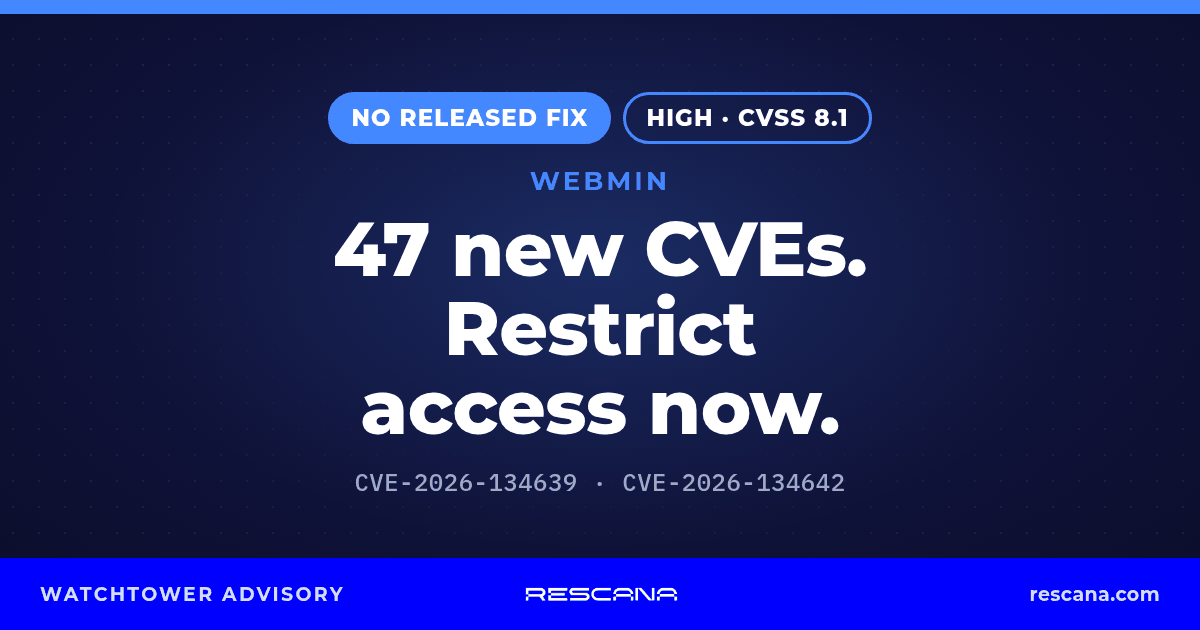
Status: Webmin versions through 2.670 are affected by a batch of 47 vulnerabilities assigned by CVE Numbering Authority (CNA) VulnCheck and published on November 24, 2026 (CVE.org from 10:20 p.m. EST; NVD at 11:17 p.m. EST, 2026-11-25T04:17 UTC), with nine vulnerabilities rated CVSS 3.1 High (7.4 to 8.1). The most severe issues allow unauthenticated access with default Windows setup credentials (admin/admin over plain HTTP), root code execution during cluster FastRPC file transfers or plaintext RPC calls, root code execution or package tampering via plaintext HTTP downloads and bypassed GnuPG checks, and root file overwrites through the Minecraft module's playtime cron job. No fixed release has shipped yet: Webmin 2.670 (September 20, 2026) remains the latest published release on Webmin's download site and GitHub Releases as of 1:25 a.m. EST on November 25, 2026. Although CHANGELOG.md on the master branch carries an unreleased 2.680 heading and maintainers committed partial fixes on master for a future release, no 2.680 package exists and several download-integrity fixes remain unimplemented. As of our check, no source we opened reports exploitation in the wild.
CVE-2026-134639 is not in CISA's Known Exploited Vulnerabilities (KEV) catalog.
None of the other eight primary CVEs in this advisory (CVE-2026-134642, CVE-2026-134647, CVE-2026-134630, CVE-2026-134326, CVE-2026-134283, CVE-2026-134438, CVE-2026-134638 and CVE-2026-134644) appear in CISA catalogVersion 2026.11.24 (1,795 entries, released 12:47 p.m. EST on November 24, 2026).
Executive Summary
Webmin is a widely deployed web-based system administration interface for Unix, Linux and Windows servers, often exposed on port 10000 and running with root privileges. The batch stems from researcher Armin Šupuk's November 2026 security audit of Webmin 2.670, reported in Webmin GitHub issue #2941. Nine issues reach High severity under CVSS 3.1 (7.4 to 8.1), while the remaining 38 CVEs carry CVSS 3.1 scores from 3.9 to 6.5.
| CVE | Component | Precondition and Impact | CVSS 3.1 / 4.0 (CNA) | Master Branch Status (Unreleased) |
|---|---|---|---|---|
| CVE-2026-134639 | Windows setup.bat |
Provisions admin/admin with SSL off on port 10000 |
8.1 / 9.2 | No fix commit |
| CVE-2026-134642 | fastrpc.cgi |
Unauthenticated connection to cluster file-transfer sockets; root RCE | 7.5 / 7.7 | Fixed on master (0678fbfa6) |
| CVE-2026-134647 | web-lib-funcs.pl, fastrpc.cgi |
Cleartext cluster RPC over raw TCP despite SSL config; root RCE | 7.5 / 7.7 | Fixed on master (aca804236, 63666bd62) |
| CVE-2026-134630 | Perl Modules (cpan/download.cgi) |
Plaintext HTTP CPAN download runs Makefile.PL as root |
7.5 / 7.7 | No fix commit |
| CVE-2026-134326 | webmin/webmin-lib.pl |
Installs unsigned module updates if GnuPG setup fails | 7.5 / 7.7 | Fixed on master (f502e624d) |
| CVE-2026-134283 | web-lib-funcs.pl (http_download) |
Skips TLS certificate chain and hostname checks | 7.5 / 7.7 | Deferred per issue #2941 |
| CVE-2026-134438 | webmin/cluster-* upgrade.cgi |
Plaintext HTTP upgrade downloads; GnuPG off by default | 7.5 / 7.7 | Partial: upgrade signature checks on by default (d8cb97ada, webmin-lib.pl); no commits to the three upgrade.cgi files; HTTP unchanged |
| CVE-2026-134638 | usermin/upgrade.cgi |
Plaintext HTTP Usermin upgrade without signature checks | 7.5 / 7.7 | No fix commit |
| CVE-2026-134644 | minecraft/minecraft-lib.pl |
Path traversal via chat messages overwrites files as root | 7.4 / 8.3 | Fixed on master (f178e3149) |
Most of these nine flaws require a specific configuration or network position, such as an on-path attacker intercepting outbound fetches, active Webmin cluster FastRPC operations, a Windows installation from setup.bat or an enabled Minecraft module.
What to do first (Rescana guidance):
- Restrict network access to Webmin port 10000 and FastRPC ports so management interfaces and cluster RPC listeners are reachable only over VPNs or trusted administrative subnets.
- Audit any Windows Webmin servers immediately for an
adminaccount using default credentials or plain HTTP, rotate passwords and enforce HTTPS. - Stop using Webmin's built-in web UI updaters and CPAN installer until upstream ships signed TLS-verified updates; apply updates only through signed operating system package repositories.
Technical Information
This section uses only published VulnCheck, CVE.org, NVD and Webmin GitHub repository records. We do not describe an exploit.
Windows default credentials (CVE-2026-134639, CWE-1392). According to VulnCheck, Webmin's Windows setup.bat script provisions an administrator account with default admin/admin credentials and disables SSL. An unauthenticated attacker reaching port 10000 over HTTP can sign in and obtain full Webmin administrative control if those defaults remain unchanged. VulnCheck assigns a CVSS 3.1 base score of 8.1 (High) and a CVSS 4.0 score of 9.2.
Cluster FastRPC exposure (CVE-2026-134642, CWE-306; CVE-2026-134647, CWE-319). In fastrpc.cgi, tcpwrite and tcpread file-transfer listener sockets accept connections without verifying an active RPC session (CVE-2026-134642). A network peer that connects to these sockets during cluster file operations can read transferred files or replace staged packages, leading to root code execution. Separately, web-lib-funcs.pl and fastrpc.cgi send cluster RPC traffic over raw TCP even when SSL is configured (CVE-2026-134647), allowing an on-path attacker to read session IDs and remote_eval payloads or modify calls in transit to run code as root on managed hosts.
Plaintext fetches, TLS bypass and signature gaps (CVE-2026-134630, CVE-2026-134326, CVE-2026-134283, CVE-2026-134438, CVE-2026-134638). Five issues affect how Webmin fetches code and updates over the network:
- CVE-2026-134630 (CWE-494): The Perl Modules (
cpan/download.cgi) installer fetches CPAN indexes and module archives over plaintext HTTP without checksum or signature checks and runsMakefile.PLas root before confirmation. - CVE-2026-134326 (CWE-347): In
webmin/webmin-lib.pl, module update installs bypass cryptographic signature checks when GnuPG setup fails, allowing tampered or unsigned modules to run as root. - CVE-2026-134283 (CWE-295): The shared
http_downloadhelper inweb-lib-funcs.plskips TLS certificate chain and hostname verification, allowing an on-path attacker to substitute downloaded modules, themes or catalog content. - CVE-2026-134438 (CWE-494):
webmin/upgrade.cgi,cluster-webmin/upgrade.cgiandcluster-usermin/upgrade.cgidownload upgrade packages over plaintext HTTP with GnuPG signature verification disabled by default, enabling on-path substitution of RPM, Debian or tarball packages executed as root. - CVE-2026-134638 (CWE-494):
usermin/upgrade.cgidownloads Usermin upgrade packages over plaintext HTTP without signature or digest checks.
Minecraft Server playtime path traversal (CVE-2026-134644, CWE-22). When the Minecraft Server module's playtime tracking is enabled, minecraft/minecraft-lib.pl parses player chat logs without validating them, so chat content from an unauthenticated player can steer the root check_playtime_limits cron job into overwriting arbitrary files (CVSS 3.1 7.4 High; CVSS 4.0 8.3).
Broader 47-CVE audit batch. All 47 CVEs share the same November 25, 2026 04:17 UTC NVD publication window (where NVD lists vulnStatus: Deferred and displays CNA VulnCheck scores). The 44 CVE.org records we checked credit security researcher Armin Šupuk as finder, with Webmin maintainer Ilia Ross credited as remediation developer on CVE-2026-134642 and CVE-2026-134647. The remaining 38 CVEs carry CVSS 3.1 scores from 3.9 to 6.5, covering issues such as empty-hash authentication bypass in password_change.cgi, plaintext or unverified TLS in LDAP, IMAP and SMTP connections and the SMTP service monitor, command injection in LDAP client checks, weak randomness in password/TOTP generation, and stored cross-site scripting across multiple modules.
Affected Products and Release Status
- Affected: Webmin through 2.670 (all platforms where the corresponding modules or scripts are used;
CVE-2026-134639applies specifically to Windows installations usingsetup.bat). - Published release status: Webmin 2.670, released September 20, 2026 (GitHub release published September 21, 2026 UTC), remains the latest official release on webmin.com/download/, webmin.com/changelog/, Webmin's YUM repository and GitHub Releases (whose Releases and Tags lists show no
2.680). - Upstream
masterbranch status (unreleased): Webmin'smasterbranchCHANGELOG.mdcontains an unreleased2.680 (November 21, 2026)section listing TLS for FastRPC calls and file transfers (implemented inaca804236and63666bd62); the earlier FastRPC transfer authentication fix (0678fbfa6, October 15) is onmasterbut is not listed in that section. On issue #2941, maintainer Ilia Ross stated that fixes for findings crossing a real security boundary are in commits237d57ec4throughece49ad15onmasterand will be in the next Webmin release, while downloads skipping certificate or signature checks require a larger change and will be handled separately. Commits to the affected files include Minecraft playtime (f178e3149), GnuPG bypass (f502e624d), default upgrade signature checks (d8cb97ada) and empty-hash password changes (b82a7cfea);setup.bat,cpan/download.cgiandusermin/upgrade.cgishow no commits since 2.670.
How to Find Your Exposure
- Inventory every Webmin and Usermin host across cloud, on-premises and Windows environments, recording version, exposed listening ports and whether port 10000 is reachable from untrusted networks (Rescana guidance).
- Check Windows deployments for default accounts and HTTP-only access: Verify whether
adminexists with weak or default credentials and whether MiniServ SSL is enabled (Rescana guidance). - Check for Webmin clustering and Registered Servers: Confirm whether FastRPC (
fastrpc.cgi) is used between hosts, and identify which network paths carry cluster RPC or file transfers (Rescana guidance). - Review active modules and update workflows: Check whether the Perl Modules (
cpan), Minecraft Server or web-based Webmin/Usermin upgrade features are enabled or scheduled (Rescana guidance).
Workaround and Mitigation
Because no fixed Webmin release has shipped as of 1:25 a.m. EST on November 25, 2026, apply the following compensating controls immediately (Rescana guidance):
- Remove public exposure to Webmin. Place port 10000 (and any FastRPC ports) behind a VPN, bastion host or strict IP allowlist so untrusted clients cannot reach login pages,
fastrpc.cgiorpassword_change.cgi. - Secure Windows installations immediately. If Webmin was installed via
setup.bat, rotate or disable theadminaccount, confirm no accounts carry empty password hashes, and enforce TLS on MiniServ before allowing network access. - Isolate FastRPC cluster traffic. Restrict cluster RPC communication to private management VLANs or encrypted tunnels (such as SSH or WireGuard) until an official release containing the FastRPC authentication and TLS fixes ships and remote cluster peers are upgraded before the controller, as the 2.680 changelog requires.
- Disable insecure in-app download and upgrade workflows. Avoid installing Perl modules through Webmin's
cpanmodule and avoid upgrading Webmin, Usermin or Webmin modules via the built-in HTTP web UI fetchers. Instead, upgrade Webmin via signed OS package managers (aptordnf) over verified HTTPS repositories, and verify GnuPG signatures manually on offline packages. - Disable Minecraft playtime limits if unused. If the Minecraft Server module is active, disable
check_playtime_limitsor restrict untrusted player access until a release containing theminecraft-lib.pltraversal fix is published. - Monitor for the next official Webmin release on
webmin.comrather than deploying unverified snapshots, and review webmin.com/security/ for follow-up advisories covering download TLS verification.
Timeline (EST)
- September 20, 2026: Webmin releases version 2.670, the latest packaged release currently available.
- November 20, 2026, 7:44 a.m. EST: Researcher Armin Šupuk opens GitHub issue #2941 referencing a security audit of Webmin 2.670.
- November 21, 2026, 11:24 a.m. EST:
CHANGELOG.mdonmasteris updated under an unreleased2.680 (November 21, 2026)heading; no2.680tag or release exists. - November 23, 2026, 5:15 p.m. EST: Maintainers commit fixes on
masterfor Minecraft playtime traversal, GnuPG update checks, default upgrade signature verification and empty-hash password changes (f178e3149,f502e624d,d8cb97ada,b82a7cfea). - November 23, 2026, 7:23 p.m. EST: Maintainer Ilia Ross posts on issue #2941 that fixes in commits
237d57ec4throughece49ad15will ship in the next Webmin release, while download TLS/signature fixes require separate work. - November 24, 2026, 10:20 to 10:21 p.m. EST: CVE.org publishes the VulnCheck-assigned CVE records (2026-11-25T03:20 UTC).
- November 24, 2026, 11:17 p.m. EST: NVD publishes the 47 Webmin CVE records (2026-11-25T04:17 UTC) with
vulnStatus: Deferredand CNA VulnCheck scores. - November 25, 2026, 1:09 to 1:25 a.m. EST: Our verification confirms 2.670 remains the latest published release, no
2.680tag or release exists, none of the 47 CVEs appear in CISA KEV (2026.11.24), and no exploitation is reported.
Third-Party Risk (TPRM) Angle
Hosting providers, managed service providers and Linux/Windows server operators frequently run Webmin on customer-facing or internal infrastructure, sometimes exposing port 10000 directly to the internet. An exposed default Windows install or compromised cluster controller gives an attacker root-level access across managed servers (Rescana guidance).
Questions that give a usable answer:
- Do any suppliers or managed infrastructure partners expose Webmin (2.670 or earlier) on port 10000 or use Webmin FastRPC clustering?
- If Webmin runs on Windows or in a cluster, have you verified that default
admincredentials are disabled, TLS is enforced and port 10000 is restricted to trusted networks? - Have you disabled Webmin's built-in HTTP upgrade and CPAN download features while awaiting the next official signed release?
Need help identifying suppliers exposing Webmin or verifying their compensating controls? Our team can help prioritize vendor outreach and track remediation. Talk to an expert
Sources
- Webmin GitHub Issue #2941 (audit disclosure and maintainer response on
masterfixes and deferred download TLS/signature changes; read November 25, 2026). - Webmin GitHub CHANGELOG.md (master) (unreleased 2.680 draft entries and 2.670 release date September 20, 2026; read November 25, 2026).
- Webmin Download, Webmin Changelog and Webmin Security (confirming 2.670 remains the latest published release; read November 25, 2026).
- NVD: CVE-2026-134639 and NVD: CVE-2026-134642 (published November 24, 2026, 11:17 p.m. EST;
vulnStatus: Deferred; CNA VulnCheck scores and full 47-CVE NVD API batch checked November 25, 2026). - CVE.org: CVE-2026-134642 (CVE List records checked November 25, 2026: 44 cached CVE.org records for finder credits, CWE classifications and timestamps).
- VulnCheck CNA advisories for the nine primary CVEs, including CVE-2026-134639 (Windows setup.bat), CVE-2026-134642 (fastrpc.cgi sockets), CVE-2026-134647 (FastRPC cleartext), CVE-2026-134630 (CPAN RCE), CVE-2026-134326 (GnuPG bypass), CVE-2026-134283 (http_download TLS), CVE-2026-134438 (upgrade.cgi), CVE-2026-134638 (Usermin upgrade.cgi) and CVE-2026-134644 (Minecraft playtime) (read November 25, 2026).
- CISA: Known Exploited Vulnerabilities catalog JSON feed (catalogVersion 2026.11.24, 1,795 entries; none of the 47 CVEs listed; checked 1:09 a.m. EST, November 25, 2026).