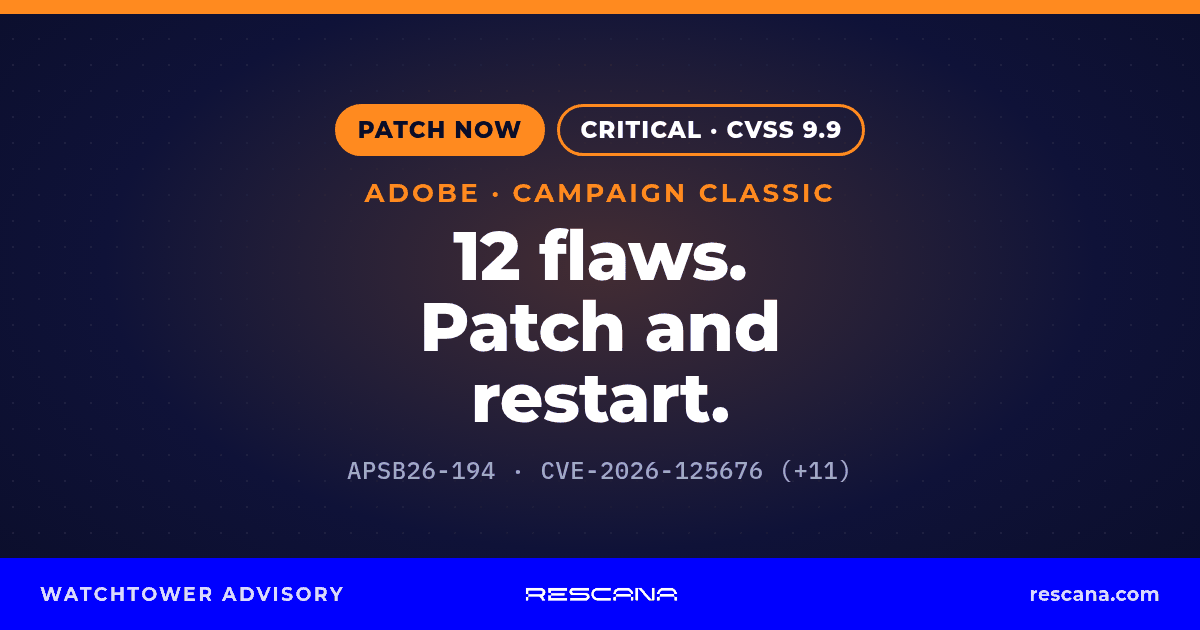
Status: On 24 November 2026, Adobe published security bulletin APSB26-194 (Priority 2) for Adobe Campaign Classic on Windows and Linux, covering 12 critical vulnerabilities rated between CVSS 3.1 9.0 and 9.9. Seven are CVSS 9.9 code-injection flaws (CWE-94) that allow a low-privilege user on the network to run arbitrary code with no user interaction and changed scope. Adobe states it is not aware of any exploits in the wild for any of these issues. The fixed builds, 7.4.4 build 9404 and 7.4.5 build 9421, reached General Availability on 18 November 2026, six days before the bulletin, and require an nlserver restart to take effect. Adobe-hosted instances have already been remediated; customers running on-premise or hybrid deployments must install the update themselves.
CVE-2026-125676, CVE-2026-125675, CVE-2026-123987, CVE-2026-123986, CVE-2026-123723, CVE-2026-123722, CVE-2026-123342, CVE-2026-125717, CVE-2026-123721, CVE-2026-125716, CVE-2026-125718 and CVE-2026-125723 are not in CISA's Known Exploited Vulnerabilities (KEV) catalog.
Executive Summary
Adobe Campaign Classic servers manage customer marketing databases and outbound email and message delivery. Under Adobe's hosting documentation, Managed Services (hosted) environments are fully hosted, installed and configured by Adobe, while on-premise customers manage all software and hardware updates themselves. Hybrid deployments keep the Campaign marketing instance and personally identifiable information on-premise inside the customer's firewall while using Adobe's cloud only for execution, so hybrid customers must patch their on-premise server too.
All twelve are network-reachable with Changed scope (S:C). Eleven need only a low-privilege account (PR:L), and ten of those need no user interaction (UI:N); the stored XSS flaw CVE-2026-125723 needs a victim to view a page (UI:R). Reflected XSS CVE-2026-125716 (CVSS 9.3) needs no account (PR:N), only a victim who opens a crafted URL or page.
| Branch | Affected builds | Fixed build | Deployment scope |
|---|---|---|---|
| Campaign Classic 7.4.5 | Build 9420 and earlier | 7.4.5 build 9421 | On-premise and hybrid (Windows, Linux) |
| Campaign Classic 7.4.4 | Build 9403 and earlier | 7.4.4 build 9404 | On-premise and hybrid (Windows, Linux) |
| Adobe-hosted (Managed Services) | Remediated by Adobe | Remediated | No customer action required per release notes |
What to do first (Rescana guidance):
- Confirm your hosting model and build number using
Help > About...in the Adobe Campaign Client console, and prioritize any internet-facing or contractor-accessible on-premise or hybrid instance. - Update to 7.4.4 build 9404 or 7.4.5 build 9421 after taking a database backup, then restart
nlserver. The release notes state that the fix is active by default only afternlserverrestarts. - Align Client Consoles to the updated server build so operators do not remain on mismatched clients.
Technical Information
This section uses only Adobe's security bulletin, Adobe's Campaign Classic release notes, and the CVE.org and NVD records published by Adobe as CVE Numbering Authority (CNA). We do not describe exploit techniques or proof-of-concept material.
| CVE | Weakness | Impact | CVSS 3.1 (Adobe CNA) | Vector |
|---|---|---|---|---|
| CVE-2026-125676 | Code Injection (CWE-94) | Arbitrary code execution | 9.9 Critical | AV:N/AC:L/PR:L/UI:N/S:C/C:H/I:H/A:H |
| CVE-2026-125675 | Code Injection (CWE-94) | Arbitrary code execution | 9.9 Critical | AV:N/AC:L/PR:L/UI:N/S:C/C:H/I:H/A:H |
| CVE-2026-123987 | Code Injection (CWE-94) | Arbitrary code execution | 9.9 Critical | AV:N/AC:L/PR:L/UI:N/S:C/C:H/I:H/A:H |
| CVE-2026-123986 | Code Injection (CWE-94) | Arbitrary code execution | 9.9 Critical | AV:N/AC:L/PR:L/UI:N/S:C/C:H/I:H/A:H |
| CVE-2026-123723 | Code Injection (CWE-94) | Arbitrary code execution | 9.9 Critical | AV:N/AC:L/PR:L/UI:N/S:C/C:H/I:H/A:H |
| CVE-2026-123722 | Code Injection (CWE-94) | Arbitrary code execution | 9.9 Critical | AV:N/AC:L/PR:L/UI:N/S:C/C:H/I:H/A:H |
| CVE-2026-123342 | Code Injection (CWE-94) | Arbitrary code execution | 9.9 Critical | AV:N/AC:L/PR:L/UI:N/S:C/C:H/I:H/A:H |
| CVE-2026-125717 | SQL Injection (CWE-89) | Privilege escalation | 9.6 Critical | AV:N/AC:L/PR:L/UI:N/S:C/C:H/I:H/A:N |
| CVE-2026-123721 | Incorrect Authorization (CWE-863) | Privilege escalation | 9.6 Critical | AV:N/AC:L/PR:L/UI:N/S:C/C:H/I:H/A:N |
| CVE-2026-125716 | Reflected XSS (CWE-79) | Privilege escalation | 9.3 Critical | AV:N/AC:L/PR:N/UI:R/S:C/C:H/I:H/A:N |
| CVE-2026-125718 | SQL Injection (CWE-89) | Security feature bypass | 9.1 Critical | AV:N/AC:L/PR:L/UI:N/S:C/C:H/I:L/A:L |
| CVE-2026-125723 | Stored XSS (CWE-79) | Privilege escalation | 9.0 Critical | AV:N/AC:L/PR:L/UI:R/S:C/C:H/I:H/A:H |
- Code Injection (
CWE-94, seven CVEs, CVSS 9.9): Adobe's CNA records state that each of these seven vulnerabilities allows a low-privilege attacker over the network, without user interaction, to execute arbitrary code in the context of the current user, with Changed scope and High confidentiality, integrity and availability impact. - SQL Injection (
CWE-89, CVE-2026-125717 at 9.6 and CVE-2026-125718 at 9.1): Both allow a low-privilege attacker without user interaction to abuse SQL queries. Adobe classifiesCVE-2026-125717as privilege escalation (C:H/I:H/A:N) andCVE-2026-125718as security feature bypass yielding unauthorized read and limited write access (C:H/I:L/A:L). - Incorrect Authorization (
CWE-863, CVE-2026-123721, CVSS 9.6): A low-privilege attacker without user interaction can gain elevated access to sensitive resources. - Cross-Site Scripting (
CWE-79, CVE-2026-125716 at 9.3 and CVE-2026-125723 at 9.0):CVE-2026-125716is a reflected XSS issue requiring no privileges (PR:N) when a victim visits a crafted URL or interacts with a compromised web page, enabling elevated access or session takeover.CVE-2026-125723is a stored XSS flaw where a low-privilege attacker injects script into vulnerable form fields, running in a victim's browser when they view that page and impacting confidentiality, integrity and availability. - Credit and NVD status: Adobe credits researcher
edrafor reporting seven of the vulnerabilities (CVE-2026-125676,CVE-2026-125675,CVE-2026-123987,CVE-2026-123986,CVE-2026-123722,CVE-2026-123342andCVE-2026-123721). No researcher is listed for the remaining five. All twelve NVD records currently sit in Awaiting Analysis and carry Adobe's CNA scores.
Affected Products and Fixed Versions
- Affected: Adobe Campaign Classic 7.4.4 build 9403 and earlier and 7.4.5 build 9420 and earlier on Windows and Linux.
- Fixed: Adobe Campaign Classic 7.4.4 build 9404 and 7.4.5 build 9421, both released to General Availability on 18 November 2026.
- Deployment scope: APSB26-194 says the update applies to on-premise deployments; the release notes also urge hybrid customers to update and confirm Adobe-hosted instances are already remediated.
How to Find Your Exposure
- Inventory every Campaign Classic deployment across production, staging and regional instances, and confirm whether each is Adobe-hosted, hybrid or on-premise (Rescana guidance).
- Check the server and console build in the Adobe Campaign Client console via
Help > About...as documented in Adobe's build upgrade FAQ. Any on-premise or hybrid instance on7.4.4 build 9403or earlier, or7.4.5 build 9420or earlier, is in scope. - Review who holds low-privilege accounts on on-premise and hybrid instances, including marketing operators, agencies and integration accounts, because eleven of the twelve flaws require
PR:LandCVE-2026-125716requires no account at all (Rescana guidance).
Workaround and Mitigation
Adobe lists no workaround or configuration toggle in APSB26-194 or the release notes; updating to a fixed build is the remediation. Follow Adobe's published build upgrade process:
- Back up the database on every instance before applying the build update, as recommended in Adobe's upgrade documentation.
- On Windows, stop web services and
nlserver6(iisreset /stop,net stop nlserver6, and thewebmdlredirection server), then confirm withnlserver pdumpthat no tasks remain active before replacing files. - Install 7.4.4 build 9404 or 7.4.5 build 9421. On Windows, run
Setup.exe(Update or Repair), then runnlserver config -postupgrade -allinstancesonce, only on annlserver webapplication server, to synchronize resources and update schemas and the database. On Linux, install the updated RPM (yum update) or DEB (apt install) package; resources synchronize automatically, though you should check for errors, then stop and restart Apache (orhttpd). - Restart
nlserverand the web server. Adobe's release notes specify that annlserverrestart is required to load the build and that the security fix is active by default once restarted. - Update Client Consoles so operator consoles match the new server build, per Adobe's build upgrade FAQ.
- Confirm completion by verifying in
Help > About...that the server build reports9404or9421, and restrict network exposure of Campaign Classic operator and web interfaces to trusted networks where possible (Rescana guidance).
Indicators of Compromise
Adobe reports no exploitation in the wild for any of the twelve CVEs in APSB26-194 and has published no indicators of compromise. No third-party primary source we checked reports live exploitation, and no proof-of-concept code was opened or linked.
Timeline (EST)
- 18 November 2026: Adobe Campaign Classic 7.4.4 build 9404 and 7.4.5 build 9421 reach General Availability with security updates requiring an
nlserverrestart, six days before the security bulletin is published. - 24 November 2026: Adobe publishes APSB26-194 (Priority 2), noting no known exploits in the wild.
- 24 November 2026, 12:47 p.m. EST: CVE.org publishes all twelve Adobe CNA CVE records (
17:47UTC), and CISA releases KEVcatalogVersion 2026.11.24(1,795 entries) with none of the twelve CVEs listed. - 24 November 2026, 1:18 p.m. EST: NVD publishes all twelve CVE records (
18:18UTC) inAwaiting Analysisstatus. - 25 November 2026, 1:10 a.m. EST: Our source check finds no EPSS scores (0 records) and no exploitation reports in Adobe's bulletin or the other primary sources opened.
Third-Party Risk (TPRM) Angle
Marketing agencies, fulfillment partners and regional business units often run on-premise or hybrid Adobe Campaign Classic instances holding customer contact databases and email or SMS sending credentials. A single compromised low-privilege agency account on an unpatched server is enough to reach the seven CVSS 9.9 code-injection flaws (Rescana guidance).
Questions that give a usable answer (Rescana guidance):
- Do you run Adobe Campaign Classic in an on-premise or hybrid deployment that stores or sends our customer data?
- What exact build is the server running today (
7.4.4 build 9404or7.4.5 build 9421, or an earlier build)? Note that7.4.4 build 9403(15 October 2026) also carried security updates in Adobe's release notes, yet build 9403 remains affected by APSB26-194. - Was
nlserverrestarted after installing the build, and did you confirm the updated build number inHelp > About...?
Need help checking which marketing or email vendors run on-premise Adobe Campaign Classic and verifying their build status? Our team can help track supplier responses and prioritize follow-ups. Talk to an expert
Sources
- Adobe Security Bulletin APSB26-194: Security update available for Adobe Campaign Classic (published 24 November 2026; CVEs, CVSS 3.1 scores and vectors, affected and fixed builds, Priority 2, researcher credit, exploitation statement; read 25 November 2026).
- Adobe Experience League: Adobe Campaign Classic Latest Release (updated 18 November 2026; 7.4.5 build 9421 and 7.4.4 build 9404 GA dates, on-premise and hybrid guidance, Adobe-hosted remediation status,
nlserverrestart requirement; read 25 November 2026). - Adobe Experience League: Campaign Classic Hosting Models (updated 5 October 2026; Managed Services/Hosted vs. on-premise vs. hybrid architecture; read 25 November 2026).
- Adobe Experience League: Upgrading to a new build (on-premise) and Build upgrade FAQ (database backup,
nlserver pdump,nlserver config -postupgrade -allinstances,Help > About..., Client Console alignment; read 25 November 2026). - NVD records for all twelve CVEs (via NVD CVE API v2.0) and CVE.org CNA records (published 24 November 2026 at 12:47 p.m. EST on CVE.org and 1:18 p.m. EST on NVD, Awaiting Analysis; checked 1:10 a.m. EST, 25 November 2026).
- CISA: Known Exploited Vulnerabilities catalog, JSON feed (
catalogVersion 2026.11.24, 1,795 entries; none of the twelve CVEs listed; checked 1:10 a.m. EST, 25 November 2026) and FIRST EPSS API (0 records returned; checked 1:10 a.m. EST, 25 November 2026).