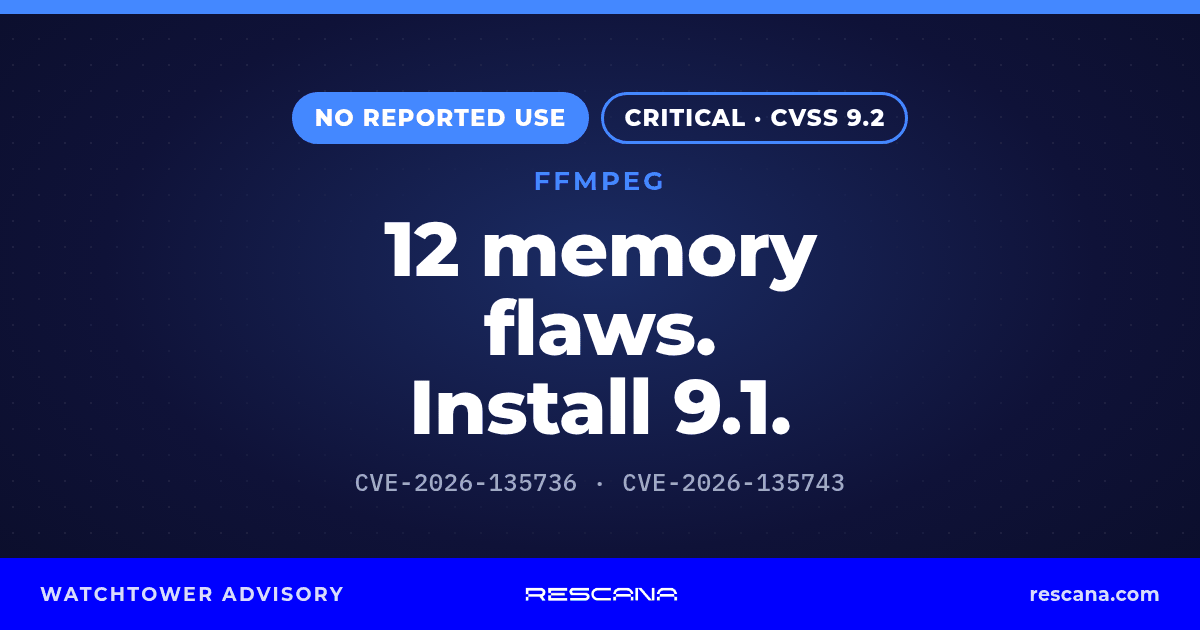
Status: FFmpeg versions before 9.1 have a cluster of 12 memory-corruption CVEs that the National Vulnerability Database (NVD) published at 23:17 EST on November 23, 2026 (NVD timestamps 2026-11-24T04:17:27 through 2026-11-24T04:17:33, which we treat as UTC). VulnCheck is the CVE Numbering Authority (CNA). The highest CNA scores are CVSS 4.0 9.2 (Critical) on CVE-2026-135736 and CVE-2026-135743, both with a network attack vector. CVE-2026-135742 is also scored AV:N, at CVSS 4.0 8.7 (High). The other nine are High with local attack vectors. NVD lists every record as Awaiting Analysis and has not published an NVD score of its own. The CNA, NVD and OSV ranges for these twelve IDs end at FFmpeg 9.1, which the download page lists as released on 2026-11-20. As of 01:49 EST on November 24, 2026, no source we opened reports exploitation in the wild. CVE-2026-135736 is not in CISA's Known Exploited Vulnerabilities (KEV) catalog. The other eleven memory-corruption CVEs in this cluster, and CVE-2026-135733 and CVE-2026-135739, are also not in the KEV catalog (catalogVersion 2026.11.23, released at 14:43 EST on November 23, 2026, with 1,792 entries). We checked the sources between 01:48 and 01:49 EST on November 24, 2026.
Executive Summary
FFmpeg is the multimedia library and tool many products use to process audio and video. This advisory covers 12 memory-corruption CVEs in FFmpeg before 9.1: heap and stack overflows, out-of-bounds writes and a double free in demuxers, muxers and filters. Two are scored CVSS 4.0 9.2. Three have a network attack vector, which the CNA ties to runtime filter commands, including an unauthenticated zmq or azmq filter. The CNA, NVD and OSV records say all twelve are fixed in FFmpeg 9.1.
Install 9.1, or a vendor package with the equivalent fixes, then restart every process that loads the library. The official FFmpeg security page, the n9.1 RELEASE_NOTES and the n9.1 Changelog we retrieved do not list these twelve IDs. We rely on the CNA, NVD and OSV records for the fixed release.
Two same-day records sit outside that set and still matter. CVE-2026-135739 is an out-of-bounds read in the scale filter, scored by the CNA at CVSS 4.0 8.3 and CVSS 3.1 6.5, with a network vector. It affects FFmpeg 7.1 before 9.1 and is fixed in 9.1. CVE-2026-135733 is different: the CNA titles it "FFmpeg through 9.1 Insecure Default Binding in zmq and azmq Filters," scores it CVSS 4.0 6.9, and lists versions through 9.1 as affected. Updating to 9.1 does not, according to the CNA, close that default.
FFmpeg is often shipped inside other products, containers and appliances. As Rescana guidance, inventory those bundled copies, ask the vendor which FFmpeg version they ship, rebuild or upgrade to 9.1, and restart the service that loads the library. If you enable zmq or azmq, follow the socket guidance under Workaround and Mitigation, including after you install 9.1.
Technical Information
VulnCheck is the CNA. Descriptions below follow the CNA titles and the component and impact the CNA assigns. We do not reproduce trigger details.
| CVE | CNA title (short) | Component | Affected (CNA) | CVSS 4.0 | CVSS 3.1 |
|---|---|---|---|---|---|
| CVE-2026-135706 | Heap buffer overflow via libmodplug demuxer | modplug_read_header() in libavformat/libmodplug.c |
0 before 9.1 | 7.3 High, AV:L | 7.0 High, AV:L |
| CVE-2026-135709 | Out-of-bounds write via ogg_buffer_data() |
libavformat/oggenc.c |
0 before 9.1 | 7.3 High, AV:L | 7.0 High, AV:L |
| CVE-2026-135722 | Heap buffer overflow in the WAV muxer peak envelope writer | libavformat/wavenc.c |
0 before 9.1 | 8.5 High, AV:L | 7.8 High, AV:L |
| CVE-2026-135723 | Double free in the IMF CPL parser | fill_marker() in libavformat/imf_cpl.c |
0 before 9.1 | 7.3 High, AV:L | 7.0 High, AV:L |
| CVE-2026-135725 | Stack-based buffer overflow via ff_rtmp_packet_write() |
libavformat/rtmppkt.c |
0 before 9.1 | 8.5 High, AV:L | 7.8 High, AV:L |
| CVE-2026-135734 | Heap out-of-bounds write via the deflicker filter histogram | libavfilter/vf_deflicker.c |
0 before 9.1 | 8.5 High, AV:L | 7.8 High, AV:L |
| CVE-2026-135736 | Heap out-of-bounds write via a deband filter coupling command | libavfilter/vf_deband.c |
4.4 before 9.1 | 9.2, AV:N | 8.1 High, AV:N |
| CVE-2026-135737 | Heap out-of-bounds write via the tmidequalizer filter | libavfilter/vf_tmidequalizer.c |
0 before 9.1 | 8.5 High, AV:L | 7.8 High, AV:L |
| CVE-2026-135738 | Heap out-of-bounds write via signalstats filter histograms | libavfilter/vf_signalstats.c |
0 before 9.1 | 8.5 High, AV:L | 7.8 High, AV:L |
| CVE-2026-135740 | Heap out-of-bounds write via the readeia608 filter histogram | libavfilter/vf_readeia608.c |
0 before 9.1 | 8.5 High, AV:L | 7.8 High, AV:L |
| CVE-2026-135742 | Integer truncation via zmq filter recv_msg() |
zmq and azmq filters in libavfilter/f_zmq.c |
0 before 9.1 | 8.7 High, AV:N | 7.5 High, AV:N |
| CVE-2026-135743 | Heap out-of-bounds read and write via the dynaudnorm filter | cqueue_resize() in libavfilter/af_dynaudnorm.c |
4.3 before 9.1 | 9.2, AV:N | 8.1 High, AV:N |
The CNA assigns CWE-122, CWE-787, CWE-415, CWE-121 and CWE-197 across these twelve IDs, as listed in the CVE records.
CVE-2026-135736, CVE-2026-135742 and CVE-2026-135743 are the network-scored memory-corruption CVEs. The CNA ties 135736 and 135743 to a runtime command sent through sendcmd or asendcmd, or through an unauthenticated zmq or azmq filter, and says a crash or potential code execution is possible. Their shared vectors are CVSS:4.0/AV:N/AC:H/AT:P/PR:N/UI:N/VC:H/VI:H/VA:H/SC:N/SI:N/SA:N and CVSS:3.1/AV:N/AC:H/PR:N/UI:N/S:U/C:H/I:H/A:H. CVE-2026-135742 is an availability impact only in the CNA vectors (CVSS 4.0 8.7, CVSS:4.0/AV:N/AC:L/AT:N/PR:N/UI:N/VC:N/VI:N/VA:H/SC:N/SI:N/SA:N; CVSS 3.1 7.5).
CVE-2026-135725 is a stack overflow the CNA places in ff_rtmp_packet_write() and attributes to a malicious RTMP server, but VulnCheck scored it AV:L. We do not treat it as an unauthenticated remote network flaw.
The other local-vector CVEs are reached, on the CNA's wording, when FFmpeg processes crafted media or, for CVE-2026-135709, when a page allocation fails while writing Ogg output. Those eight issues and the RTMP overflow are High on both CVSS 4.0 and 3.1.
CVE-2026-135739 and CVE-2026-135733 are summarized in the Executive Summary. CVE-2026-135733 is scored CVSS 4.0 6.9 (CVSS:4.0/AV:N/AC:L/AT:N/PR:N/UI:N/VC:N/VI:L/VA:L/SC:N/SI:N/SA:N) and CVSS 3.1 6.5, with an affected range of 0 through 9.1 inclusive.
Affected Product Versions
The CNA product is FFmpeg, vendor FFmpeg. Ten of the twelve memory-corruption CVEs are affected from version 0 to less than 9.1. CVE-2026-135736 is affected from 4.4, and CVE-2026-135743 from 4.3, to less than 9.1. The fixed release for all twelve, and for CVE-2026-135739, is FFmpeg 9.1. CVE-2026-135733 is affected through 9.1 inclusive.
The download page states, "9.1 was released on 2026-11-20." Debian's FFmpeg source-package tracker page we retrieved does not mention these twelve IDs, so we do not report a Debian package status. Ubuntu, SUSE and Red Hat tracker pages we requested for a lead CVE in this set were not usable, so we do not report a package status for those vendors either. If you rely on a vendor or distribution build, confirm whether it includes the 9.1 fixes or an equivalent backport.
As Rescana guidance, treat any product or appliance that ships its own copy of FFmpeg as in scope until you know the bundled version is 9.1 or later, or that the vendor has backported the fixes.
Timeline (EST)
- 2026-11-20 (date as printed, no time of day on the page): The FFmpeg download page lists FFmpeg 9.1 as released.
- 14:43 EST, November 23, 2026: CISA released catalogVersion 2026.11.23 of its Known Exploited Vulnerabilities catalog, with 1,792 entries. This cluster is not listed.
- 23:17 EST, November 23, 2026: NVD published these records, status Awaiting Analysis.
- 01:48 to 01:49 EST, November 24, 2026: Our source check. No exploitation report in the sources we opened.
How to Find Your Exposure
As Rescana guidance, look for both the ffmpeg binary and every library or product that vendors a copy of libavformat or libavfilter.
- On a host that has the tools installed, run
ffmpeg -version(orffprobe -version). Anything before 9.1 is in the CNA range for these twelve CVEs, with the 4.4 and 4.3 floors for CVE-2026-135736 and CVE-2026-135743. - Check distribution packages (
ffmpeg,libavformat,libavfilter) and container images that install FFmpeg. - Search build manifests, bills of materials and vendor advisories for a bundled FFmpeg version. Transcoding farms, media pipelines and appliances are common places to look. If the vendor does not publish a version, ask them.
- If you enable the zmq or azmq filters, inventory where those command sockets listen. See Workaround and Mitigation for what to do, including after 9.1.
Workaround and Mitigation
The fix the CNA, NVD and OSV give for these twelve CVEs, and for CVE-2026-135739, is FFmpeg 9.1. Install that release, or a vendor package that includes the equivalent fixes, then restart every process that loads the library. Rebuild and redeploy any product that vendors FFmpeg, then restart it.
The official FFmpeg security page we opened does not list these twelve IDs and does not offer a separate workaround for them in the text we retrieved. We do not invent one.
Until you can install 9.1 or a backport, as Rescana guidance, do not feed untrusted media to an affected FFmpeg build, including automated ingest and transcode pipelines.
As Rescana guidance, if you use runtime filter commands or the zmq or azmq filters, restrict who can send those commands. The CNA for CVE-2026-135733 describes an unauthenticated command socket bound to all interfaces on TCP port 5555 by default. Do not expose those sockets on untrusted networks, including after you install 9.1.
Indicators of Compromise
No IP addresses, domains, file hashes or other indicators of compromise were published in the sources we opened for this cluster. We did not open any public proof of concept, and this advisory does not link or describe one. Absence of published indicators is not evidence that a host is unaffected.
Third-Party Risk (TPRM) Angle
Suppliers who transcode, stream or inspect media may ship a copy of FFmpeg you will not see in your own package inventory. As Rescana guidance, ask which FFmpeg version they run, whether 9.1 or a backport is in their build, and when they will restart the services that load it. If a supplier enables zmq or azmq, ask how the command socket is bound and who can reach it, including after they move to 9.1.
Need help working out which vendors ship a bundled FFmpeg build still below 9.1? Our team can help you prioritize the outreach.
Sources
Facts are taken from the pages and APIs we opened between 01:48 and 01:49 EST on November 24, 2026. NVD HTML detail pages in this check returned a site shell; CVE facts come from the NVD 2.0 API, the CVE List API and OSV, and we still link the NVD detail URLs. We do not cite pull requests, source-file line anchors, GitHub fix commits or unusable distribution tracker pages.
- NVD API and detail pages for CVE-2026-135706, CVE-2026-135709, CVE-2026-135722, CVE-2026-135723, CVE-2026-135725, CVE-2026-135734, CVE-2026-135736, CVE-2026-135737, CVE-2026-135738, CVE-2026-135740, CVE-2026-135742, CVE-2026-135743, CVE-2026-135739 and CVE-2026-135733: CNA descriptions, scores, affected ranges, CWE and NVD status Awaiting Analysis; published 23:17 EST, November 23, 2026.
- CVE List API and OSV records for the same IDs: CNA VulnCheck titles, metrics, version ranges and the 9.1 fixed release.
- VulnCheck CNA advisories for the IDs above; the page titles we opened match the CNA titles, including the deband, zmq recv_msg and dynaudnorm records.
- FFmpeg download page: 9.1 listed as released 2026-11-20.
- FFmpeg security page: other 2026 CVEs listed; these twelve IDs not listed in the copy we retrieved.
- n9.1 RELEASE_NOTES and n9.1 Changelog: no cluster CVE IDs.
- CISA KEV catalog JSON feed: catalogVersion 2026.11.23, released 14:43 EST, November 23, 2026, 1,792 entries; the CVEs in this advisory are not present.
- Debian security tracker, source package ffmpeg: retrieved page does not mention these twelve CVE IDs.