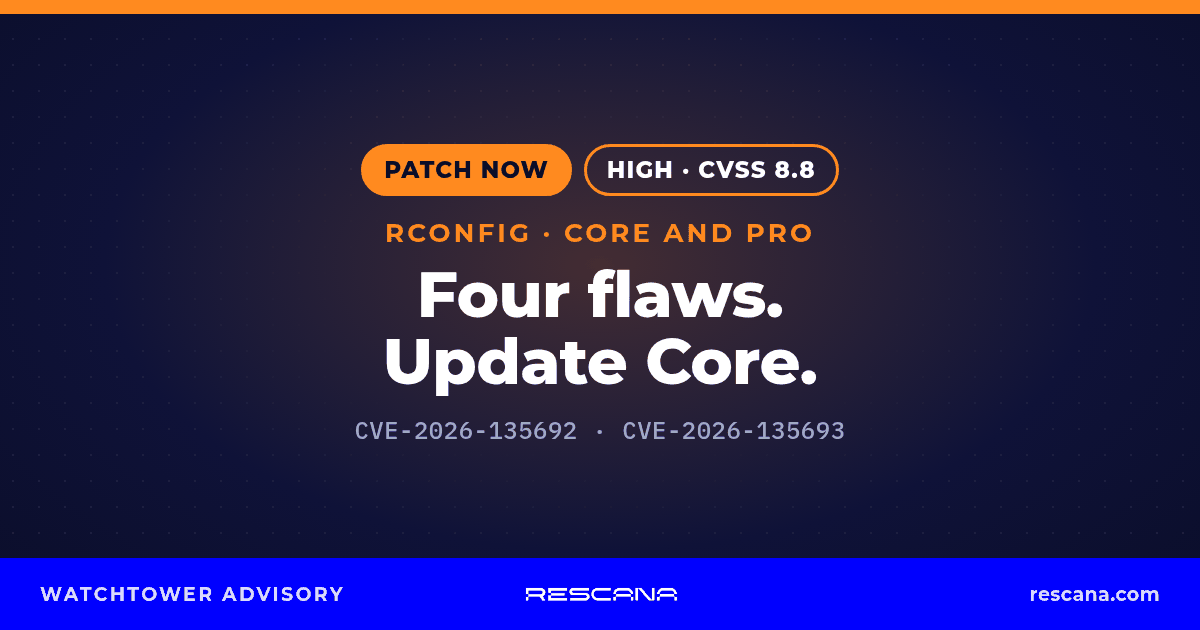
Status: On 23 November 2026 (EST), the CVE numbering authority (CNA) VulnCheck published four CVE records for rConfig Core and rConfig Pro, the network configuration management tool. They are CVE-2026-135692 (PHP object injection, CVSS 3.1 8.8), CVE-2026-135693 (stored cross-site scripting, CVSS 3.1 8.7, CVSS 4.0 9.3), CVE-2026-135695 (authorization bypass in the users API, CVSS 3.1 8.8) and CVE-2026-135696 (server-side request forgery, CVSS 3.1 7.5). rConfig had already shipped the Core fixes between August and November 2026. Core 8.2.22 is the lowest single Core version that fixes all four. As of 01:17 EST on 24 November 2026, no source we opened reports exploitation, and none of the four CVEs appears in the CISA KEV catalog.
CVE-2026-135692 is not in CISA's Known Exploited Vulnerabilities (KEV) catalog. CVE-2026-135693 is not in CISA's Known Exploited Vulnerabilities (KEV) catalog. CVE-2026-135695 is not in CISA's Known Exploited Vulnerabilities (KEV) catalog. CVE-2026-135696 is not in CISA's Known Exploited Vulnerabilities (KEV) catalog. We read catalogVersion 2026.11.23 (1,792 entries, released 14:43 EST on 23 November 2026) at 01:17 EST on 24 November 2026.
Executive Summary
rConfig holds device passwords and configuration backups for the routers, switches and firewalls it manages, which makes the server a high-value target. NVD describes the object injection, users API and request forgery flaws as needing an authenticated user. The cross-site scripting flaw runs script in the session of a user who views stored configuration text.
The four CVEs split into three fixed-version groups, and they do not line up neatly with product editions:
| CVE | Flaw | CVSS 3.1 (VulnCheck CNA) | Core affected | Core fixed | Pro fixed (rConfig) |
|---|---|---|---|---|---|
| CVE-2026-135692 | PHP object injection, CWE-502 | 8.8 High (CVSS 4.0: 8.7) | 8.0.0 up to 8.2.16 | 8.2.17 | 8.4.0 |
| CVE-2026-135693 | Stored cross-site scripting, CWE-79 | 8.7 High (CVSS 4.0: 9.3) | 8.0.0 up to 8.2.16 | 8.2.17 | 8.4.0 |
| CVE-2026-135695 | Users API authorization bypass, CWE-639 | 8.8 High (CVSS 4.0: 8.7) | 8.0.0 up to 8.2.12 | 8.2.13 | 8.4.0 |
| CVE-2026-135696 | Server-side request forgery, CWE-918 | 7.5 High (CVSS 4.0: 7.7) | 8.2.19 up to 8.2.21 | 8.2.22 | 8.4.3 (8.4.1 to 8.4.2 affected) |
One Core version covers all of it: 8.2.22 or later. The newest fix, for CVE-2026-135696, shipped in 8.2.22 on 18 November 2026. rConfig's Core changelog lists later releases (8.2.23, 8.2.24 and 8.3.0), so any of those is also past all four fixes. An install on 8.2.19 to 8.2.21 is exposed to all four. An install on 8.2.18 or earlier is not in the CVE-2026-135696 range, but it is exposed to CVE-2026-135692 and CVE-2026-135693 (and to CVE-2026-135695 below 8.2.13) and to older rConfig advisories described below.
Pro needs a separate check. rConfig's advisory page lists Pro up to 8.3.3 as affected by the first three CVEs, fixed in 8.4.0, and Pro 8.4.1 to 8.4.2 as affected by CVE-2026-135696, fixed in 8.4.3. The NVD record for CVE-2026-135696 lists no Pro versions. The same page lists Pro up to 8.4.0 as affected by the Critical CVE-2026-124079, fixed in Pro 8.4.1. rConfig lists 8.4.3 as the fixed Pro version, but its Pro changelog shows no 8.4.3 release; 8.5.0 (20 November 2026) is the first release after 8.4.2. The Pro target is 8.5.0: update to it and confirm with rConfig that your build includes the fix for CVE-2026-135696 (Rescana guidance).
Technical Information
This section is limited to what NVD, rConfig's release notes and rConfig's advisory page say.
- CVE-2026-135692, PHP object injection (CWE-502). Per NVD, rConfig Core 8.0.0 before 8.2.17 and Pro before 8.4.0 unserialize decrypted attributes without class restrictions. An authenticated attacker can store a crafted serialized value in an encrypted field such as a device password, and it triggers command execution as the web server user when read. rConfig's 8.2.17 release notes say a serialized object in an encrypted field was instantiated on read. Credit goes to 360 Alpha Lab.
- CVE-2026-135693, stored cross-site scripting (CWE-79). The Config Search "View Matches" dialog showed configuration text without escaping it. NVD says attackers can place markup in device banners, interface descriptions, ACL remarks or SNMP locations to run script in a user's session and read stored configurations containing secrets. Credit goes to 360 Alpha Lab.
- CVE-2026-135695, users API authorization bypass (CWE-639). In Core 8.0.0 through 8.2.12, rConfig says any signed-in user could set another user's password, including an administrator's. The 8.2.13 release notes say user management endpoints now require an administrator. Credit goes to Adam Nurudini (QwesiRED).
- CVE-2026-135696, server-side request forgery (CWE-918). Core 8.2.19 added a loopback guard that stops a device pointing at the rConfig server itself. rConfig says a device address given as a hostname that resolved to the rConfig server itself was not blocked, which bypassed that guard, and a signed-in user able to add devices could use it to reach internal services. NVD's description says this can lead to remote code execution. The CVSS 3.1 score uses high attack complexity (7.5). rConfig's Core changelog says 8.2.22 resolves addresses before saving and again at connection time. Credit goes to stilwel.
Affected Products and Fixed Versions
- rConfig Core: update to 8.2.22 or later (8.3.0, 20 November 2026, is the newest release we saw in rConfig's Core changelog).
- rConfig Pro: the NVD records list Pro before 8.4.0 for CVE-2026-135692, CVE-2026-135693 and CVE-2026-135695. rConfig's changelog lists Pro 8.4.0 on 12 October 2026 and Pro 8.5.0 on 20 November 2026 as the newest release. For CVE-2026-135696, rConfig lists Pro 8.4.1 to 8.4.2 as affected and Pro 8.4.3 as fixed, while the NVD record names no Pro versions. Pro up to 8.4.0 is also affected by CVE-2026-124079 (fixed in Pro 8.4.1). rConfig lists 8.4.3 as the fixed Pro version, but its Pro changelog shows no 8.4.3 release; 8.5.0 (20 November 2026) is the first release after 8.4.2. Update to 8.5.0 and confirm with rConfig that your build includes the fix for CVE-2026-135696 (Rescana guidance).
- Upgrade notes from rConfig's Core changelog: 8.2.19 raised the minimum PHP version (8.2.35, 8.3.36 or 8.4.27), and 8.2.24 requires PHP 8.4.28 or later. The first upgrade from 8.2.18 or earlier needs a
git pullfollowed bysudo ./update.sh --no-pull. After 8.2.22, devices whose address resolves to the rConfig server itself fail to download until the address is corrected. - Other rConfig advisories on the same path: rConfig's advisory page lists a Critical Redis and job queue issue, CVE-2026-124079 (fixed in Core 8.2.19 and Pro 8.4.1), and a table export that disclosed stored credentials and API tokens, CVE-2026-135694 (fixed in Core 8.2.20 and Pro 8.4.0). Core 8.2.22 covers both. An Apache default site issue on RHEL-family installs is fixed in Core 8.2.23, so RHEL-family Apache installs need a release newer than 8.2.22 (Rescana guidance). For Pro, rConfig lists that fix as deploy scripts from 19 November 2026 or 8.4.3.
How to Find Your Exposure
- Find every rConfig server, including test and lab copies, and record the edition (Core or Pro) and exact version (Rescana guidance).
- If Core is older than 8.2.22, or Pro is older than 8.4.3, treat the server as exposed. Check Core 8.2.19 to 8.2.21 first, because those versions are in the range of all four CVEs (Rescana guidance).
- List every account and API token that can reach the server, and check whether the server is reachable from user networks or the internet (Rescana guidance).
Workaround and Mitigation
The vendor fix is the update. We found no published workaround for these four CVEs in the sources cited here. In order:
- Update Core to 8.2.22 or later, after reading the upgrade notes above, because the PHP requirement has changed across these releases (Rescana guidance).
- Update Pro to 8.5.0. rConfig lists 8.4.3 as the fixed Pro version, but its Pro changelog shows no 8.4.3 release; 8.5.0 (20 November 2026) is the first release after 8.4.2. Confirm with rConfig that your build includes the fix for CVE-2026-135696 (Rescana guidance).
- Confirm Redis requires a password. rConfig's Core 8.2.19 notes say Redis now requires authentication, set automatically on fresh installs and upgrades. Verify it on your server (Rescana guidance).
- Review accounts and rotate secrets if misuse is possible. Review the user list and reset passwords for accounts you do not recognise. If you cannot rule out misuse before the update, rotate stored device credentials and API tokens (Rescana guidance).
- Restrict network access to the rConfig web interface and API to the administrators and systems that need it (Rescana guidance).
Timeline (EST)
- 10 August 2026: Core 8.2.13 is released, with the users API fix.
- 10 to 11 September 2026: rConfig lists the object injection and cross-site scripting advisories (10 September), and Core 8.2.17 is released (11 September, 01:14 EST).
- 12 October 2026: Pro 8.4.0 is listed in rConfig's changelog.
- 18 November 2026: Core 8.2.22 is released (01:23 EST), the same day rConfig lists the request forgery advisory.
- 20 November 2026: Core 8.3.0 and Pro 8.5.0 are listed.
- 23 November 2026: VulnCheck publishes the four CVE records (about 19:11 EST) and NVD imports them (about 20:17 EST; status Received, and Deferred for CVE-2026-135696).
- 24 November 2026, 01:17 EST: Our check of catalogVersion 2026.11.23 found none of these four CVEs listed. No source we opened reports exploitation.
Third-Party Risk (TPRM) Angle
rConfig is used by network teams, managed service providers and hosting providers that handle device configurations for other organizations. The people to ask are suppliers who manage your network devices or keep configuration backups for you (Rescana guidance).
Questions that give a usable answer:
- Do you run rConfig Core or Pro to manage or back up any device that carries our traffic or data, including shared servers that hold several customers' configurations?
- Which edition and version is in production? If Core is older than 8.2.22, or Pro is older than 8.4.3, on what date will you update?
- If you run Pro 8.4.1 or 8.4.2, when will you move to 8.4.3 or later, the release rConfig lists as fixing CVE-2026-135696?
- Who and what can sign in to that server, and was the user list reviewed after the update?
Need help working out which suppliers run rConfig and how fast they update? Our team can help you prioritize them and track their answers. Talk to an expert
Sources
- NVD: CVE-2026-135692 (published 20:17 EST, 23 November 2026; status Received; retrieved via the NVD API; the other three NVD records were published at the same time, with status Received except CVE-2026-135696, Deferred).
- NVD: CVE-2026-135693 (retrieved via the NVD API).
- NVD: CVE-2026-135695 (retrieved via the NVD API).
- NVD: CVE-2026-135696 (retrieved via the NVD API).
- CVE records for the four CVEs (VulnCheck CNA; published about 19:11 EST, 23 November 2026; retrieved via the CVE List API).
- rConfig: security advisories page (advisories rCFG-SA-2026-05, 07, 08, 09, 10, 11 and 15 with Core and Pro affected and fixed versions, CVE IDs, dates and credits; re-read 01:27 EST, 24 November 2026).
- GitHub: rConfig Core 8.2.13 release, 8.2.17 release and 8.2.22 release (release notes opened 24 November 2026).
- rConfig Core CHANGELOG (8.2.13 to 8.3.0 entries, PHP requirements and upgrade notes; read 24 November 2026).
- rConfig: changelog for Pro, Enterprise and Vector (Pro 8.4.0, 8.4.1, 8.4.2 and 8.5.0 dates; read 24 November 2026).
- CISA: Known Exploited Vulnerabilities catalog, JSON feed (catalogVersion 2026.11.23, 1,792 entries; none of the four CVEs listed; checked 01:17 EST, 24 November 2026).