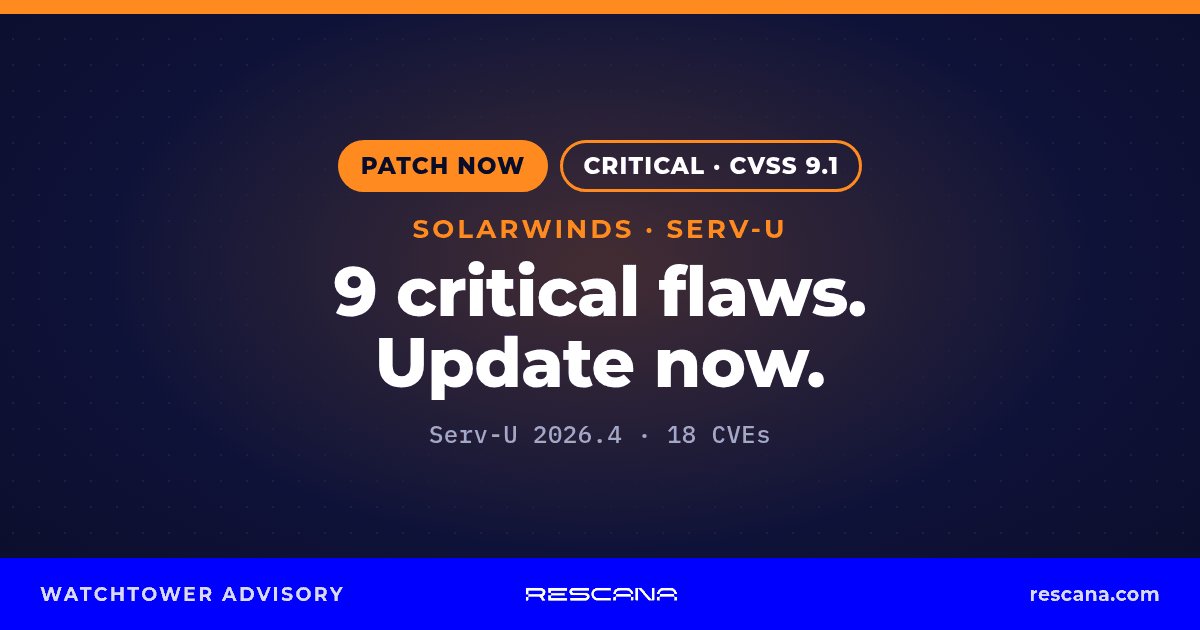
Status: SolarWinds released Serv-U 2026.4 on November 24, 2026 and fixed 18 vulnerabilities in Serv-U 2026.3 and below. Nine are rated CVSS 3.1 9.1 Critical by SolarWinds, two High and seven Medium. Two of the Critical flaws (CVE-2026-123172 and CVE-2026-123168) can lead to privilege escalation to root. Every Critical flaw needs a high-privileged account (PR:H), such as a domain administrator, group administrator or system administrator, so none of them is an anonymous remote takeover on its own. We found no report of exploitation and none of the CVEs is in CISA's KEV catalog. The fix for all 18 is Serv-U 2026.4.
CVE-2026-123168 is not in CISA's Known Exploited Vulnerabilities (KEV) catalog.
CVE-2026-123172 is not in CISA's Known Exploited Vulnerabilities (KEV) catalog.
CVE-2026-123167 is not in CISA's Known Exploited Vulnerabilities (KEV) catalog.
CVE-2026-82322 is not in CISA's Known Exploited Vulnerabilities (KEV) catalog.
CVE-2026-82321 is not in CISA's Known Exploited Vulnerabilities (KEV) catalog.
CVE-2026-82320 is not in CISA's Known Exploited Vulnerabilities (KEV) catalog.
CVE-2026-82319 is not in CISA's Known Exploited Vulnerabilities (KEV) catalog.
CVE-2026-82316 is not in CISA's Known Exploited Vulnerabilities (KEV) catalog.
CVE-2026-82315 is not in CISA's Known Exploited Vulnerabilities (KEV) catalog.
CVE-2026-82313 is not in CISA's Known Exploited Vulnerabilities (KEV) catalog.
CVE-2026-123166 is not in CISA's Known Exploited Vulnerabilities (KEV) catalog.
CVE-2026-82317 is not in CISA's Known Exploited Vulnerabilities (KEV) catalog.
CVE-2026-123173 is not in CISA's Known Exploited Vulnerabilities (KEV) catalog.
CVE-2026-123170 is not in CISA's Known Exploited Vulnerabilities (KEV) catalog.
CVE-2026-123169 is not in CISA's Known Exploited Vulnerabilities (KEV) catalog.
CVE-2026-123171 is not in CISA's Known Exploited Vulnerabilities (KEV) catalog.
CVE-2026-82314 is not in CISA's Known Exploited Vulnerabilities (KEV) catalog.
CVE-2026-123165 is not in CISA's Known Exploited Vulnerabilities (KEV) catalog.
Executive Summary
Serv-U is SolarWinds' managed file transfer (MFT) server, and MFT servers are often run on internet-facing hosts for partners, customers and automated transfers (Rescana reading). The nine Critical records cover insecure direct object reference, type confusion, path traversal, time-of-check to time-of-use (TOCTOU) races and validation flaws that let an administrator of one domain or group reach the server administrator, the underlying files or, on Linux, root. In a shared or multi-domain Serv-U deployment, where domain administrators are delegated to departments, customers or partners, that crosses a trust boundary (Rescana reading).
Four of the 18 need no account at all (PR:N): HTTP response header injection (CVE-2026-123165, needs a victim to interact), first-factor password brute force (CVE-2026-123170), username enumeration (CVE-2026-123171) and an out-of-bounds read through SSH key exchange (CVE-2026-123173, 6.8, AC:H). They are rated Medium and none is scored above 6.8, but because they need no account they matter most on internet-facing servers (Rescana reading).
SolarWinds' trust center and the CVE records list the affected product as Serv-U 2026.3 and below on Windows and Linux, and the fixed release as Serv-U 2026.4. SolarWinds lists no interim mitigation and says the risk is lower on Windows. SolarWinds recommends upgrading "as soon as is practical."
What to do first (Rescana guidance):
- Upgrade every Serv-U server to 2026.4, starting with Linux hosts, internet-facing hosts and any deployment with delegated domain or group administrators.
- Reduce who holds administrator roles until the upgrade is done, and remove stale domain, group and system administrator accounts.
- Keep the management interface off the internet and turn on multi-factor authentication for every administrator.
Technical Information
This section relies on SolarWinds' Serv-U 2026.4 release notes, SolarWinds' trust center advisories, the CVE.org and NVD records for each CVE, CISA's KEV catalog and the FIRST EPSS API. We do not describe exploit steps or proof-of-concept material, and we opened none.
All scores below are CVSS 3.1 values set by SolarWinds as the CVE Numbering Authority (CNA). NVD has not added its own scores yet: the nine records numbered CVE-2026-123165 to CVE-2026-123173 are Undergoing Analysis and the nine numbered CVE-2026-82313 to CVE-2026-82322 are Awaiting Analysis, and NVD displays the SolarWinds scores. Where a record carries two scores, the higher one is the Linux scenario and the lower one is the Windows scenario. In the last column, PR:H, PR:L and PR:N are the CVSS privileges required values (high, low, none), UI:R means a user must interact, and AC:H means high attack complexity. "one score" in the Windows column means the record carries a single score for both platforms.
| CVE | Weakness | Effect | CVSS 3.1 (Linux or default) | Windows | Privileges and interaction |
|---|---|---|---|---|---|
| CVE-2026-123168 | Insufficient validation (CWE-20) | Root on Linux | 9.1 | 4.7 | PR:H |
| CVE-2026-123172 | Unnecessary privileges (CWE-250) | Root on Linux | 9.1 | 4.7 | PR:H |
| CVE-2026-123167 | Path traversal (CWE-35) | Domain admin reads files needing higher privileges | 9.1 | 4.7 | PR:H |
| CVE-2026-82322 | IDOR, improper access control (CWE-284) | Domain group admin to server admin | 9.1 | 4.7 | PR:H |
| CVE-2026-82321 | Type confusion (CWE-843) | Domain admin to system admin | 9.1 | one score | PR:H |
| CVE-2026-82320 | Type confusion (CWE-843) | Domain admin to system admin | 9.1 | 7.2 | PR:H |
| CVE-2026-82319 | TOCTOU race (CWE-367) | Read and write app files outside home directory, privilege escalation | 9.1 | 7.2 | PR:H |
| CVE-2026-82316 | TOCTOU race (CWE-367) | Access or modify protected files, possible code execution | 9.1 | 3.8 | PR:H |
| CVE-2026-82315 | TOCTOU race (CWE-367) | Access or modify protected files, possible code execution | 9.1 | 3.8 | PR:H |
| CVE-2026-82313 | Business logic, missing authorization (CWE-862) | Higher privileged account, then commands or code; needs SMTP configured | 8.4 | 6.8 | PR:H, UI:R |
| CVE-2026-123166 | OS command injection (CWE-78) | Command injection, Windows only | n/a | 7.2 | PR:H |
| CVE-2026-82317 | Stored XSS (CWE-79) | Script in admin browser, Linux only | 6.8 | n/a | PR:L, UI:R |
| CVE-2026-123173 | Out-of-bounds read (CWE-125) | Memory disclosure via SSH KEXINIT | 6.8 | one score | PR:N |
| CVE-2026-123170 | Password brute force (CWE-307) | Repeated first-factor attempts | 6.5 | one score | PR:N |
| CVE-2026-123169 | TOTP brute force and replay (CWE-307) | MFA code guessing and replay | 5.4 | one score | PR:L |
| CVE-2026-123171 | Username enumeration (CWE-203) | Learn which accounts exist | 5.3 | one score | PR:N |
| CVE-2026-82314 | Denial of service (CWE-400) | Memory exhaustion; needs SMTP configured | 4.9 | one score | PR:H |
| CVE-2026-123165 | HTTP response header injection (CWE-113) | Manipulate a victim's browser session | 4.7 | one score | PR:N, UI:R |
The nine Critical flaws (CVSS 9.1). Each has the vector AV:N/AC:L/PR:H/UI:N/S:C/C:H/I:H/A:H for Linux: reachable over the network, low complexity, high privileges, no user interaction, changed scope, and high confidentiality, integrity and availability impact.
- CVE-2026-123172 and CVE-2026-123168 can escalate privileges to root on Linux. SolarWinds credits the Intigriti Bug Bounty Program for both. CVE-2026-123172 is classed as execution with unnecessary privileges (
CWE-250) and CVE-2026-123168 as improper input validation (CWE-20). Windows scores for both are 4.7. - CVE-2026-82322 is an insecure direct object reference that lets a domain group administrator bypass restrictions and become server administrator (
CWE-284). - CVE-2026-82321 and CVE-2026-82320 are two type confusion flaws (
CWE-843) that let a domain administrator escalate to system administrator. - CVE-2026-123167 is a path traversal issue (
CWE-35) that lets a domain administrator access files that otherwise need elevated privileges. - CVE-2026-82319, CVE-2026-82316 and CVE-2026-82315 are three TOCTOU race conditions (
CWE-367). A user with domain administrator or higher privileges may access or modify protected files outside the intended directory. For CVE-2026-82319 that means read and write access to application files and privilege escalation. For CVE-2026-82316 and CVE-2026-82315 SolarWinds adds that this can potentially lead to code execution.
The two High flaws. CVE-2026-82313 (8.4 on Linux, 6.8 on Windows) is a business logic flaw (CWE-862) that may give access to a higher-privileged account, which can then run commands or code. It needs a high-privileged account and a configured SMTP server. CVE-2026-123166 (7.2) is OS command injection (CWE-78) from unsanitized user-controlled arguments and affects Windows installations only; it also needs high privileges.
The seven Medium flaws. CVE-2026-82317 is a stored cross-site scripting issue (CWE-79) on Linux only, caused by missing input validation, and it only affects administrators. CVE-2026-82314 is a denial of service through excessive memory use that needs a specific configuration and an SMTP server. CVE-2026-123169 (TOTP brute force and code replay) and CVE-2026-123170 (first-factor password brute force) stem from insufficient protection against repeated attempts (CWE-307). CVE-2026-123171 reveals whether a username exists (CWE-203). CVE-2026-123173 is an out-of-bounds read that can disclose server memory (CWE-125) and CVE-2026-123165 is HTTP response header injection (CWE-113). The release notes table puts CVE-2026-123173 one band higher than the CVE record and the SolarWinds trust center (6.8, Medium); we follow the Medium rating.
Exploitation signals. CISA's ADP SSVC entries on CVE.org record Exploitation: none for 17 of the 18 records. CVE-2026-82317 has no ADP entry yet. FIRST EPSS scores dated November 25, 2026 run from 0.52% to 3.12% (highest: CVE-2026-82313). Serv-U does have a KEV history, so attackers have targeted it before: CVE-2021-35211 is in CISA's Known Exploited Vulnerabilities (KEV) catalog, added November 3, 2021. CVE-2021-35247 is in CISA's Known Exploited Vulnerabilities (KEV) catalog, added January 21, 2022. CVE-2024-28995 is in CISA's Known Exploited Vulnerabilities (KEV) catalog, added July 17, 2024. CVE-2026-28318 is in CISA's Known Exploited Vulnerabilities (KEV) catalog, added June 5, 2026. CISA marks known ransomware campaign use as Known for CVE-2021-35211 only.
Third-party CVEs. The release notes also list 11 third-party CVEs fixed in 2026.4, scored 3.7 to 9.1, in a separate table. They are not part of the count of 18 above, and we did not analyze them individually. Run your scanner against 2026.4 to confirm they clear (Rescana guidance).
Affected Product Versions
- Affected: SolarWinds Serv-U 2026.3 and below, on Windows and Linux. CVE-2026-123166 affects Windows only and CVE-2026-82317 affects Linux only.
- Fixed: SolarWinds Serv-U 2026.4, released November 24, 2026, for all 18 CVEs.
- Other changes in 2026.4: the release notes also list an upgrade to OpenSSL 3.5 LTS, FIPS 140-3 support, Curve25519 SSH key exchange, and a fix for a case where LDAP users in sAMAccountName format could reset their multi-factor authentication accounts. SolarWinds lists no CVE for that fix.
How to Find Your Exposure
- Inventory every Serv-U instance and record its version, operating system and whether it is reachable from the internet, including partner-hosted, standby and disaster recovery servers. Anything on 2026.3 or below is affected (Rescana guidance).
- List every administrator account by role: system administrators, domain administrators and group administrators. The Critical flaws start from one of these roles, so each extra administrator is extra exposure (Rescana guidance).
- Prioritize Linux hosts. The root escalation paths apply on Linux and SolarWinds rates the Windows risk lower. A compromise that reaches root is a full host compromise (Rescana guidance).
- Find hosts that expose HTTP, SFTP or the management interface to untrusted networks, because four Medium flaws need no account (Rescana guidance).
Workaround and Mitigation
SolarWinds lists no workaround in the release notes, the trust center advisories or the CVE records. The remediation is to upgrade to Serv-U 2026.4. Back up the Serv-U configuration first, as with any MFT upgrade (Rescana guidance).
Rescana guidance until and after patching:
- Limit and review administrator roles. Remove unused domain and group administrators, and require multi-factor authentication for all of them.
- Restrict the management interface to a management network or VPN, and do not expose it to the internet.
- Watch for brute force and enumeration. Alert on bursts of failed logins, failed TOTP codes and repeated lookups of usernames, which three of the Medium flaws make easier.
- Review administrator activity and file changes outside users' home directories, and any new administrator accounts or role changes, on servers that ran 2026.3 or below.
- Test before cutover. The new release changes cryptography: FIPS mode now restricts weaker SSH ciphers such as Rijndael-cbc and Triple DES-cbc, hmac-sha1 MACs and the diffie-hellman-group14-sha1 key exchange. Confirm that legacy partner clients still connect.
- Treat older logs as sensitive. The release notes say 2026.4 stops writing MFA one-time passcodes to log files, so logs from earlier builds may contain them (Rescana reading). Restrict access to them and consider rotating any long retention copies (Rescana guidance).
Indicators of Compromise
SolarWinds and CISA have not published indicators of compromise for these CVEs, and we found no exploitation reports as of our check. We list none. SolarWinds and CISA reference no public proof-of-concept code for these CVEs, and we opened none. Monitor the SolarWinds trust center for updates, and run the review steps in Workaround and Mitigation (Rescana guidance).
Timeline (EST)
- November 24, 2026, 11:27 a.m. EST to 11:47 a.m. EST: SolarWinds publishes the 18 CVE records on CVE.org. The SolarWinds trust center shows all 18 advisories as first published November 24, 2026, with Serv-U 2026.4 as the fixed version, and the Serv-U 2026.4 release notes carry the release date November 24, 2026.
- November 24, 2026, 12:18 p.m. EST: NVD publishes all 18 records.
- November 24, 2026, 11:56 p.m. EST to 11:57 p.m. EST: CISA ADP adds SSVC entries (Exploitation: none) to eleven records.
- November 25, 2026, 11:43 a.m. EST to 11:44 a.m. EST: CISA ADP adds SSVC entries (Exploitation: none) to six more records. CVE-2026-82317 has none.
- November 25, 2026, 2:48 p.m. EST: CISA releases KEV catalogVersion 2026.11.25 (1,805 entries) with none of the 18 CVEs listed.
- 1:05 a.m. EST to 2:27 a.m. EST, November 26, 2026: Our verification of the SolarWinds release notes and advisories, CVE.org, NVD, CISA KEV and EPSS.
Third-Party Risk (TPRM) Angle
Managed service providers, payment processors, healthcare and logistics partners often run Serv-U to exchange files with customers, and delegate domain administration to the customer or partner. A compromised delegated administrator on an unpatched server can reach other domains or the host itself (Rescana reading).
Questions for suppliers that operate file transfer servers (Rescana guidance):
- Do you run SolarWinds Serv-U to exchange files with us or to host data about us, and is it reachable from the internet?
- Are all instances on Serv-U 2026.4, and on which date did each one upgrade?
- Who holds domain, group and system administrator roles, is multi-factor authentication enforced for them, and when were those accounts last reviewed?
Need help finding which suppliers in your portfolio run internet-facing file transfer servers and tracking their patch status? Talk to an expert
Sources
- SolarWinds: Serv-U 2026.4 release notes (release date November 24, 2026; fixed CVE tables, third-party CVE table, other changes; checked 2:27 a.m. EST, November 26, 2026).
- SolarWinds Trust Center: security advisories and the per-CVE advisory pages for CVE-2026-123168, CVE-2026-123172, CVE-2026-123167, CVE-2026-82322, CVE-2026-82321, CVE-2026-82320, CVE-2026-82319, CVE-2026-82316, CVE-2026-82315, CVE-2026-82313, CVE-2026-123166, CVE-2026-82317, CVE-2026-123173, CVE-2026-123170, CVE-2026-123169, CVE-2026-123171, CVE-2026-82314, CVE-2026-123165 (affected product Serv-U 2026.3 and below, fixed version Serv-U 2026.4, first published November 24, 2026; checked 2:27 a.m. EST, November 26, 2026).
- CISA: Known Exploited Vulnerabilities catalog, JSON feed (catalogVersion 2026.11.25, 1,805 entries, released 2:48 p.m. EST November 25, 2026; none of the 18 CVEs listed; Serv-U entries CVE-2021-35211, CVE-2021-35247, CVE-2024-28995 and CVE-2026-28318; checked 2:27 a.m. EST, November 26, 2026).
- CVE.org records (SolarWinds CNA descriptions, CVSS 3.1 vectors and scenarios, CWEs and CISA ADP SSVC entries; checked 2:27 a.m. EST, November 26, 2026): CVE-2026-123168, CVE-2026-123172, CVE-2026-123167, CVE-2026-82322, CVE-2026-82321, CVE-2026-82320, CVE-2026-82319, CVE-2026-82316, CVE-2026-82315, CVE-2026-82313, CVE-2026-123166, CVE-2026-82317, CVE-2026-123173, CVE-2026-123170, CVE-2026-123169, CVE-2026-123171, CVE-2026-82314, CVE-2026-123165.
- NVD detail pages (status Awaiting Analysis or Undergoing Analysis; SolarWinds CNA scores shown; checked 2:27 a.m. EST, November 26, 2026): CVE-2026-123168, CVE-2026-123172, CVE-2026-123167, CVE-2026-82322, CVE-2026-82321, CVE-2026-82320, CVE-2026-82319, CVE-2026-82316, CVE-2026-82315, CVE-2026-82313, CVE-2026-123166, CVE-2026-82317, CVE-2026-123173, CVE-2026-123170, CVE-2026-123169, CVE-2026-123171, CVE-2026-82314, CVE-2026-123165.
- FIRST: EPSS API (scores dated November 25, 2026 for the 18 CVEs; checked 2:27 a.m. EST, November 26, 2026).
- MITRE CWE definitions: CWE-20, CWE-35, CWE-78, CWE-79, CWE-113, CWE-125, CWE-203, CWE-250, CWE-284, CWE-307, CWE-367, CWE-400, CWE-843, CWE-862.