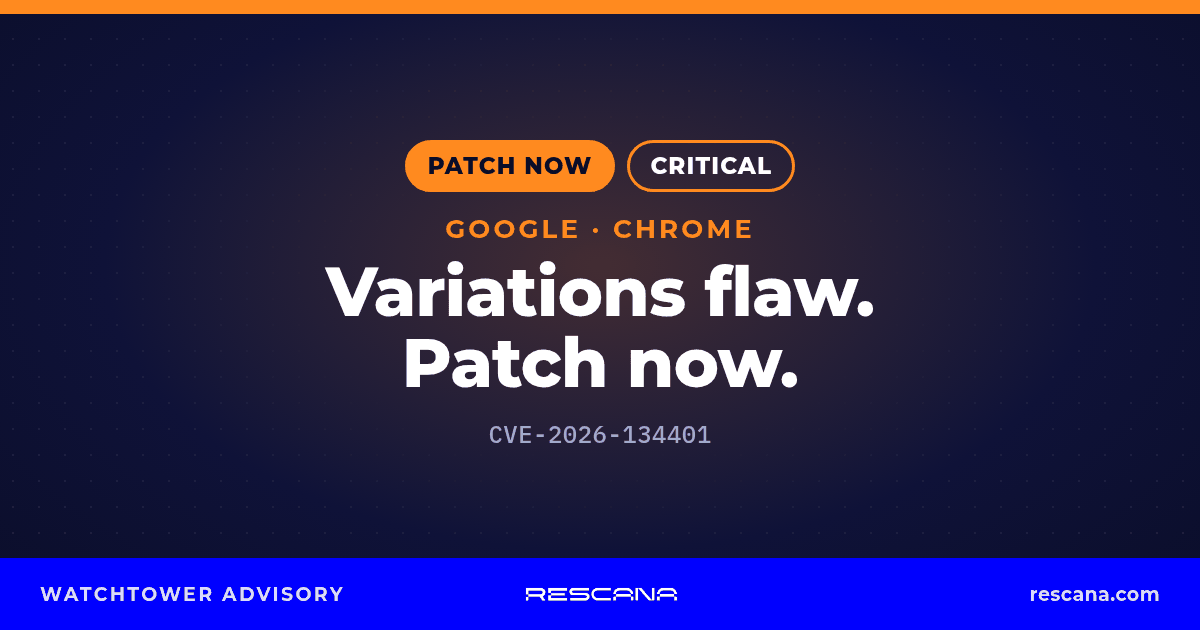
Status: On November 23, 2026, Google updated the Chrome Stable channel to 158.0.8127.88/.89 for Windows and Mac and 158.0.8127.88 for Linux. The post lists one security fix: CVE-2026-134401, which Google rates Critical and describes as improper input validation in Variations, reported by Google on August 28, 2026. The CVE record (CNA: Chrome) says the flaw in Google Chrome prior to 158.0.8127.88 "allowed a remote attacker to potentially execute arbitrary code outside the sandbox via a crafted HTML page." The same day, Google updated Extended Stable to 156.0.8078.114 for Windows and Mac and listed the same CVE, and released Chrome 158 (158.0.8127.92) for Android with the same security fixes as the corresponding desktop builds unless otherwise noted (no exception is noted). Google's Stable channel post does not mention exploitation in the wild. CISA's SSVC assessment, in the CISA ADP data on the CVE record and in the NVD API, lists exploitation as none.
CVE-2026-134401 is not in CISA's Known Exploited Vulnerabilities (KEV) catalog.
Executive Summary
This is a single-fix Stable update. Google's post says it "will roll out over the coming days/weeks," so a device with auto-update still on may not yet be on the fixed build. Confirm the version and install the update.
| Channel | Fixed build, per Google, November 23, 2026 | Notes |
|---|---|---|
| Chrome desktop Stable, Windows and Mac | 158.0.8127.88 or 158.0.8127.89 | Google writes this as 158.0.8127.88/.89. |
| Chrome desktop Stable, Linux | 158.0.8127.88 | |
| Chrome Extended Stable, Windows and Mac | 156.0.8078.114 | The Extended Stable post lists CVE-2026-134401 as the one security fix. It does not mention Linux. |
| Chrome for Android | 158.0.8127.92 | Google says Android releases contain the same security fixes as the corresponding desktop builds (Windows and Mac 158.0.8127.88/.89, Linux 158.0.8127.88) unless otherwise noted. The November 23 Android post does not note an exception. We read this as the Android fix for CVE-2026-134401 (Rescana reading). |
What to do first:
- Update every Chrome desktop to 158.0.8127.88 or 158.0.8127.89 on Windows and Mac, and to 158.0.8127.88 on Linux, or to a later Stable build.
- If you run Extended Stable, update to 156.0.8078.114 or later on Windows and Mac.
- Update Chrome for Android to 158.0.8127.92 or later (Rescana reading of Google's "same security fixes" statement).
- Confirm the build actually installed. Google says the desktop rollouts take place over coming days/weeks (Rescana guidance).
- Google's November 23 ChromeOS Stable post updates the browser to 158.0.8127.98 but does not list this CVE. We do not treat that post as confirmation that the CVE is fixed on ChromeOS (Rescana reading).
Technical Information
This section uses only Google's published release posts, the CVE record, NVD and CISA. We do not describe an exploit.
CVE-2026-134401, improper input validation in Variations. Google's Stable channel post lists: "[N/A][554051967] Critical CVE-2026-134401: Improper input validation in Variations. Reported by Google on 2026-08-28." The CVE record and NVD use the description quoted in the Status section and add "(Chromium security severity: Critical)." The weakness is CWE-20, Improper Input Validation, attributed to Chrome. Google notes that access to bug details and links may be kept restricted until a majority of users are updated. We did not open the Chromium issue tracker entry.
Scoring. Google, as the CNA, did not publish a CVSS score. It rates the issue Critical in the Stable channel post and in the CVE text. NVD's page still says "NVD assessment not yet provided" and shows a NIST NVD base score of N/A. The NVD API lists the record as Analyzed, last modified at 2:24 p.m. EST on November 25, 2026, with a CPE range of Google Chrome up to but not including 158.0.8127.88. The only CVSS 3.1 score on the NVD page and in the NVD API is from CISA ADP: 9.6 (Critical), vector AV:N/AC:L/PR:N/UI:R/S:C/C:H/I:H/A:H (network, low complexity, no privileges, user interaction required, scope changed, high impact on confidentiality, integrity and availability).
Exploitation. Google's November 23 Stable, Extended Stable and Android posts do not mention exploitation in the wild. The Stable channel credit is "Reported by Google on 2026-08-28." CISA's SSVC assessment (CISA Coordinator), in the CISA ADP data on the CVE record and in the NVD API, dated 7:00 p.m. EST on November 23, 2026, lists exploitation as none, automatable as no, and technical impact as total. No source we opened published indicators or named a threat actor, and we did not search for a proof of concept.
Affected Product Versions
- Affected (CVE record and NVD): Google Chrome prior to 158.0.8127.88. NVD's analyzed configuration is CPE
cpe:2.3:a:google:chromeup to, excluding, 158.0.8127.88. - Fixed, desktop Stable (Google, November 23, 2026): 158.0.8127.88/.89 for Windows and Mac, and 158.0.8127.88 for Linux.
- Fixed, Extended Stable (Google, November 23, 2026): 156.0.8078.114 for Windows and Mac. The Extended Stable post does not mention Linux.
- Fixed, Android (Google, November 23, 2026, Rescana reading of the "same security fixes" statement): 158.0.8127.92. Google released that build the same day and said it contains the same security fixes as the desktop .88/.89 builds unless otherwise noted, with no exception noted.
- ChromeOS: Google's November 23 ChromeOS / ChromeOS Flex Stable post updates most devices to OS version 16868.29.0 (browser 158.0.8127.98) but does not list this CVE. We do not state a ChromeOS fixed version from that post (Rescana reading).
How to Find Your Exposure
- Check the Chrome version on every desktop, laptop, VDI image and managed browser, including Extended Stable rings (Rescana guidance). Google's help page "Update Google Chrome" says the current version number is the series of numbers beneath the "Google Chrome" heading on the About Google Chrome page (open Chrome, then More, then Help, then About Google Chrome). That page also causes Chrome to check for updates.
- Check Chrome for Android against 158.0.8127.92 or later (Rescana guidance).
- Ask managed service providers and suppliers who support you through a browser, or who run Chrome in a hosted desktop, which build they are on (Rescana guidance).
Workaround and Mitigation
Google's November 23 Stable and Extended Stable posts present the new builds as the update to install and do not list a workaround. They say the updates will roll out over the coming days/weeks.
Google's help page "Update Google Chrome" says Chrome can update automatically, and that updates normally happen in the background when you close and reopen the browser. To check and apply an update on a computer: open Chrome, select More, then Help, then About Google Chrome, then Relaunch if that option is shown. If you cannot find Relaunch, the help page says you are on the latest version. The same page says Windows users should close all Chrome windows and tabs and then relaunch Chrome; Linux users should use their package manager; Chromebook users should update the Chromebook operating system.
Until every device is on a fixed build (Rescana guidance): keep update checks enabled, do not postpone a pending relaunch on machines that still show an older build, push 158.0.8127.88 through the package manager on Linux fleets, and recheck version numbers after the update because the rollout is staggered.
Indicators of Compromise
Google, NVD, the CVE record and CISA have not published indicators of compromise for CVE-2026-134401. We do not list any.
Timeline (EST)
- August 28, 2026: Google reported the issue, according to the November 23 Stable channel post ("Reported by Google on 2026-08-28").
- November 23, 2026: Google publishes the Stable channel update to 158.0.8127.88/.89 (Windows and Mac) and 158.0.8127.88 (Linux), the Extended Stable update to 156.0.8078.114 (Windows and Mac), the Chrome for Android 158.0.8127.92 release, and a ChromeOS Stable update to browser 158.0.8127.98 that does not list this CVE. The Chrome blog atom and RSS feeds returned HTTP 500 when we requested them, so we do not state a clock time for these posts.
- November 23, 2026, 6:29 p.m. EST: CVE.org publishes CVE-2026-134401 (2026-11-23T23:29:54.386Z).
- November 23, 2026, 7:00 p.m. EST: CISA ADP records its SSVC assessment (exploitation none).
- November 23, 2026, 7:17 p.m. EST: NVD publishes the record (2026-11-24T00:17:30.460).
- November 24, 2026, 11:56 p.m. EST: CISA ADP updates its container on the CVE record (2026-11-25T04:56:44.560Z).
- November 25, 2026, 2:24 p.m. EST: NVD last modified the record (2026-11-25T19:24:34.530). The API status is Analyzed. The page still shows "NVD assessment not yet provided."
- November 25, 2026, 2:48 p.m. EST: CISA released catalogVersion 2026.11.25 (1,805 entries, 2026-11-25T19:48:12.4344Z).
- November 26, 2026, 1:05 to 1:11 a.m. EST: our first check of Google's posts, the CVE record, the rendered NVD page, the NVD API and the CISA catalog feed.
Third-Party Risk (TPRM) Angle
Suppliers, managed service providers and partners may run Chrome on workstations, virtual desktops or support jump hosts that reach your systems. A browser still on a build before the fixed versions above can put those sessions at risk if a user or a support technician opens a crafted page (Rescana guidance).
Questions that give a usable answer:
- Do you run Google Chrome (Stable, Extended Stable or Android) on any device or hosted desktop used for our work or to reach our systems?
- Which exact build is each of those browsers on now? If it is below 158.0.8127.88 (desktop Stable), 156.0.8078.114 (Extended Stable) or 158.0.8127.92 (Android), on what date will it be updated?
- Have you confirmed the new build after Google's staggered rollout, rather than assuming auto-update has already finished?
Need help working out which suppliers still run an older Chrome build and how fast they patch? Our team can help you prioritize them and track their answers. Talk to an expert
Sources
- Google Chrome Releases: Stable Channel Update for Desktop (Monday, November 23, 2026; Stable 158.0.8127.88/.89 for Windows and Mac and 158.0.8127.88 for Linux; one security fix, CVE-2026-134401, Critical, improper input validation in Variations, reported by Google on 2026-08-28; no mention of exploitation in the wild; read 1:05 a.m. EST, November 26, 2026).
- Google Chrome Releases: Extended Stable Update for Desktop (Monday, November 23, 2026; Extended Stable 156.0.8078.114 for Windows and Mac; one security fix, CVE-2026-134401; read 1:06 a.m. EST, November 26, 2026).
- Google Chrome Releases: Chrome for Android Update (Monday, November 23, 2026; Chrome 158.0.8127.92 for Android; "Android releases contain the same security fixes as their corresponding Desktop releases (Windows & Mac: 158.0.8127.88 /.89 Linux: 158.0.8127.88) unless otherwise noted"; no exception noted; read 1:06 a.m. EST, November 26, 2026).
- Google Chrome Releases: Stable Channel Update for ChromeOS / ChromeOS Flex (Monday, November 23, 2026; OS 16868.29.0, browser 158.0.8127.98; this CVE is not listed; read 1:06 a.m. EST, November 26, 2026).
- Google Chrome Help: Update Google Chrome (About Google Chrome version check and Relaunch; Windows, Linux and Chromebook update notes; read 1:09 a.m. EST, November 26, 2026).
- CVE.org: CVE-2026-134401 (CNA Chrome; description, CWE-20, affected Chrome prior to 158.0.8127.88; CISA ADP CVSS 3.1 9.6 and SSVC; published 6:29 p.m. EST, November 23, 2026; API JSON and rendered page read 1:05 to 1:11 a.m. EST, November 26, 2026).
- NVD: CVE-2026-134401 (published 7:17 p.m. EST, November 23, 2026; last modified 2:24 p.m. EST, November 25, 2026; API status Analyzed; page: "NVD assessment not yet provided," CISA ADP CVSS 3.1 9.6, CWE-20 from Chrome, CPE up to excluding 158.0.8127.88, Chromium issue tagged Permissions Required; API JSON and rendered page read 1:05 to 1:11 a.m. EST, November 26, 2026).
- CISA catalog JSON feed (catalogVersion 2026.11.25, 1,805 entries, released 2:48 p.m. EST, November 25, 2026; checked 1:05 a.m. EST, November 26, 2026).
- MITRE: CWE-20, Improper Input Validation.