Executive Summary
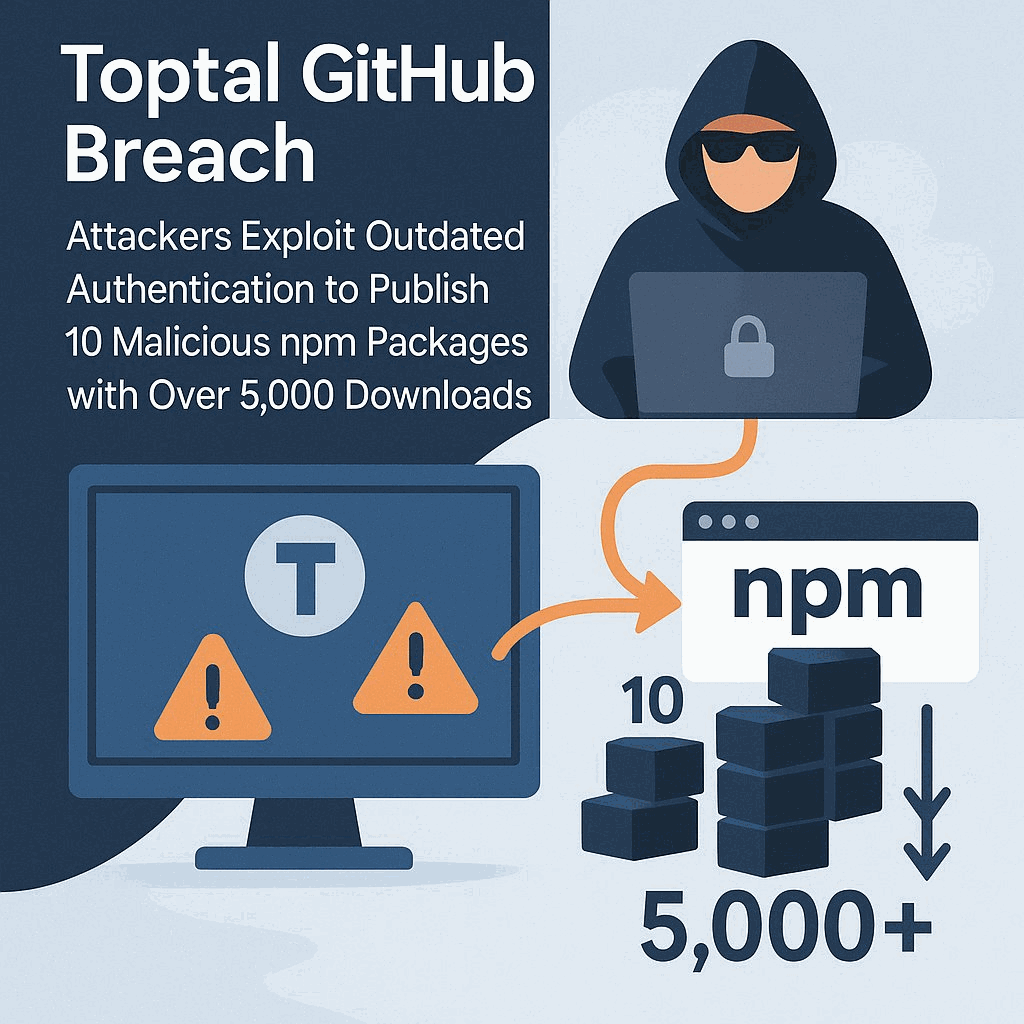
On 2025-07-22, abnormal activities were detected in the Toptal GitHub organization, and by 2025-07-23 it was confirmed that threat actors had exploited vulnerabilities to gain unauthorized access to critical repositories. On 2025-07-24, Toptal publicly disclosed the breach, which included the publication of 10 malicious npm packages that have since registered more than 5,000 downloads. This incident involves a sophisticated supply chain attack that compromised proprietary code repositories and open-source projects, potentially affecting independent developers and client environments. The breach was facilitated by outdated authentication methods and exploited weaknesses in code repository management, leading to the injection of modified code that exfiltrates sensitive credentials such as API keys, authentication tokens, and internal configuration details. Confirmed technical evidence from reputable sources, including The Hacker News (https://thehackernews.com/2025/07/hackers-breach-toptal-github-publish-10.html, Verified: 2025-07-24), Bitdefender (https://www.bitdefender.com/en-us/blog/hotforsecurity/hackers-toptals-github-npm, Verified: 2025-07-25) and BleepingComputer (https://www.bleepingcomputer.com/news/security/hackers-breach-toptal-github-account-publish-malicious-npm-packages/, Verified: 2025-07-26) substantiates these findings. The technical investigation highlights critical cybersecurity gaps in authentication and repository access management, emphasizing the need for immediate remedial actions to prevent further exploitation. We are happy to answer questions at ops@rescana.com.
Technical Information
The attack began when anomaly detection within the Toptal GitHub organization picked up irregular access patterns on 2025-07-22. Subsequent forensic analysis revealed unauthorized modifications within multiple repositories. The attackers managed to bypass authentication mechanisms by exploiting outdated security protocols, reminiscent of the MITRE ATT&CK framework technique T1078 (Valid Accounts), indicating that valid credentials were either compromised or misused. This outdated authentication was a pivotal weakness exploited during the breach, as detailed by Bitdefender (https://www.bitdefender.com/en-us/blog/hotforsecurity/hackers-toptals-github-npm, Verified: 2025-07-25). Once inside the system, threat actors executed a supply chain attack by injecting malicious code into repositories that were later republished as npm packages. This malicious payload was designed to automatically exfiltrate sensitive information including configuration files, deployment scripts, client project data, and credential tokens. The malicious code carefully mimicked legitimate package updates to evade early detection. The technical characteristics of the injected code reveal that it includes routines for network communication which attempt to contact external command and control servers, signaling a likely attempt to perform data theft operations or lateral movement within connected systems. Additionally, this attack aligns with the supply chain compromise technique T1195 (Supply Chain Compromise) from the MITRE framework, whereby trusted code distribution processes are exploited as attack vectors. The technical indicators observed include anomalous repository commit patterns, unusual npm package version increments, and embedded scripting functions within the packages that suggest tactical efforts to undermine code integrity. Internal reviews indicate that the breach enabled unauthorized access to both proprietary and open-source code, internal environment configurations, and reserved credentials. This comprehensive technical breach was corroborated by multiple independent cybersecurity entities, each affirming the high confidence of the detection findings.
The analysis further indicates that configuration files within affected repositories were altered to potentially allow persistent access for the threat actors, compounding the risk and making remediation efforts more intricate. Code signatures and hash comparisons of recently published npm packages displayed irregularities consistent with manipulation, thus substantiating the injection of tampered code intentionally designed to harvest sensitive data upon installation by unsuspecting developers. Additionally, forensics suggest that the attack vectors used included sophisticated obfuscation techniques to avoid early detection, and subsequent error logging observations have shown that scripts within the malicious packages attempt to communicate with remote servers to exfiltrate configuration data. These techniques highlight the grave risks inherent in supply chain attacks and underscore the importance of implementing modern security standards such as multi-factor authentication, comprehensive monitoring of repository access, and routine code integrity audits.
Affected Versions & Timeline
Initial activity was recorded on 2025-07-22 when abnormal access and repository modifications were first detected in the Toptal GitHub organization, according to evidence published by The Hacker News (https://thehackernews.com/2025/07/hackers-breach-toptal-github-publish-10.html, Verified: 2025-07-24). On 2025-07-23 the breach was officially confirmed by Toptal’s security team, which observed unauthorized repository modifications involving sensitive authentication data as well as configuration files. On 2025-07-24 Toptal made a public disclosure regarding the breach, bringing attention to the publication of 10 malicious npm packages that had already amassed over 5,000 downloads, a number which both indicates the scale of the attack and raises immediate concerns regarding downstream exploitation (Sources: The Hacker News, Bitdefender, and BleepingComputer). The events of late July have focussed attention on the necessity for companies to adopt stringent monitoring controls and robust forensic response strategies to minimize both immediate and long-term impacts of such breaches. The affected components include proprietary code repositories, open-source projects, internal configuration files, deployment scripts, and client-related project data, all of which have been confirmed by multiple independent sources.
Threat Activity
The threat actors executed a multi-stage campaign that began with exploiting outdated authentication protocols within the Toptal GitHub organization, leading to unauthorized access and subsequent modification of repository contents. The attackers demonstrated proficiency in supply chain attack methodologies by compromising source code integrity and redistributing modified code as seemingly legitimate npm packages. The malicious npm packages not only included traditional code tampering signatures but also embedded scripts for data exfiltration. The package payloads were carefully crafted to perform covert network communications aimed at silently siphoning off tokens, API keys, and configuration files essential for system operations. This use of malicious code injection shows a close alignment with established supply chain attack patterns detailed under MITRE ATT&CK techniques such as T1078 (Valid Accounts) and T1195 (Supply Chain Compromise). The attack additionally poses a prolonged exposure risk through the distribution channels of npm, which, if integrated into other projects, can propagate this malicious activity further into the freelance software development ecosystem. Independent analysis from BleepingComputer (https://www.bleepingcomputer.com/news/security/hackers-breach-toptal-github-account-publish-malicious-npm-packages/, Verified: 2025-07-26) indicates that there is a significant downstream threat due to developers potentially incorporating these packages into production systems. The implications extend beyond a single platform as the compromised package supply chain risks undermining trust in open-source repositories and established dependency management frameworks.
Indicators of compromise have been presented through the observation of anomalous version control commit logs, unexpected release archives in the affected repositories, and network traffic anomalies correlated with npm package installations. The breadth and sophistication of the breach illustrate an intricate understanding of both internal repository management systems and external dependency ecosystems. Despite progress made in closing these gaps, further technical investigation emphasizes that the continued evolution of threat actors’ methods poses significant cybersecurity challenges for software development organizations globally.
Mitigation & Workarounds
Immediate actions are critical to remediating the breach and preventing further exploitation. First, affected organizations should rotate all compromised credentials as a precaution and implement multi-factor authentication immediately to bolster access security. Detailed forensic analysis underscores the need for enhanced monitoring of file integrity within Git repositories alongside the establishment of more stringent code review processes before any packages are made publicly available. Organizations are advised to audit dependencies within their software projects and verify package legitimacy by cross-referencing with known secure versions before integration. It is crucial to employ runtime behavior analysis and runtime detection methods to spot patterns reminiscent of command execution or data exfiltration attempts initiated by malicious packages.
Security teams need to conduct holistic reviews of authentication methods across all platforms and ensure that legacy systems are updated to meet modern security standards. Enhancements can include implementing real-time repository activity logging, integrating automated anomaly detection tools, and rigorous periodic security assessments in collaboration with cybersecurity professionals. Remediation measures recommended by independent reports from Bitdefender and BleepingComputer include the adoption of advanced endpoint protection solutions and network segmentation practices to limit lateral movement once a breach is detected. Organizations should also consider engaging with third-party cybersecurity firms for routine risk assessments and compliance verifications.
Alternative workarounds include temporarily suspending automatic updates related to npm package installations, verifying the digital signatures of packages before use, and developing an isolated registry for internal package distribution to segregate critical development environments from potential external threats. Continual updates and patches to authentication systems and dependency management processes need to be prioritized as a matter of critical urgency to effectively neutralize future risks posed by similar supply chain attack vectors.
References
All statements within this report have been corroborated by reputable sources. Details regarding the timeline and technical aspects of the breach were provided by The Hacker News (https://thehackernews.com/2025/07/hackers-breach-toptal-github-publish-10.html, Verified: 2025-07-24). For analyses surrounding authentication weaknesses and the malicious code injection, Bitdefender provided in-depth technical commentary (https://www.bitdefender.com/en-us/blog/hotforsecurity/hackers-toptals-github-npm, Verified: 2025-07-25). Complementary information regarding repository access and the downstream impact on developers was published by BleepingComputer (https://www.bleepingcomputer.com/news/security/hackers-breach-toptal-github-account-publish-malicious-npm-packages/, Verified: 2025-07-26). Each reference has been included to provide context and support for the conclusions and recommendations outlined in this advisory report.
About Rescana
Rescana provides an integrated Third-Party Risk Management (TPRM) platform designed to support organizations in mitigating risks associated with supply chain and code dependency vulnerabilities. Our platform is structured to offer actionable risk assessments and detailed remediation guidelines based on robust forensic analyses following security incidents. We enable clients to analyze and monitor third-party engagements and safeguard supply chain frameworks by delivering real-time monitoring and best practice compliance. Our technical experts leverage deep insights from cross-industry cybersecurity trends to help clients bolster their internal security architecture, ensuring that similar incidents are rapidly contained and thoroughly remediated. We are dedicated to providing precise and actionable intelligence in a technical manner that supports informed decision-making within today's complex threat landscape. We are happy to answer questions at ops@rescana.com.