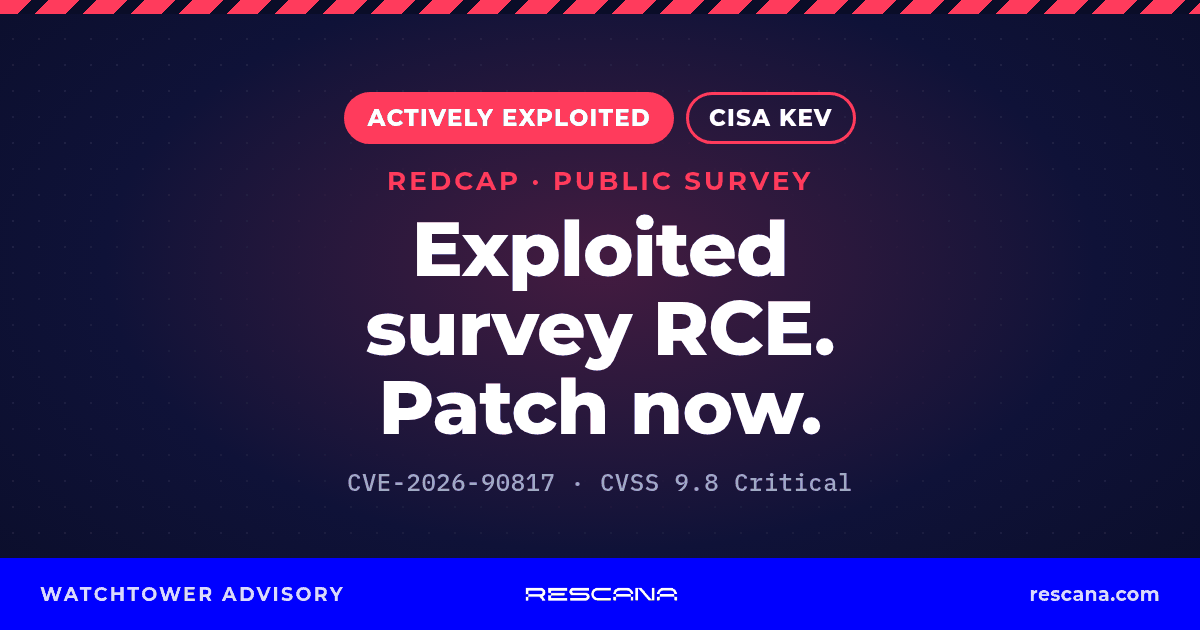
Status: CVE-2026-90817 is in CISA's Known Exploited Vulnerabilities (KEV) catalog, added November 18, 2026, with a federal due date of 21 November 2026 and CISA's forensic triage flag set. It lets an unauthenticated attacker who knows a valid public survey hash run code on a self-hosted REDCap server. The fix is not new: the CVE record lists REDCap 16.0.49 LTS, 17.3.10 LTS and 17.4.4 Standard Release as unaffected, and REDCap says, in a statement quoted by Unit 42, that it shipped the update within two days of learning of the flaw in September. Palo Alto Networks Unit 42 reported exploitation that installed cryptocurrency miners on 7 October 2026. Any REDCap server still below those versions and serving public surveys should be patched today and checked for compromise. We last checked at 02:15 EST on 19 November 2026.
Executive Summary
REDCap is the research data capture platform Vanderbilt University distributes to its consortium of universities, hospitals and research institutes. Each consortium partner installs and runs REDCap on its own servers (REDCap FAQ), and an instance can hold study and clinical data. Public surveys are one of its core features: a project publishes a link, anyone with the link can answer, and no login is needed.
CVE-2026-90817 abuses that public survey entry point. According to the CVE record, an attacker can manipulate HTTP requests "to access an unintended controller route from a public survey context" and supply "a crafted file-path/stream parameter during import handling", leading to arbitrary code execution on the server. The record says the attacker "does not have to be authenticated in order to exploit this, but exploitation requires knowledge of a valid public survey hash". The affected range starts at REDCap 13.3.0.
Three things decide whether a REDCap server is exposed:
- An affected build. REDCap 13.3.0 or later, below 16.0.49 on the 16.0 LTS line, below 17.3.10 on the 17.3 LTS line, or below 17.4.4 on the Standard line.
- A valid public survey hash. This is the main precondition. A public survey hash is the
s=value in a public survey link, so it is not a secret once a survey link has been published on a website, in an email or in a recruitment flyer (Rescana guidance). A server with no public surveys, or whose survey links never leave a closed audience, is much harder to reach this way. - Reachability. The attacker needs to reach the survey page over HTTP(S). Public surveys are usually internet-facing by design.
How serious is it in practice? (Rescana guidance) The survey hash requirement is real but weak for any instance that runs open recruitment surveys, which is the main reason organizations put REDCap on the internet. Patches have been available since September, so the gap is unpatched instances, not a missing fix. The data at stake is what makes this matter: a compromised REDCap server can expose research and clinical records, not only the host.
Exploitation status. CISA added the CVE to KEV on 18 November 2026 and lists ransomware use as "Unknown". CISA's SSVC entry on the CVE record rates exploitation "active", automatable "yes" and technical impact "total". Unit 42's 7 October 2026 note says "Attackers are actively exploiting CVE-2026-90817" and describes an in-memory chain that deployed XMRig Monero miners (Unit 42). Public exploit detail has been available since 27 September 2026, when Securifera, which found the flaw and is the CVE's assigning authority, published a technical write-up of the exploit; we do not name or link it. FIRST's EPSS model gave the CVE a 3.7% probability score on 18 November, in the 90th percentile.
Technical Information
Where the flaw sits. The CVE record places the bug in REDCap's "survey passthrough routing and Data Import processing logic". The CVE record assigns two weaknesses, and CISA's KEV entry repeats them:
- CWE-73, external control of file name or path: during data import handling, the server accepts a crafted file path or stream parameter.
- CWE-94, code injection: that input leads to code being generated and run on the server.
The routing flaw that lets a request from a public survey context reach the import controller is part of the record's description but has no separate CWE.
CISA's KEV entry describes the same chain: "crafted HTTP requests that access an unintended controller route from a public survey context and supply a crafted file-path or stream parameter during data import processing."
Severity. The only CVSS score is the CNA's: 9.8 Critical under CVSS 3.1 (network attack vector, no privileges, no user interaction, high impact to confidentiality, integrity and availability). Securifera, the research firm that found the flaw, is the CNA. NVD's record was still "Undergoing Analysis" at 02:15 EST on 19 November, with no NVD score.
What exploitation looked like. Unit 42's note gives the clearest public picture. It says attackers sent an unauthenticated HTTP POST to a public survey URL with an accessible survey hash, routed it to the Data Import controller, and staged a "transient Blade template web shell" in REDCap's temp/cache directory. From there, it says, the web shell ran a Base64-encoded bash command in memory, fetched payloads disguised as JPEG images, and installed XMRig under a hidden directory in /var/tmp. Unit 42 also reports persistence through crontab changes and an attacker SSH key appended to authorized_keys files, plus history wiping. Code runs with the web server's permissions (php-fpm in Unit 42's case), which normally includes REDCap's database credentials in its configuration file (Rescana guidance).
Timeline (EST).
- September 2026: REDCap shipped the fixed releases. REDCap's statement, quoted by Unit 42: "After learning of this vulnerability in September, REDCap released a software update addressing it within two days."
- 20 September 2026, 07:05 EST: CVE-2026-90817 published by Securifera.
- 27 September 2026: Securifera published a technical write-up with exploit detail (not linked here).
- 7 October 2026: Unit 42 reported in-the-wild exploitation for cryptocurrency mining.
- 18 November 2026: CISA adds the CVE to KEV (catalog version 2026.11.18, released 14:17 EST), due 21 November.
Affected Product Versions
| Release line | Affected | Fixed in |
|---|---|---|
| REDCap 16.0 LTS | 13.3.0 and later, below 16.0.49 | 16.0.49 LTS |
| REDCap 17.3 LTS | below 17.3.10 | 17.3.10 LTS |
| REDCap Standard (any release below 17.4.4) | below 17.4.4 | 17.4.4 Standard Release |
Source: the CVE record (13.3.0 affected; 16.0.49, 17.3.10 and 17.4.4 unaffected) and its solution text, "Upgrade to REDCap 16.0.49 LTS, 17.3.10 LTS, or 17.4.4 Standard Release, as applicable." The per-line ranges are our reading of those entries. Releases before 13.3.0 are not listed as affected. Any instance on an older release line between 13.3.0 and 16.0 has no fix on its own line and needs to move to a fixed release.
On vendor confirmation. REDCap's release notes and security announcements are published on the consortium's community site, which requires a member login, so we could not read them. The versions above come from the CVE record. REDCap's public statement relayed by Unit 42 confirms that a fix shipped in September but does not name versions. Consortium administrators should confirm the exact build in REDCap's own change log before closing the ticket.
How to Find Your Exposure
The steps below are Rescana guidance unless a source is named. All are read-only.
1. Find every REDCap instance. Include departmental and project servers outside central IT, test and training copies, and instances hosted for you by a partner. REDCap is licensed per institution, so research offices and IT often keep separate inventories.
2. Read the version. The Control Center shows the installed version to administrators. REDCap also serves its application from a versioned directory, so URLs on the server contain redcap_v followed by the version number. Compare each instance to the table above.
3. Check for public surveys. In each project, the Survey Distribution Tools page shows the public survey link if one is enabled. Count the projects with a public survey and where those links have been published. A server with any published public survey link should be treated as meeting the hash precondition.
4. Check reachability. Note which instances answer on the internet and which sit behind VPN, SSO gateways or IP allowlists. Internet-facing instances with public surveys come first.
5. Confirm after upgrading. Re-check the version in the Control Center and in the redcap_v path, and confirm that old version directories are not still reachable on the web server.
Workaround and Mitigation
Patch. Upgrade to 16.0.49 LTS, 17.3.10 LTS or 17.4.4 Standard Release, or a later release on the same line. CISA's KEV required action is to apply mitigations per vendor instructions and follow BOD 26-04, including its forensic triage requirements, or discontinue use of the product if mitigations are unavailable.
Assume compromise on exposed instances. CISA flagged this KEV entry for forensic triage. CISA's BOD 26-04 guidance sets out the steps: scope the systems involved, preserve and collect evidence, patch and stabilize, contain, analyze, then decide whether to escalate (CISA). For a REDCap server that was internet-facing with public surveys on an affected build at any time since 1 September 2026, or earlier if your logs go back further, patching alone is not enough: preserve web server and PHP logs, a memory capture and a disk image before patching or rebooting, then patch. Unit 42 describes an in-memory chain, so a disk image alone can miss evidence (Rescana guidance).
Interim options until you can patch (Rescana guidance, not vendor-published mitigations):
- Take public surveys offline on affected instances, or restrict the server to known networks. This removes the precondition the CVE record names, at the cost of survey responses.
- Block survey-context requests to non-survey routes at a reverse proxy or WAF, based on the request pattern in the Indicators of Compromise section below. Treat this as a stopgap: it depends on matching one known request shape.
- Limit what the web server account can reach. Check that the account running PHP cannot write outside REDCap's temp and upload directories and cannot read credentials it does not need.
After a confirmed or suspected compromise (Rescana guidance): rotate the REDCap database password and any API tokens, SMTP and LDAP or SSO secrets in the configuration, remove unknown SSH keys and cron entries, and review whether research or clinical data was accessed. That last step may bring data protection and research ethics reporting duties.
Indicators of Compromise
CISA has published no IoCs, and we found none from REDCap in public sources. Unit 42 published the following from the campaign it observed on 7 October 2026 (Unit 42). Treat them as one campaign's artifacts, not a complete list.
- Exploit request shape: an unauthenticated POST to the public survey endpoint (
/surveys/?s=<hash>) carrying a__passthruparameter androute=DataImportController:index. Search web server logs for survey requests that include__passthruand aroute=value naming a controller other than the survey itself. - Web shell: a
.bladecfile staged under REDCap'stemp/cachedirectory (Unit 42 observed it under/var/www/html/redcap/temp/cache/). - Miner staging:
/var/tmp/.syslog-a224be51/xmrig.tar.gz, and miner processes renamed to syslog-style names such assyslog-ng-followed by a hash. - Persistence: new crontab entries pulling image-named payloads, an unknown RSA key in
authorized_keys, a modified~/.profile, and cleared shell history. - Payload hash (SHA-256):
39a435123dc1fffd499aa2acf11ef46e3ee2e805bf137811af0c2c5b12546920, the second-stage dropper script. - Exploit source IP: 202.61.130[.]221.
- Mining pool and wallet: the miner configuration pointed to auto.c3pool[.]org. Unit 42 also published the attacker's XMR payout wallet address, which you can match in miner configuration files:
87maYgt7bMvgDxQsBavYNVDr6BQgJNaaRKXg2yBh8A3GLVoizCq9eeycBT7v6kdnm8f41Vfz84x6XLeEUJDRqvYbSrhvzTw.
Detection leads (Rescana guidance): child processes of php-fpm or the web server running bash, sh or curl; outbound connections from the REDCap host to mining pools or cloud storage it has no reason to contact; sustained high CPU on the REDCap host; and files under temp/cache that do not match normal REDCap template cache activity.
Third-Party Risk (TPRM) Angle
REDCap is used across the research ecosystem: academic medical centers, contract research organizations, research networks, and the universities and hospitals that collect data for your studies. If a partner collects your study data in REDCap, your participants' data sits on their server, under their patch cycle (Rescana guidance).
The risk concentrates in three supplier types:
- Research partners and CROs that run REDCap instances holding your study data, especially with open public recruitment surveys.
- Hosting providers and IT service firms that operate REDCap on behalf of smaller institutions.
- Healthcare partners that use REDCap for registries, quality projects or patient-reported outcomes linked to your organization.
Send these three questions to suppliers that run REDCap for you or hold your data in it (Rescana guidance):
- Which REDCap version runs on each instance that holds our data, and when was it upgraded to 16.0.49 LTS, 17.3.10 LTS, 17.4.4 Standard Release or later?
- Did any instance holding our data serve public surveys from the internet on an affected build at any time since 1 September 2026, and if so, what forensic review did you perform and what did it find?
- If you found signs of compromise, which projects and records were on the server, and when will you notify us under our data agreement?
Ask for evidence, not reassurance: the version shown in the Control Center, the upgrade date, and a summary of the log review covering the request pattern Unit 42 published. Record answers against each supplier, and follow up with any partner that cannot name its version or has not done a compromise review.
What to do internally: find every REDCap instance you run or fund, patch it today, take public surveys offline where you cannot, and run a compromise check on anything that was exposed. We will update this advisory if REDCap or CISA publishes further guidance or indicators, or if ransomware use is reported.
Need help working out which research partners and suppliers run REDCap exposed to CVE-2026-90817? Our team can help you prioritize them and track their answers. Talk to an expert
Sources
- CVE record for CVE-2026-90817 (CVE Services API): Securifera as CNA; published 20 September 2026, 07:05 EST; affected 13.3.0 and later; unaffected 16.0.49, 17.3.10, 17.4.4; CVSS 3.1 9.8; CISA ADP SSVC and KEV entries added 18 November 2026.
- NVD record for CVE-2026-90817: status Undergoing Analysis, CNA score only (checked 02:15 EST, 19 November 2026).
- CISA: CISA Adds Four Known Exploited Vulnerabilities to Catalog: 18 November 2026.
- CISA KEV catalog feed, JSON: version 2026.11.18 (released 14:17 EST, 18 November; checked 02:15 EST, 19 November). CVE-2026-90817 dateAdded 2026-11-18, dueDate 2026-11-21, ransomware use Unknown, forensic triage Yes, CWE-73 and CWE-94.
- CISA BOD 26-04 implementation guidance: Forensic Triage Steps.
- Palo Alto Networks Unit 42: Exploitation of CVE-2026-90817 for evasive cryptocurrency mining campaign: 7 October 2026, including REDCap's statement on the fix.
- REDCap Community Site: consortium community hub; release notes require a member login and were not read.
- FIRST EPSS API: 0.03749, 90.1th percentile (score date 18 November 2026).