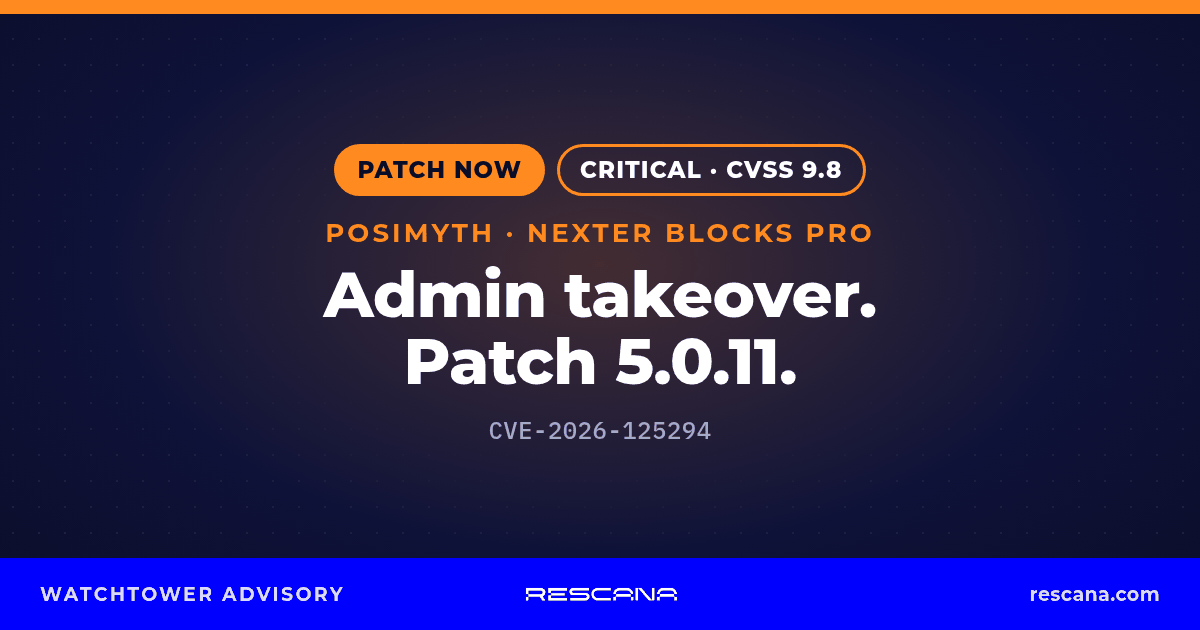
Status: On 20 November 2026, Wordfence, the CVE numbering authority (CNA), disclosed CVE-2026-125294, an unauthenticated privilege-escalation flaw in Nexter Blocks Pro, the commercial WordPress plugin from POSIMYTH, in all versions up to and including 5.0.10. Wordfence rates it Critical, CVSS 3.1 9.8 (AV:N/AC:L/PR:N/UI:N/S:U/C:H/I:H/A:H). The CNA says an unauthenticated attacker can register a new account that receives the Administrator role, which is enough to take over the site. POSIMYTH's Nexter changelog for Nexter Block Pro 5.0.11, dated 16 November 2026, records a security fix for this class of issue in the Login/Register block's registration handler. This CVE is in the Pro plugin, not the free Nexter Blocks plugin. As of 06:28 EST on 22 November 2026, no source we opened reports exploitation. CVE-2026-125294 is not in CISA's Known Exploited Vulnerabilities (KEV) catalog. We read catalogVersion 2026.11.20 (1,790 entries, released 12:48 EST on 20 November 2026) at 06:28 EST on 22 November 2026.
Executive Summary
Nexter Blocks Pro is POSIMYTH's commercial Gutenberg block and page-builder plugin, sold alongside the free Nexter Blocks plugin. CVE-2026-125294 affects the Pro plugin only. Sites that run only the free plugin are not in the CNA's affected product list.
The flaw is in the registration handler of the plugin's Login/Register block. The CNA says that, on a site where user registration is enabled and a page contains that block, an unauthenticated attacker can create an account that is given the full Administrator role. An administrator on a WordPress site can install plugins, change files and run code, so this is a site-takeover path, not only a new low-privilege user.
POSIMYTH published the 5.0.11 Pro changelog on 16 November 2026, four days before the CVE was disclosed. The vendor says the fix restricts user-meta keys to a strict ASCII allowlist and that legitimate Advanced Custom Fields registration is unaffected.
What to do first:
- Confirm whether you run Nexter Blocks Pro, not only the free Nexter Blocks plugin, and record the Pro version.
- Update Pro to 5.0.11 or later. The vendor's 5.0.11 changelog is the patch for this issue. A separate free-plugin 5.0.11, dated 18 November 2026, records a different security change (button-preset permissions) and does not fix CVE-2026-125294.
- If you cannot update immediately, disable user registration if you do not need it, and take pages that use the Login/Register block off the public site if you can. Do not delay the update to do this (Rescana guidance).
- After you update, review accounts with the Administrator role, especially any created while a vulnerable version was running, and disable or remove unexpected administrators (Rescana guidance).
NVD has imported the CVE record (published 14:16 EST on 21 November 2026) and currently shows Wordfence's 9.8 as the Primary CVSS 3.1 score. NVD's status is Deferred, not Analyzed, so there is no separate NVD score. FIRST's EPSS API returned no score for this CVE when we checked on 22 November 2026 (the daily scores then current were dated 21 November). A search of public GitHub repository metadata for the CVE ID on 22 November 2026 returned no public repository. We do not link to or describe proof-of-concept material.
Technical Information
This section is limited to what POSIMYTH and the CNA have published. We do not describe an exploit or reproduce a payload.
Wordfence's CVE record, published 13:31 EST on 21 November 2026, titles the issue "Nexter Blocks Pro <= 5.0.10 - Unauthenticated Privilege Escalation to Unicode Collation Confusion in 'tpgb_acf_key' Parameter" and assigns CWE-269 (Improper Privilege Management). It scores the issue CVSS 3.1 9.8, with no privileges required and no user interaction. The CNA says the result of a successful attack is that the attacker's own newly registered account receives the complete Administrator role.
The vendor's 5.0.11 changelog describes the same outcome in the Login/Register block's registration handler and names CWE-269. It attributes the bug to a bypass of a byte-based meta-key denylist using a Unicode "confusable" custom-field key, together with WordPress's default accent-insensitive database collation, which can cause the new user's capabilities to be overwritten. The changelog says the fix is a strict ASCII allowlist on user-meta keys, applied before the denylist.
The CNA says the issue is reachable when user registration is enabled and a page contains the Login/Register block. WordPress sites do not always allow open registration; that setting must actually be on for this path to work. The CNA does not say the free Nexter Blocks plugin is affected, and the vendor changelog we used is the Pro 5.0.11 entry (the page heading is "Nexter Block Pro").
Credit in the CVE record is to the finder 0xd4rk5id3. The CNA's timeline says the vendor was notified at 14:43 EST on 9 November 2026 and that the issue was disclosed on 20 November 2026 (the disclosure timestamp is date-only, so we give no clock time).
Affected Product Versions
- Affected: Nexter Blocks Pro, all versions up to and including 5.0.10, as listed by Wordfence in the CVE record. Vendor: POSIMYTH. Product name in the CVE record: Nexter Blocks Pro.
- Fixed: Nexter Blocks Pro 5.0.11, per POSIMYTH's Nexter changelog dated 16 November 2026. The changelog index still showed this as the 5.0.11 Pro entry when we checked on 22 November 2026; we saw no later Pro 5.0.x security release in that index.
- Not in scope of this CVE: the free Nexter Blocks plugin (plugin-directory slug the-plus-addons-for-block-editor). That plugin has its own 5.0.11, dated 18 November 2026, with a different security note. Do not treat a free-plugin update as a Pro patch, and do not treat the free plugin's public install count as a count of Pro sites.
Timeline (EST)
- 9 November 2026, 14:43 EST: Vendor notified, according to the CNA timeline (19:43:27 UTC).
- 16 November 2026: POSIMYTH's changelog dated this day describes the Nexter Block Pro 5.0.11 unauthenticated privilege-escalation fix. The page gives a date and no time of day.
- 20 November 2026: CNA disclosure date (timestamp 00:00:00 UTC, so we treat it as a date only).
- 21 November 2026, 13:31 EST: CVE record published (18:31:29 UTC).
- 21 November 2026, 14:16 EST: NVD imported the record (published 19:16:31 UTC), status Deferred, CNA score shown as Primary.
- 22 November 2026, 06:28 EST: Our check of catalogVersion 2026.11.20 (1,790 entries) found CVE-2026-125294 not listed. No source we opened reports exploitation.
How to Find Your Exposure
- In the WordPress plugin list, look for Nexter Blocks Pro. The free Nexter Blocks plugin can be present on the same site; it is not, by itself, this CVE.
- Record the Pro version. Any release through 5.0.10 is in the CNA's affected range. 5.0.11 is the vendor's fixed release.
- Check whether user registration is enabled on the site, and whether any public page includes the plugin's Login/Register block. Both conditions are part of the CNA's reachability statement.
- If the site ran Pro 5.0.10 or earlier at any point, review Administrator accounts for registrations you do not recognize (Rescana guidance).
Workaround and Mitigation
The vendor's published remediation is to apply the 5.0.11 Pro fix. The changelog does not offer a temporary workaround.
What that means in practice (Rescana guidance):
- Update Nexter Blocks Pro to 5.0.11 or later on every site that runs it, and confirm the version afterward. Do not assume that updating the free Nexter Blocks plugin is enough.
- Until the Pro plugin is updated: if the site does not need public registration, turn it off. If a public page uses the Login/Register block, unpublish or remove that block if you can. These steps narrow the path the CNA describes; they are not a substitute for the patch, and you should not delay the update to do them.
- After the update: review every Administrator account, starting with accounts created while a vulnerable version was installed. Disable or delete unexpected administrators. If an unexpected administrator account was used, rotate credentials that account could have read or changed, including other admin passwords, API keys and deployment secrets. Export logs if you can, but do not delay the patch to do it.
- Treat a site that was running a vulnerable Pro version with registration and the Login/Register block exposed as possibly compromised until that review is done.
Indicators of Compromise
None published by the vendor or the CNA. The changelog and the CVE record contain no hashes, IP addresses, domains, file paths or log signatures. We have not created our own indicators.
Third-Party Risk (TPRM) Angle
This is a commercial WordPress page-builder plugin. The people to ask are suppliers who design, host or maintain WordPress sites for you: agencies, freelancers, managed WordPress hosts and marketing vendors that use Nexter or "The Plus Addons" branding (Rescana guidance). The free plugin is widely listed in the WordPress plugin directory; that does not tell you whether a supplier also runs Pro, and we have no public install count for the Pro plugin.
Questions that give a usable answer:
- Do any of the WordPress sites you run for us include Nexter Blocks Pro, the commercial plugin, as opposed to only the free Nexter Blocks plugin?
- What Pro version is installed on each site? If it is 5.0.10 or earlier, on what date will you update to 5.0.11 or later?
- Is user registration enabled on those sites, and does any public page use the Login/Register block?
- Have you reviewed Administrator accounts created while a vulnerable version was installed, and will you tell us what you found?
Need help working out which suppliers run Nexter Blocks Pro on sites that handle your brand or your customers' data? Our team can help you prioritize them and track their answers. Talk to an expert
Sources
- POSIMYTH / Nexter: Nexter Block Pro version 5.0.11 changelog (16 November 2026; unauthenticated privilege-escalation fix in the Login/Register block registration handler; checked 22 November 2026).
- Nexter changelog index (used to confirm that the 16 November Pro 5.0.11 entry was still the Pro 5.0.11 listing, and that the 18 November 5.0.11 entry is the free "Nexter Block" plugin with a different security note; checked 22 November 2026).
- CVE record CVE-2026-125294 (Wordfence CNA; published 13:31 EST, 21 November 2026; title, CVSS 3.1 9.8, affected versions through 5.0.10, CWE-269, finder 0xd4rk5id3, notification and disclosure dates). We retrieved the official record via the CVE List API.
- NVD: CVE-2026-125294 (record imported 14:16 EST, 21 November 2026; status Deferred; Wordfence CVSS 3.1 9.8 shown as Primary; retrieved via the NVD API on 22 November 2026).
- GitHub Advisory Database: GHSA-73wm-fwpc-v2g5 (mirrors the CVE record; retrieved 22 November 2026).
- CISA: KEV catalog JSON feed: catalogVersion 2026.11.20, released 12:48 EST, 20 November 2026, 1,790 entries; CVE-2026-125294 is not listed in KEV; checked 06:28 EST, 22 November 2026.
- Nexter Blocks product page and Nexter home page (product family; not a vulnerability advisory).
- Nexter Blocks (free plugin) in the WordPress plugin directory (used only to confirm that the free plugin's current release is 5.0.11; the Nexter changelog dates that release 18 November 2026 with a different security fix; not a source for the Pro CVE).