Author: Shay Shabtai
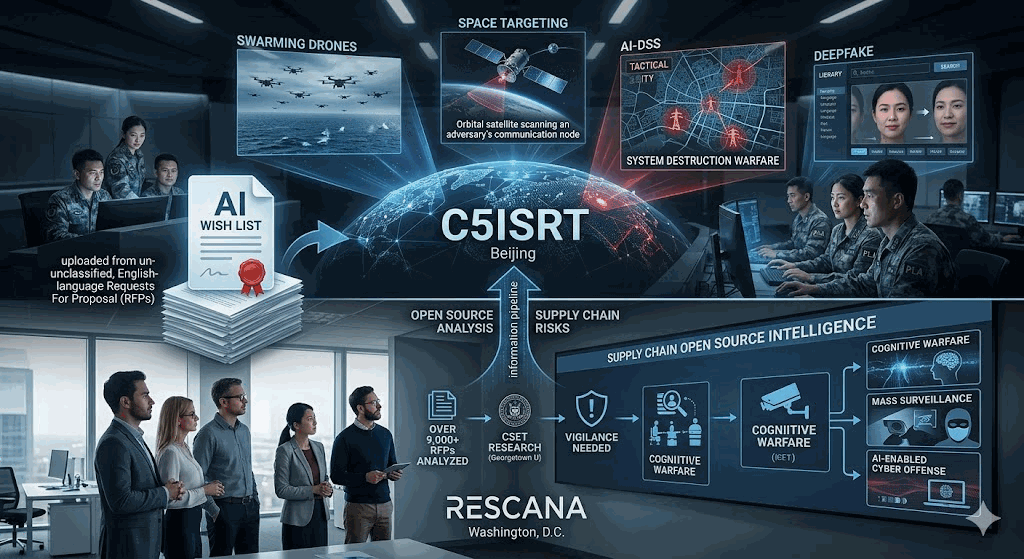
The following is a Rescana review of research prepared by CSET in Washington DC on China’s Military AI Wish. It illustrates: a) The significant value of open source analysis on your Third Party engagement and relations; b) How your Cyber Risk Landscape evolves as a result of AI; c) The seriousness of China’s State level Advanced Persistent Threats.
Open source Research on Supply Chain
Recent research published in February 2026 by CSET (Center of Security and Emerging Technology), a Washington DC Georgetown University Think Tank, analyzes China’s People’s Liberation Army (PLA) AI Wish List. It is doing so through open sources on supply chain: Reviewing over 9,000 unclassified Requests For Proposal (RFPs) from 2023 and 2024.
China looks to utilize external innovation
The requests reflects an effort to access advanced capabilities from nontraditional commercial vendors outside China’s traditional defense industrial base. Most of the requests involve relatively small budgets and short acquisition timelines (up to half a year), which suggest an emphasis on agile R&D and rapid iteration.
Intelligentizing C5ISRT
From the review of what seems to be very explicit requests, it is evident that the PLA is pursuing Intelligentization: Integration of emerging technologies to achieve information dominance in the entire spectrum of command, control, communications, computers, cyber, intelligence, surveillance, reconnaissance and targeting (C5ISRT).
AI-Enabled Decision Support Systems (AI-DSS)
The PLA is developing AI-DSS to manage the massive amount of information generated by modern battlefield sensors and to compensate for perceived weaknesses in its officer corps' decision-making skills. This focus supports the concepts of System Destruction Warfare and Multi-Domain Precision Warfare, which aims to paralyze an adversary by striking critical communication networks, sensors and command systems. It includes:
- Strategic Awareness: Tools that use deep web crawling and big data mining to analyze news and social media to predict global events, social unrest, and political tensions.
- Resource Allocation: Assist commanders in setting objectives and coordinating efforts across different warfare domains.
- Tactical Command and Control: Systems for the simultaneous coordination for example of more than 80 airborne assets over distances greater than 200 miles.
- Precision Targeting Across All Domains including space and cyber: Experimenting with AI to find, identify and track targets in the air, land, sea, space, and cyber domains. It includes specific request algorithms for space-specific target detection.
Communication, Computers and Cyber
The PLA is looking for advanced IT&Communication capabilities:
- Communication & Networks: Leveraging AI to enhance broadband data transfer capabilities, network security and network management and maintenance.
- Communication interference: Enhance the ability to detect, intercept, jam and destroy satellite communication and communication devices.
- Cyber warfare: Weaponizing large amounts of data to advance offensive and defensive cyber capabilities (‘active cyber defense’) most probably based on AI technologies.
- Encryption: Using AI for stress testing of encryption techniques including Japanese MISTY1 and quantum resistant cryptography for both offensive and defensive efforts.
Mass Surveillance and Digital Control
The PLA is utilizing a range of AI technologies for Mass Surveillance and Digital Control:
- Installation Security: Systems featuring over 1,000 cameras of varying types and facial recognition tools capable of identifying people wearing masks.
- Digital Surveillance: Extract data from uninstalled or irrecoverable cellphone applications and perform real-time scanning of popular Chinese social media apps.
- Personnel Monitoring: Score personnel based on their digital footprint, including visits to ‘dangerous’ websites or use of VPNs.
Cognitive Domain and Psychological Warfare
The PLA considers Cognitive Domain Operations essential for shaping narratives, eroding public morale and manipulating social cohesion.
- Deepfakes: Requests for Intelligent Deepfake Systems that can replace faces and heads in videos across ten languages to create synthetic media libraries.
- Cognitive Targeting: Platforms to analyze and simulate social engineering and map online communities to identify and exploit psychological vulnerabilities.
Main Takeaways to your organization
| Benefits from Supply Chain Open source information: Much can be learned about organizational Business, IT and Cyber Security aims and posture.Vigilance needed in connection with Chinese advanced Hi-Tech and Startup scene: It is probable that advanced AI tools developed together will serve Chinese military innovation and strive for dominance. Cyber warfare: Organizations should prepare for significant improvement of state level offensive cyber capabilities as a result of embedded AI based technologies. Space capabilities vulnerability: Organizational BCP should take into account possible disruption in space-capabilities based business and operational processes. Mass surveillance: Organizations should analyze advanced mass surveillance capabilities as a possible multiplier of threat to them.Deep Fake Threat: Organizational BCP should prepare a response to advanced AI based deep fake campaigns which will try to undermine and even collapse the business.Business opportunity: Creating response and counter balance the advanced Chinese tools is a business opportunity. |