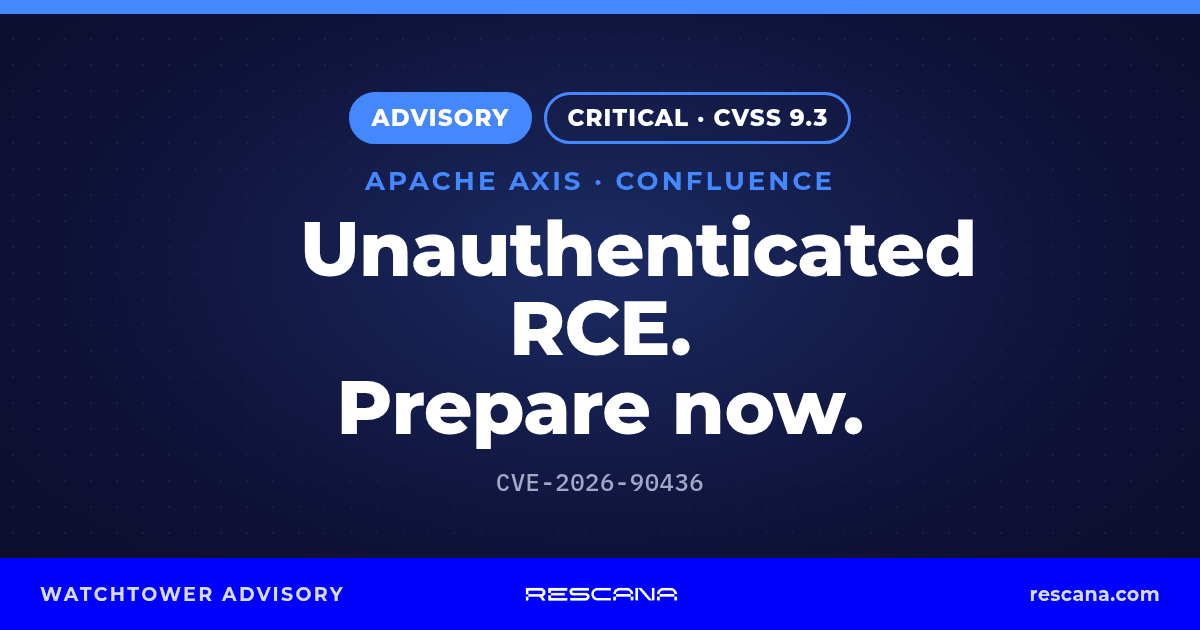
The Apache Software Foundation has disclosed CVE-2026-90436, a critical flaw in end-of-life Apache Axis 1.x through 1.4. According to Apache, deserialization of an inbound SOAP fault allows unauthenticated remote class instantiation, which leads to remote code execution when a suitable class is on the application's classpath. Authentication handlers configured on a service do not stop it, and Apache does not expect to ship a fixed Axis 1.x release. Apache, as the CNA, rates the issue critical without a numeric score; CISA's ADP assessment scores it CVSS 3.1 9.8 Critical (Secondary). NVD has not published a Primary score.
Atlassian has issued a Critical advisory (CVSS 4.0 9.3) for self-managed Confluence Data Center, which uses Axis for its XML-RPC and SOAP APIs. An instance is vulnerable only if Remote API (XML-RPC & SOAP) is enabled. That setting has been off by default for new installations since Confluence 3.0, and Atlassian says the feature was fully removed in Confluence 10.0. Confluence 10.x and later are not impacted, and Atlassian Cloud sites are not affected. The only fixed Data Center version Atlassian lists is 9.2.28.
Rapid7 reported on 16 November 2026 that its MDR detected exploitation of CVE-2026-90436 against Confluence Data Center in a customer environment on 13 November. Rapid7 is the only source we found reporting Confluence exploitation. Atlassian's advisory was last modified on 10 November, before that detection, and does not discuss exploitation; the CVE is not in the CISA Known Exploited Vulnerabilities catalog. Organizations that run Confluence Data Center should check whether Remote API is enabled and, if it is, apply 9.2.28 or move to a 10.x release, or turn the API off until they can. Anyone still bundling Axis 1.x should follow Apache's guidance.
Technical Information
The CVE Program record was published by Apache as CNA on 6 November 2026 at 15:37:55Z (17:37 Asia/Jerusalem) and updated on 10 November at 18:37:36Z (20:37 Asia/Jerusalem). It assigns CWE-470 (unsafe reflection), is tagged unsupported-when-assigned, and credits José Apari-Pantigozo of OKIOK as the finder. CISA's ADP vector is CVSS:3.1/AV:N/AC:L/PR:N/UI:N/S:U/C:H/I:H/A:H.
Apache's oss-security announcement of 6 November 2026, 15:32:01Z (17:32 Asia/Jerusalem), explains the flaw. "Loading alone runs the class's static initializer." The fault is parsed "before any per-service handler chain runs, so authentication handlers configured on a service do not protect against it." Apache recommends migrating to another SOAP engine, such as Apache Axis 2/Java; alternatively, use an Axis 1.x build with patch commit 41f3b4e8 applied.
The NVD record, read from the NVD API 2.0, is Awaiting Analysis (last modified 12 November, 17:06:26Z / 19:06 Asia/Jerusalem) and shows only CISA's Secondary score.
Atlassian's advisory carries a release date of 9 November 2026 at 22:00 PST (10 November 2026, 08:00 Asia/Jerusalem) and was last modified on 10 November 2026. Its Jira ticket CONFSERVER-104610 says that if Remote API is enabled, "an unauthenticated attacker who can reach the Confluence instance can execute arbitrary commands with the privileges of the Confluence operating-system account," which could allow reading or altering application data and secrets, modifying files, and disrupting the service. Atlassian "cannot confirm if your instances have been affected by this vulnerability" and has not published indicators of compromise.
Exploitation and KEV. Rapid7's Emergent Threat Response, published on 16 November 2026 at 18:16:51Z (20:16 Asia/Jerusalem), reported that on 13 November its MDR "detected exploitation of CVE-2026-90436 against Atlassian Confluence Data Center in a customer environment," and that the CVE "is now being actively exploited in the wild against both known affected products." Rapid7 also said that, separately on 13 November, "N-able reported exploitation in the wild against N-central for a vulnerability that strongly correlates to CVE-2026-90436." Both the exploitation wording and the correlation are Rapid7's: N-able's own 13 November blog post lists indicators of compromise it describes as "relevant only to customers who have not disabled the Legacy API," but does not name CVE-2026-90436 or Apache Axis. Rapid7 also reported a public proof-of-concept published on 12 November that targets N-central; this advisory does not name, link or reproduce it. For the N-central side, see our advisory on N-able N-central Able2Shell.
CVE-2026-90436 is not in the CISA KEV catalog (JSON feed: catalogVersion 2026.11.13, released 13 November 2026 at 20:24:18Z / 22:24 Asia/Jerusalem, checked 17 November 2026 at 07:58 Asia/Jerusalem). CISA's ADP entry of 10 November still lists SSVC exploitation as "none", automatable "yes" and technical impact "total"; it predates Rapid7's reported 13 November detection.
Affected Product Versions
| Product | What the vendor or CNA states | Official fix |
|---|---|---|
| Apache Axis 1.x through 1.4 (EOL) | Affected, per Apache. No fixed 1.x release is expected. | Migrate to another SOAP engine (Apache recommends Axis 2/Java) or apply official patch commit 41f3b4e8. |
| Atlassian Confluence Data Center 1.x through 9.x | Affected only when Remote API (XML-RPC & SOAP) is enabled. Off by default for new installations since 3.0. | 9.2.28 is the only fixed version Atlassian lists. Atlassian also recommends patching to the latest version. |
| Atlassian Confluence 10.x and later | Not impacted. Atlassian says the Remote API feature was fully removed in 10.0. | Not applicable. |
| Atlassian Cloud (sites on atlassian.net or jira.com) | "This vulnerability has no impact on Atlassian Cloud sites, and no action is required." | Not applicable. |
Other products embedding Axis 1.x through 1.4 are in scope of the CVE; follow each vendor's fix path. Rapid7 notes that both Confluence Data Center and N-central require a non-default configuration to be vulnerable.
Workaround and Mitigation
Confluence Data Center. If you can update, apply 9.2.28 or move to a current 10.x release, following Atlassian's advisory; Atlassian names no fixed release on any other branch. If you cannot update yet, Atlassian's temporary mitigation is to disable Remote API (XML-RPC & SOAP):
- Log in to Confluence as an administrator.
- Open General Configuration, then Further Configuration (also at
<base_url>/admin/viewspacesconfig.action). - Click Edit, clear the checkbox for Remote API (XML-RPC & SOAP), and click Save. Atlassian says the change takes effect immediately, without a restart. Confirm the checkbox is still clear after reload.
To validate, browse to <base_url>/plugins/servlet/soap-axis1/confluenceservice-v2. Atlassian says a correctly applied mitigation returns HTTP Status 403 - Forbidden. If you see a message about confluenceservice-v2 or an AXIS service instead, re-check the steps and contact Atlassian support. Disabling the API may stop scripts, automations and add-ons that depend on it; Atlassian suggests testing in a non-production environment first.
Apache Axis 1.x in other software. No fixed Axis 1.x release exists. Migrate to another SOAP engine such as Apache Axis 2/Java, or rebuild with patch commit 41f3b4e8; where Axis is embedded, follow that vendor's instructions.
Rescana guidance: Following Rapid7's advice, prioritize internet-accessible instances with the relevant APIs enabled, and also check internal deployments. After you disable the API or apply a fix, review logs around the SOAP endpoint. If you find unrecognized activity, treat the instance as possibly compromised.
Indicators of Compromise
Atlassian has not published IP addresses, domains, hashes or request signatures, and we list none. Atlassian cannot confirm whether instances have been affected and asks security teams to check affected instances for evidence of compromise.
Rapid7's Emergent Threat Response lists source IP addresses it associates with observed exploitation against Confluence Data Center. We do not reproduce them here; use Rapid7's current list. Rapid7 notes that their absence from logs does not confirm that an environment was unaffected.
What to Ask Your Suppliers Today
Ask vendors, SaaS providers and managed service providers that run Confluence Data Center or may still embed Apache Axis 1.x:
- Do you run Confluence Data Center, and is Remote API (XML-RPC & SOAP) enabled? If so, which version, and what is your plan and date to apply 9.2.28, move to 10.x, or disable the API?
- Do you bundle or embed Apache Axis 1.x in any product or service you provide to us? If so, which version, where does it listen, and what is your plan to migrate to another SOAP engine or apply Apache's official Axis 1.x patch?
- Have you reviewed logs for the SOAP endpoint (for Confluence, including
/plugins/servlet/soap-axis1/confluenceservice-v2) for unexpected unauthenticated requests, including against the indicators Rapid7 published?
Track incomplete answers to closure. If a supplier also runs N-able N-central, see our N-able N-central Able2Shell advisory.
Need help identifying suppliers that run Confluence Data Center or still ship Apache Axis 1.x, and tracking their fixes and answers? Our team can help you prioritize them. Talk to an expert
Sources
- Apache oss-security announcement for CVE-2026-90436: Robert Lazarski, 6 November 2026, 15:32:01Z (17:32 Asia/Jerusalem).
- CVE Program JSON for CVE-2026-90436: Apache CNA; published 6 November 2026, 15:37:55Z (17:37 Asia/Jerusalem); CISA ADP dated 10 November 2026.
- NVD API 2.0 record for CVE-2026-90436: Awaiting Analysis; CISA-ADP CVSS 3.1 9.8 Secondary.
- Atlassian security advisory: CVE-2026-90436 — Remote Code Execution in Confluence Data Center: advisory release date 9 November 2026, 22:00 PST (10 November 2026, 08:00 Asia/Jerusalem); Critical, CVSS 4.0 9.3; fixed 9.2.28.
- Atlassian Jira CONFSERVER-104610: Published / Fixed; CVSS Score 9.3; fix version 9.2.28.
- Official Axis 1.x patch commit
41f3b4e8, cited by Apache (locator only; not opened). - Rapid7 Emergent Threat Response, 16 November 2026: exploitation detected 13 November; sole source for the Confluence exploitation report and the Confluence indicator list.
- N-able, "New Security Update on N-central", 13 November 2026: IOC list for customers who have not disabled the Legacy API; does not name CVE-2026-90436 or Apache Axis.
- CISA catalog JSON feed: CVE-2026-90436 is not in the CISA KEV catalog (catalogVersion 2026.11.13).