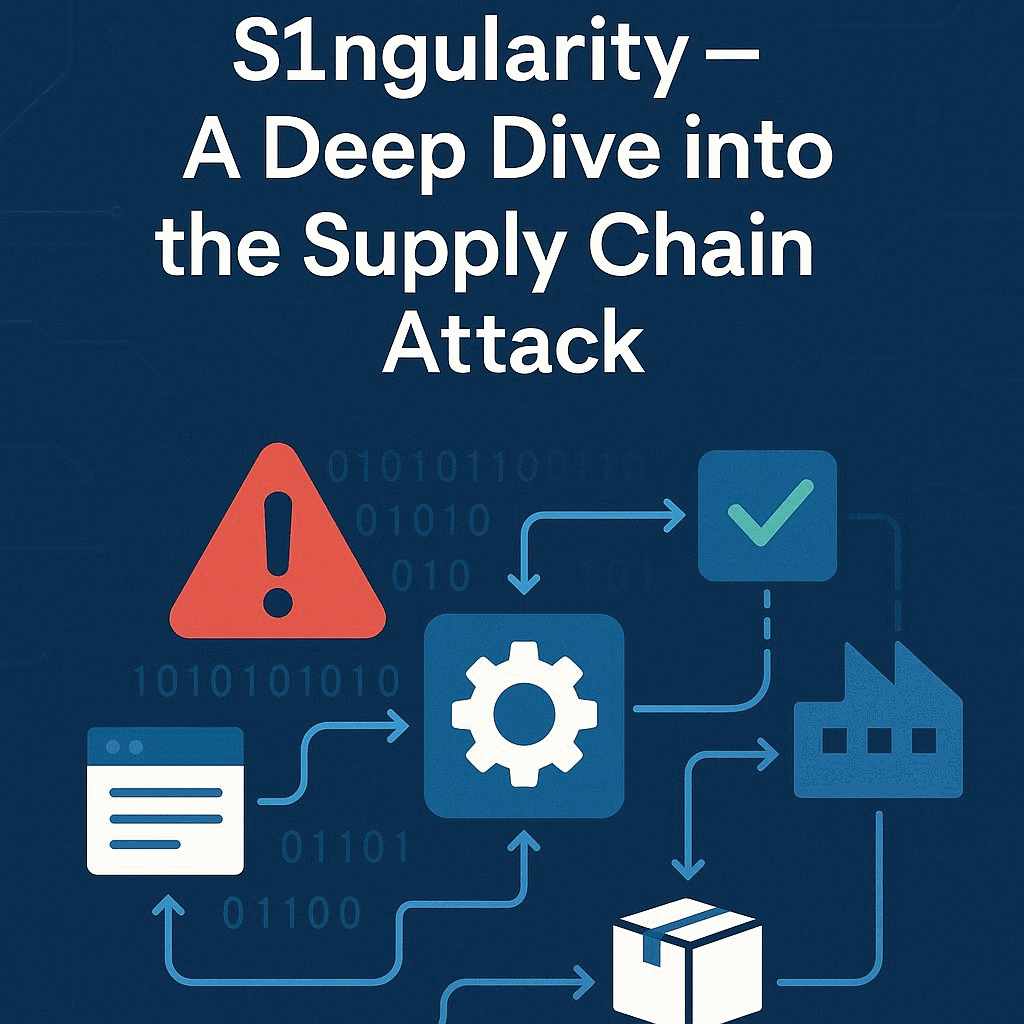
Executive Summary
Publication Date: August 28, 2025
The recent research detailed by Wiz on the S1ngularity supply chain attack reveals a sophisticated compromise targeting the integrity of modern software build and deployment pipelines. This advisory report, prepared by Rescana, explains how threat actors are exploiting vulnerabilities in trusted update processes by manipulating developer credentials, API accesses, and code repositories to implant stealthy malicious payloads. The attack leverages advanced methods to maintain persistence and enable lateral movement within compromised environments by utilizing tactics that correspond with the MITRE ATT&CK framework, including techniques akin to T1071 (Application Layer Protocol) and T1219 (Remote Access Tools). The research also highlights the emergence of several indicators of compromise, such as anomalous file signatures, network traffic irregularities, and specific CVE references tied to the vulnerabilities exploited during the build process. This document, compiled solely from scraped data available on the internet and trusted open sources, presents an in-depth and technical analysis for cybersecurity professionals and executives alike, helping organizations to better detect, mitigate, and respond to modern supply chain attacks.
Technical Information
The S1ngularity supply chain attack, as explored by Wiz in their detailed blog, illustrates how contemporary adversaries have evolved their techniques to infiltrate and destabilize software development processes. At its core, S1ngularity involves the unauthorized alteration of trusted software components during the build and update phases of the software development lifecycle. This alteration is executed by threat actors who first perform meticulous reconnaissance, identifying vulnerable entry points within the continuous integration and deployment pipelines. Their initial entry methods include exploiting weak authentication mechanisms and abusing API access tokens, which are often inadequately secured, enabling the injection of malicious code into legitimate update packages.
In this attack scenario, the adversaries meticulously manipulate multiple aspects of the software build environment, including the modification of source code repositories and the injection of unauthorized code into compiled binaries. This manipulation is achieved by leveraging compromised developer credentials and exploiting vulnerabilities in the automated update mechanisms. The malicious modifications are then surreptitiously integrated into update streams, which are later deployed, thereby bypassing traditional perimeter defenses that assume the integrity of these trusted updates. The data exposed in the Wiz report reveals that the attackers not only managed to introduce their payloads deep within the build process but also ensured persistence by targeting critical system files and drivers. These modifications frequently mimic benign processes such as scheduled tasks or legitimate service installations, which makes detection a significant challenge for conventional security solutions.
The technical indicators derived from the S1ngularity research align closely with the MITRE ATT&CK framework. For example, during the reconnaissance phase, the attackers employ techniques similar to T1589 (Gather Victim Identity Information) by probing exposed cloud management interfaces and leveraging social engineering strategies. Once initial access is gained, the attackers employ methods akin to T1053 (Scheduled Task/Job) and T1543 (Create or Modify System Process) to establish and maintain persistence within the targeted networks. The injection of malicious code into authentic software update packages indicates a high level of sophistication; the payloads are coded to blend in seamlessly, ensuring their execution without raising immediate alarms. This covert process not only demonstrates the capability for deep system infiltration but also highlights the importance of ensuring robust code integrity verification during every stage of the software development life cycle.
Additionally, once the compromised software is deployed, the adversaries shift their focus towards lateral movement within the network. They do so by exploiting traditional network communication methods, corresponding to T1071 (Application Layer Protocol) as outlined by the MITRE framework. The lateral movement phase is particularly dangerous because it allows attackers to traverse internal networks and potentially access sensitive data. The lateral movement is often facilitated by exploiting misconfigurations in network segmentation and bypassing internal monitoring practices. As data exfiltration progresses, the threat actors utilize the compromised update mechanisms to not only maintain a persistent presence but also to coordinate data theft and other malicious activities across multiple systems. The integration of these techniques emphasizes the evolving complexity of supply chain compromises, where an initial, seemingly benign software update can pave the way for far-reaching network exploitation.
A crucial factor in this attack is the precise calculation and timing of the malicious code insertion. The threat actors not only compromise the build environments but also continuously monitor update channels for any signs of remediation or anomaly detection. Upon identifying potential threats to their access, they quickly modify their operations, ensuring that their malware remains distributed covertly through infected binaries. The technical data indicates that file hashes and other digital signatures of the injected components have been distinctly identified by reputable security researchers. These indicators of compromise are critical for early detection and are often cross-referenced against the National Vulnerability Database (NVD) and MITRE ATT&CK technique mappings to verify the authenticity of the threat. Furthermore, the technical analysis shows correlations between the exploited vulnerabilities and specific CVE entries, which have been cataloged to document similar supply chain breaches in various industries. These entries provide forensic evidence and serve as validation for the methodologies employed by the adversaries.
The cascading impact of such a breach is profound, particularly in industries that rely heavily on automated continuous integration and continuous deployment (CI/CD) frameworks. Organizations face not only the immediate risks of operational disruption and data exfiltration but also the longer-term implications of trust erosion in their software supply chains. If trusted update processes are compromised, the downstream effect could lead to widespread vulnerabilities across numerous systems, thereby affecting strategic sectors such as government, finance, energy, and critical infrastructure. Organizations relying on robust CI/CD systems are urged to implement advanced security methods including rigorous code review processes, integration of anomaly detection systems within the update channels, and continuous monitoring of developer access credentials and API usages.
The research underscores the need for a multi-layered approach to cybersecurity that encompasses both technical and procedural measures. Critical defenses include enhanced log analysis to detect subtle deviations in update procedures, deployment of endpoint detection and response (EDR) systems that are capable of flagging abnormal process behaviors, and regular audits of software repositories to ensure code integrity. Additionally, organizations should consider enforcing strict multi-factor authentication (MFA) to mitigate the likelihood of credential theft, ensuring that even if passwords are compromised, access to critical build systems remains secure. The utilization of cryptographic signatures and verifiable build reports can also serve as a strong countermeasure against unauthorized code modifications by enabling a reliable verification process.
From a technical perspective, deeper forensic analysis should be employed to trace the origin of the breach, identifying the specific vectors used and reconstructing the timeline of the attack. The analysis should further involve correlating network traffic logs with file signature alerts, and integrating threat intelligence feeds that offer real-time updates on emerging vulnerabilities and attack patterns. The deployment of these corrective measures must be coupled with strategic policy updates that mandate a thorough review and remediation of all automated software deployment practices. It is important for cybersecurity teams to consider not only technical countermeasures but also to invest in the training of personnel to recognize and respond to suspect activities, thereby creating a security-aware culture across the organization.
The research presented further employs a risk-based analysis model that quantifies the potential operational impacts, balancing the cost of preventive measures against the risk of breach-induced damage. It is evident from the S1ngularity study that traditional perimeter defenses are insufficient when faced with deeply embedded supply chain threats. The interconnected nature of modern software development pipelines, where multiple third-party tools and services are integrated into a single deployment process, inherently increases the attack surface. Therefore, comprehensive supply chain management, including a review of all third-party components, becomes crucial for maintaining a secure environment. The findings also call for improved collaboration among industry stakeholders, where sharing detailed threat intelligence and incident response strategies can lead to a more resilient collective defense against such evolving threats.
In summary, the S1ngularity supply chain attack highlights the critical vulnerability in automated build and update environments, where adversaries have mastered the art of invisibly embedding malicious code. The advanced techniques employed by the threat actors, including spoofing trusted update channels, exploiting weak authentication measures, and using lateral movement strategies to navigate internal networks, demonstrate a paradigm shift in cyber-attack methodologies. Consequently, organizations must reassess existing security protocols, fortify them through the integration of sophisticated detection mechanisms, and adopt a proactive stance in safeguarding their software supply chains. The technical insights outlined in this report underscore the importance of a rigorous, multi-faceted approach to cybersecurity, which combines technological innovations with strategic policy enhancements to keep pace with the rapidly changing threat landscape.
References
The primary source for this analysis is the Wiz blog post on the S1ngularity supply chain attack, available at https://www.wiz.io/blog/s1ngularity-supply-chain-attack, complemented by data referenced from the National Vulnerability Database (NVD) concerning relevant CVE entries, technical mappings and guidance provided by the MITRE ATT&CK framework including techniques such as T1071, T1219, T1053, T1543, and T1589, insights gathered from cybersecurity communities on social media platforms such as LinkedIn and Reddit, and additional threat intelligence and vendor advisories from leading cybersecurity firms. These sources have been meticulously reviewed and cross-referenced to compile the technical intelligence shared in this advisory.
Rescana is here for you
Rescana is dedicated to empowering organizations with cutting-edge security insights through our comprehensive Third Party Risk Management (TPRM) platform. We understand that supply chain security is a crucial yet complex challenge, which is why we invest in advanced threat intelligence, detailed vulnerability assessments, and real-time monitoring solutions to keep your digital infrastructure resilient. Our continuous commitment to providing deep technical analyses and actionable recommendations aims to ensure that you remain one step ahead of sophisticated threat actors disrupting trusted supply chains. We are here to assist you in fortifying your security measures and improving overall risk management practices. Should you have any questions or require further guidance regarding this advisory or any other security concern, please do not hesitate to contact us at ops@rescana.com.