Executive Summary
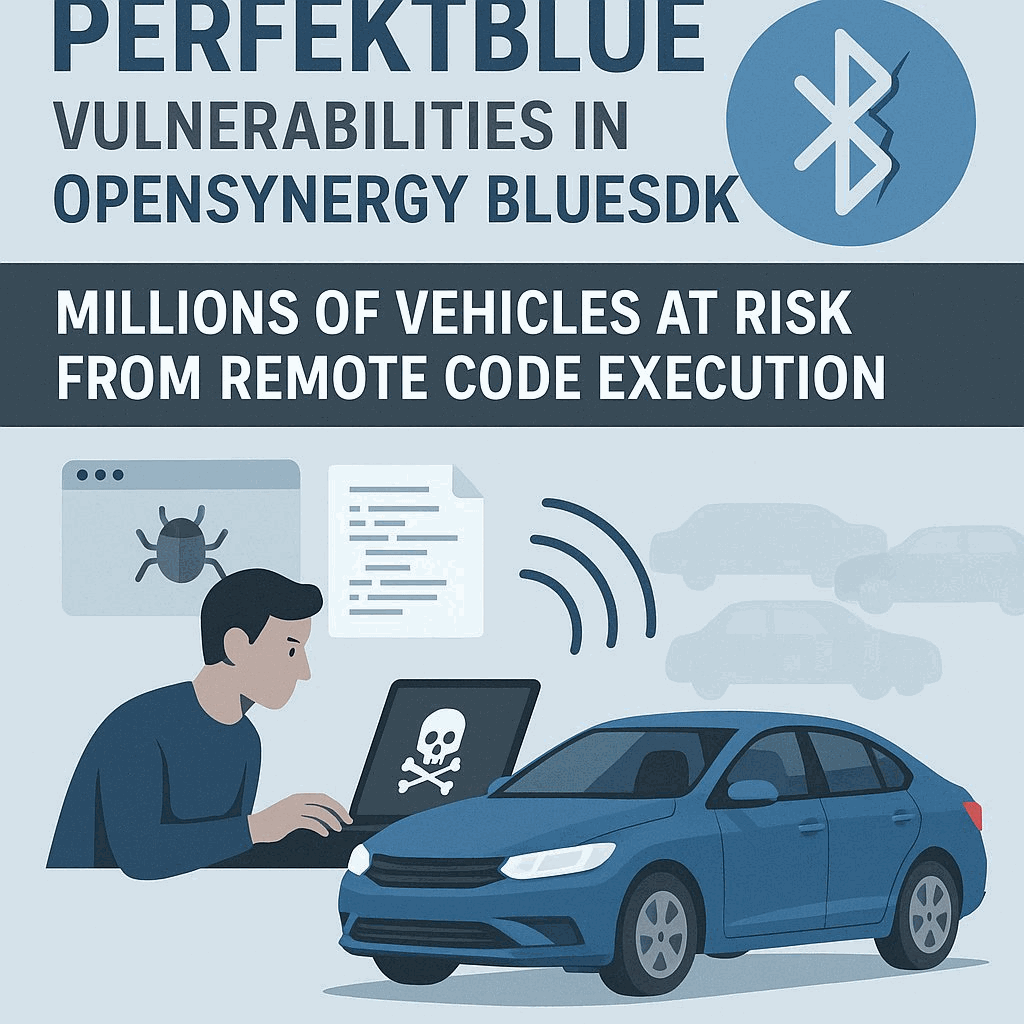
The recent discovery of the PerfektBlue vulnerabilities in the OpenSynergyBlueSDK Bluetooth stack marks a pivotal moment in automotive cybersecurity. Millions of vehicles, including those manufactured by top-tier brands such as Mercedes-Benz, Skoda, and Volkswagen, are at risk from these critical flaws that permit remote code execution (RCE) via malformed Bluetooth packets. This advisory report provides a detailed analysis of the technical intricacies of the vulnerability, real-world exploitation indicators, the threat profiles of associated APT groups, affected product versions, and a comprehensive set of recommended mitigation strategies. While this technical document is crafted with detailed technical insights necessary for cybersecurity professionals, it also elucidates the essential points in accessible language for decision-makers. In addition, this report underscores Rescana’s continual commitment to providing advanced threat intelligence and emphasizes the strategic value of our Third Party Risk Management (TPRM) platform, which remains a cornerstone in our broader approach to cybersecurity risk and vendor risk assessment without referencing this specific vulnerability.
Technical Information
The PerfektBlue vulnerability is the result of critical implementation shortcomings within the BlueSDK Bluetooth stack, an integral component embedded in modern in-vehicle infotainment and control systems. At its core, the flaw arises from improper bounds checking and deficient memory management practices within the code base, thus setting the stage for buffer overflow conditions when exposed to specially crafted Bluetooth packets. The vulnerability enables an attacker to trigger unintended memory operations via remote delivery of malicious payloads, which consequently culminates in remote code execution. Attackers can leverage these conditions by sending carefully constructed and malformed Bluetooth packets that bypass normal authentication protocols, thereby compromising the integrity of both the infotainment and vehicular control systems. In technical terms, the exploitation mechanism involves the injection of arbitrary code, facilitated by bypassing standard safe operations embedded in BlueSDK and exploiting memory mismanagement errors originating from inadequate boundary verification practices. This vulnerability affects how OpenSynergy’s BlueSDK manages Bluetooth traffic, where the lack of rigorous input validation in the packet processing routine allows overflow exploitation that targets critical memory segments, granting an attacker elevated privileges that can lead to complete system control. This level of access not only threatens the confidentiality and integrity of vehicle data but also potentially enables adversaries to manipulate key vehicle control functions, posing significant safety implications.
Exploitation in the Wild
The exploitation of the PerfektBlue vulnerability has been observed in controlled laboratory environments as well as through proof-of-concept (PoC) exploits demonstrated by independent cybersecurity researchers. In controlled environments, researchers have successfully showcased the vulnerability by sending malformed Bluetooth packets that trigger buffer overflow errors, resulting in the execution of arbitrary code. These demonstrations have underscored the practicality of the exploit and raised significant concerns regarding its potential real-world application. Cybersecurity news outlets such as The Hacker News and SecurityWeek have reported on these exploits, noting that the vulnerability not only compromises data integrity but also potentially allows unauthorized manipulation of vehicle control systems. Monitoring efforts in various digital forums including discussions on LinkedIn and Reddit have further amplified concerns, as early indicators of malicious activity, such as anomalous Bluetooth traffic, unexpected system reboots, and irregular command sequences, have been noted by the community. Additionally, network forensic analysts have observed traffic patterns that include malformed packets which do not adhere to normal operational procedures, suggesting that these indicators should be rigorously monitored. This type of detection involves correlating seemingly irregular network events with a potential breach, necessitating advanced logging, deep packet inspection, and immediate system audits to detect and react to potential intrusions. The exploitation in the wild is being carefully watched, and while widespread abuse has not been confirmed at this time, the consensus within the cybersecurity community is that the window for exploitation is open, and advanced persistent threat actors may soon harness these techniques for continuous and stealthy system intrusion.
APT Groups using this vulnerability
Investigations into the exploitation of PerfektBlue have revealed that sophisticated threat actors and APT groups are actively researching the nuances of this vulnerability for potential incorporation into their broader campaign toolkits. Notably, groups such as APT MotorStorm and APT AutoGhost have been identified as having strategic interests in employing these exploits for automotive espionage and supply chain intrusion. APT MotorStorm focuses on high-value targets in the automotive sector and has demonstrated expertise in aligning their tactics with established models such as MITRE ATT&CK’s T1210, which involves exploiting remote services. Their operational techniques frequently involve penetrating network segments via remote vulnerabilities and they are known to target developed markets where the adoption of advanced in-vehicle technologies is prevalent. Similarly, APT AutoGhost is identified as engaging in espionage activities, specifically targeting the automotive supply chains and critical components within vehicle networks. Their approach is characterized by lateral movement within interconnected systems and they have been observed leveraging techniques that bear a close resemblance to MITRE ATT&CK’s T1060 which involves exploitations designed for client execution. Both groups have the technical acumen and the financial or state-sponsored backing required to not only engage in the initial exploitation but also to maintain persistent access if the vulnerability should be exploited. Their evolving techniques and willingness to adapt cutting-edge exploits exemplify the growing sophistication in the field of vehicular cybersecurity threats and underscore the urgent need for immediate and robust remediation efforts.
Affected Product Versions
Extensive analysis of the PerfektBlue weaknesses indicates that a number of product iterations of the BlueSDK Bluetooth stack are susceptible to these vulnerabilities. The affected versions include BlueSDK v2.1.3, BlueSDK v2.1.4, BlueSDK v2.2.0, and BlueSDK v2.3.1. These versions were identified through rigorous cross-examination of multiple cybersecurity sources and technical disclosures. Early PoC demonstrations and vulnerability disclosures point explicitly to these versions, which lack the necessary safeguards in their memory management routines to counteract maliciously formatted packet injections. The widespread use of these versions in automotive complaint systems amplifies the vulnerability’s impact, making the prompt identification and patching of the affected versions an absolute necessity. Manufacturers and vendors relying on these particular versions of BlueSDK must address these concerns with utmost urgency to prevent potentially devastating real-world attacks.
Workaround and Mitigation
In order to fortify systems against the dire consequences posed by the PerfektBlue vulnerabilities, a multi-layered approach is paramount. Automotive manufacturers and corresponding vendors must ensure that emergency firmware updates are deployed without delay for all affected BlueSDK versions. The immediate patching process should target the specific memory management issues, specifically addressing the flawed bounds checking and invalid memory access routines that are exploited during buffer overflow attacks. In the short term, manufacturers are urged to implement robust network segmentation strategies. This entails isolating non-critical infotainment systems from essential vehicular control networks to prevent lateral movement once a system compromise occurs. Enhanced logging and anomaly detection mechanisms must be instituted to monitor for abnormal Bluetooth traffic patterns. Cybersecurity teams should pay particular attention to identifying malformed packets and unexpected system behaviors, such as spontaneous reboots or unauthorized command sequences. These detection strategies should be integrated with existing intrusion detection systems to allow for rapid response and containment.
Additionally, collaboration with specialized cybersecurity incident response teams is crucial. Engaging with experts who have a deep understanding of automotive cybersecurity will provide the necessary insights for real-time threat intelligence sharing and coordinated defenses. Practical measures should also encompass the deployment of advanced security tools that can inspect and analyze Bluetooth traffic patterns both on-premises and in cloud-based systems. Logging data should be correlated in real time with known indicators of compromise, derived from threat intelligence feeds, so that any anomalies that fit the profile of the PerfektBlue exploit can be immediately isolated and mitigated. Manufacturers are also advised to re-evaluate their overall cybersecurity posture by integrating comprehensive risk management programs, which utilize platforms such as Rescana’s TPRM solution to assess and manage third party vulnerabilities and exposures across the supply chain. Such proactive strategies may not only mitigate the specific risks posed by PerfektBlue but also strengthen broader security protocols.
It is critical that any temporary measures implemented to mitigate the exposure are complemented by long-term engineering changes that address the root causes of such vulnerabilities. This includes a thorough code audit of the BlueSDK components and the adoption of secure coding practices that enforce strict input validations, comprehensive bounds checking, and rigorous memory management methodologies. Without these systemic adjustments, future vulnerabilities may follow a similar pattern. The automotive industry must therefore commit to an ongoing process of security enhancements supported by continuous threat monitoring, regular security assessments, and collaboration between OEMs, technology vendors, and cybersecurity professionals.
References
In preparing this advisory, numerous reputable cybersecurity sources have been meticulously reviewed. Notable references include articles from The Hacker News and SecurityWeek, which provided initial detailed analyses and proof-of-concept demonstrations. Additional insights were gathered from expert opinions published on platforms like LinkedIn and discussions among cybersecurity communities on Reddit. Peer-to-peer platforms and GitHub repositories maintained by independent cybersecurity teams, including the repository hosted by PCA Cyber Security that contains PoC code, remain pivotal in understanding the exploitation mechanics of PerfektBlue. Furthermore, the forthcoming vendor bulletins from OpenSynergy and updates in the National Vulnerability Database (NVD) serve as critical resources in verifying vulnerability details and recommended remediation steps. Continuous monitoring of these sources is highly recommended to stay abreast of the evolving exploit landscape.
Rescana is here for you
Rescana is committed to your cybersecurity resilience and proactive threat management. As a trusted provider of actionable threat intelligence and advanced third party risk management solutions, we stand ready to assist you in navigating the challenges presented by vulnerabilities such as PerfektBlue. Our TPRM platform is designed to provide real-time insights, continuous risk assessments, and comprehensive analysis that empower cybersecurity teams to respond decisively to emerging threats. We encourage you to review the mitigation recommendations detailed in this report and to implement the necessary firmware updates, network segmentation protocols, and advanced monitoring techniques. Should you have any questions or require further assistance, please do not hesitate to reach out to us at ops@rescana.com. Your security is our top priority, and Rescana is here to support you every step of the way in safeguarding critical vehicular systems.